

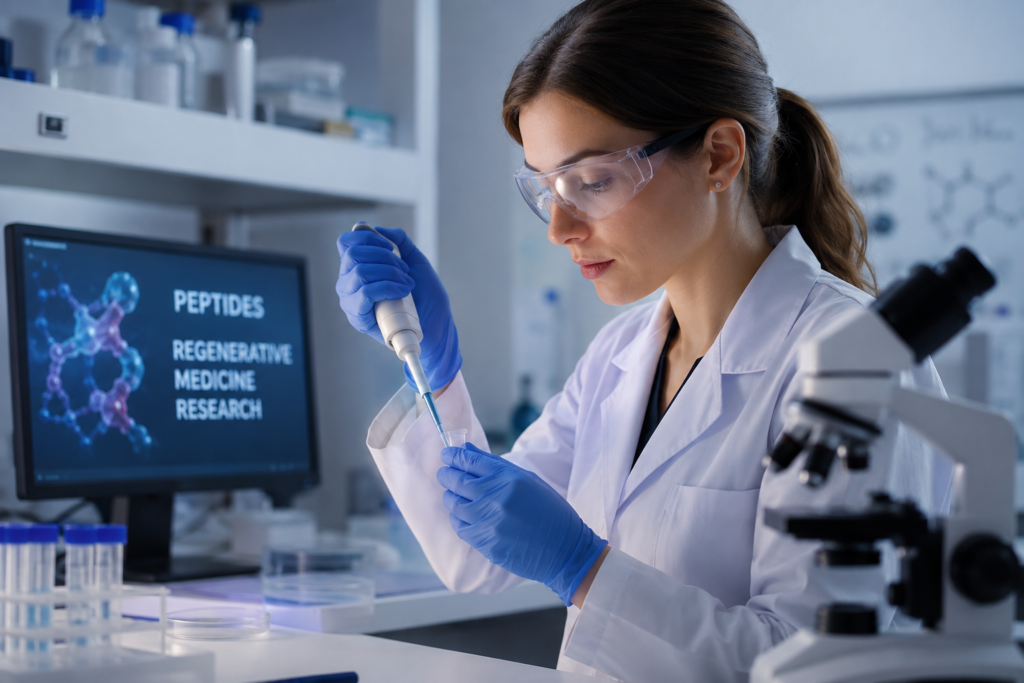
Regenerative medicine is one of the most exciting and rapidly evolving fields in modern science. Researchers around the world are exploring new ways to better understand how the body repairs, maintains, and regenerates tissues. While much of this work is still in the research stage, one area receiving significant attention is the study of research peptides.
Peptides are naturally occurring molecules that play essential roles in biological communication. Because of their ability to interact with specific receptors and cellular pathways, they have become valuable tools in laboratory investigations involving tissue biology, cellular signaling, and regenerative science.
Although peptide research continues to advance, it is important to understand that much of the work in regenerative medicine remains experimental. Research peptides are intended for laboratory studies, helping scientists better understand biological mechanisms that may contribute to future medical innovations.
In this article, we’ll explore the role peptides play in regenerative medicine research and why they continue to attract scientific interest.
What Are Research Peptides?
Peptides are short chains of amino acids connected by peptide bonds. They are naturally present throughout living organisms and are involved in numerous biological processes, including cell communication, hormone signaling, enzyme activity, and immune system regulation.
Scientists can also produce peptides in laboratories using advanced synthesis techniques. These research peptides are manufactured specifically for scientific investigations and allow researchers to study biological systems under controlled laboratory conditions.
Their precise structures and consistent quality make them valuable tools for exploring complex cellular interactions.
Understanding Regenerative Medicine
Regenerative medicine is a multidisciplinary area of research focused on understanding how tissues and cells respond to injury, aging, and disease. Scientists investigate biological processes involved in tissue maintenance, cellular repair, and regeneration to improve knowledge of how the body functions.
Research in this field draws on expertise from:
- Molecular biology
- Biotechnology
- Cell biology
- Tissue engineering
- Biomedical engineering
- Pharmacology
- Genetics
Rather than relying on a single approach, regenerative medicine combines multiple scientific disciplines to better understand the body’s natural biological systems.
Why Peptides Are Important in Regenerative Research
Peptides have become increasingly valuable because they interact with highly specific biological pathways.
Researchers use peptides to investigate:
- Cellular communication
- Protein interactions
- Growth factor signaling
- Receptor activation
- Molecular regulation
- Tissue biology
Their specificity allows scientists to examine complex biological processes in controlled laboratory settings while minimizing unrelated variables.
Studying Cellular Signaling
One of the primary roles of peptides in regenerative medicine research involves cellular signaling.
Cells constantly exchange information through chemical messengers that help regulate biological activity. Peptides often serve as part of these communication systems.
By studying peptide signaling pathways, researchers can better understand how cells respond to various biological conditions and how these pathways contribute to normal tissue function.
This knowledge supports broader scientific understanding of cellular biology.
Investigating Tissue Biology
Another important area of peptide research focuses on tissue biology.
Researchers investigate how cells interact within different tissues and how biological signaling contributes to tissue organization and maintenance.
Peptides provide useful laboratory tools for studying these interactions because they can target specific molecular pathways involved in cellular communication.
Understanding these mechanisms helps researchers expand scientific knowledge of biological systems.
Supporting Biomaterials Research
Regenerative medicine also includes the development of advanced biomaterials used in laboratory research.
Scientists continue exploring how peptides may be incorporated into research materials designed to study cell behavior and tissue interactions.
These investigations remain focused on understanding biological processes rather than developing immediate clinical applications.
Peptides provide valuable molecular tools that contribute to these interdisciplinary research efforts.
Advances in Peptide Synthesis
Modern peptide synthesis technologies have significantly improved the quality of research materials available to laboratories.
Today’s manufacturing methods allow researchers to obtain peptides with:
- High purity
- Excellent batch consistency
- Precise amino acid sequences
- Reliable analytical verification
These improvements help reduce experimental variability and support reproducible scientific investigations.
Importance of High-Purity Research Peptides
Product quality remains essential in regenerative medicine research.
Even small impurities can introduce unwanted variables into laboratory experiments.
Researchers often choose suppliers that emphasize:
- High-purity research peptides
- Comprehensive quality control
- Batch consistency
- Certificates of Analysis (COAs)
- HPLC testing
- Mass spectrometry verification
Reliable research materials help laboratories conduct studies with greater confidence.
Collaboration Across Scientific Disciplines
Peptide research brings together scientists from many different fields.
Collaborative teams often include experts in:
- Molecular biology
- Chemistry
- Biomedical engineering
- Biotechnology
- Pharmacology
- Cell biology
This multidisciplinary approach encourages innovation while expanding understanding of complex biological systems.
As regenerative medicine grows, collaboration continues playing a key role in scientific progress.
Challenges in Regenerative Medicine Research
Although peptide research has advanced considerably, researchers continue facing important challenges.
These include:
- Understanding complex biological pathways
- Improving laboratory reproducibility
- Developing standardized research methods
- Producing consistently high-quality materials
- Expanding knowledge through carefully designed experiments
Addressing these challenges requires ongoing scientific investigation and continued technological advancement.
The Future of Peptide Research
Interest in regenerative medicine continues growing each year.
Researchers are expanding studies involving:
- Molecular signaling
- Tissue engineering
- Cellular communication
- Biomaterials
- Biotechnology
- Advanced peptide synthesis
As analytical technologies improve and scientific knowledge expands, peptides will likely remain valuable tools for exploring biological mechanisms and supporting future discoveries.
While many questions remain unanswered, ongoing laboratory research continues contributing important insights into regenerative biology.
Conclusion
Peptides play an increasingly important role in regenerative medicine research by helping scientists investigate cellular communication, molecular signaling, tissue biology, and complex biological processes. Their precision, versatility, and compatibility with advanced laboratory techniques make them valuable tools across multiple scientific disciplines.
Although regenerative medicine remains an evolving field and many applications are still under investigation, peptide research continues to expand our understanding of how biological systems function. Combined with advances in biotechnology, analytical testing, and peptide synthesis, these studies are helping build the scientific foundation for future discoveries.
As research progresses, high-quality, well-characterized research peptides will remain essential for laboratories seeking accurate, reproducible, and meaningful scientific results.
Disclaimer: Research peptides are intended for laboratory research purposes only. They are not intended for human consumption, veterinary use, diagnosis, treatment, cure, or prevention of any disease. All research should be conducted by qualified professionals in accordance with applicable regulations and laboratory safety standards.
