

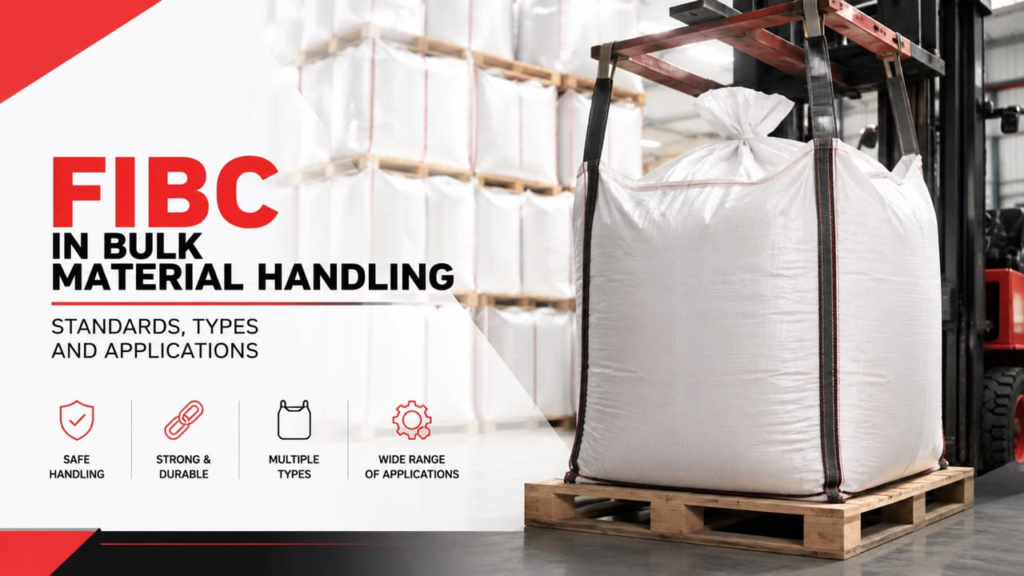
What is an FIBC?
FIBC (Flexible Intermediate Bulk Container) is a woven polypropylene container built to hold, lift and discharge dry flowable solids. Rated capacity commonly falls in the 500-2,000 kg band, with base footprints such as 90×90 cm. The unit sits between the 25 kg sack and the rigid silo, which explains the word “intermediate”. ISO (International Organization for Standardization) treats it as a defined packaging class, and ISO 21898 is the reference standard for non-dangerous goods.
FIBC design combines four subsystems: body fabric, lifting loops, the filling interface and the discharge interface. Two containers of identical volume behave differently when bulk density and load path differ. Engineers specify by fabric class, loop configuration and interface geometry.
Why do big bag, bulk bag and super sack describe the same product?
Big bag, bulk bag, jumbo bag and super sack are regional trade names for the FIBC product family. “Super sack” entered general use from a North American trademark, “big bag” dominates European purchasing language, and “jumbo bag” appears in South Asian tenders. None carries a separate technical definition, so a super sack enquiry reaches the same engineering drawing.
Terminology alignment matters in procurement, because tenders, customs codes and test certificates rarely share one word. Cesur, a producer whose first big bag line started in 1985, groups its FIBC range into 4-loop, 1-2 loop, liner and automatic filling variants. Catalogues built that way map a local name onto a technical drawing.
How is FIBC fabric engineered?
FIBC fabric starts as polypropylene granulate that is melted, extruded into film and slit into narrow tapes, a sequence called tape extrusion. Stretching the tapes orients the polymer chains and raises tensile strength along the machine direction. Looms cross warp and weft tapes into flat or circular fabric, and circular weaving removes two vertical body seams. Fabric weight typically runs between 140-220 g/m² on body panels.
Coating closes the micro gaps between tapes: coated fabric limits powder migration and moisture ingress, while uncoated fabric vents air during filling.
- Tape denier and weave density, in tapes per inch, which set fabric weight
- Coating thickness, which controls powder retention against breathability
- UV stabiliser dosage, which sets outdoor exposure life
- Seam construction and thread strength, which close the load path
- Liner type, loose or tabbed or bonded, carrying barrier and hygiene duties
Which standards govern FIBC specification?
Standards covering FIBC units split into three families: packaging performance, dangerous goods transport and electrostatic classification. ISO 21898 describes design, marking and test methods for non-dangerous goods. The UN/ADR framework (the European Agreement concerning the International Carriage of Dangerous Goods by Road) governs design type approval for hazardous loads. IEC 61340-4-4 classifies electrostatic behaviour.
| Standard or specification | What it governs |
| ISO 21898 | Design, marking, safety factor conventions and tests, non-dangerous goods |
| UN/ADR framework | Design type approval and UN packaging codes such as 13H3 for hazardous loads |
| IEC 61340-4-4 | Electrostatic classification of Types A, B, C and D, with test methods and limits |
| ISO 9001 | Quality management system of the plant, process control and batch traceability |
| BRCGS Packaging Materials | Hygiene and contamination control for food and pharmaceutical packaging |
| HACCP | Hazard analysis and critical control points across food contact production |
| Customer drawing | Safe working load, dimensions, loop and spout geometry, liner type |
What does the safety factor mean in an FIBC specification?
Safety factor (SF) is the ratio between the test load an FIBC withstands and its safe working load (SWL). The SWL is the mass the container is rated to carry in service. Two ratios dominate: 5:1 for single-trip units and 6:1 for multi-trip units. A container rated at 1,000 kg under 5:1 must survive a 5,000 kg cyclic test load.
Safety factor selection changes fabric weight, loop cross section and seam pattern, so it belongs in the enquiry. The SWL and the factor appear on the sewn label, alongside the batch reference.
FIBC electrostatic types A, B, C and D
Electrostatic classification divides FIBC units into four types, defined by how the fabric handles charge generated when powder moves against it. IEC 61340-4-4 sets the test methods and acceptance criteria. The type is a product attribute recorded on the specification sheet and the label. Selection follows the plant operator’s own hazard assessment of the filling area.
- Type A: plain woven polypropylene with no static control feature
- Type B: low breakdown voltage fabric that suppresses propagating brush discharges, supplied without a grounding connection
- Type C: interconnected conductive threads terminated in a grounding tab; the classification holds only while the unit is earthed
- Type D: static dissipative or corona discharge fabric, classified to work without a grounding connection
How does an FIBC interface with filling and discharge equipment?
Interface geometry decides whether an FIBC couples cleanly to existing plant equipment. Filling spouts are commonly specified at 35-50 cm diameter, matching the clamping range of standard filling heads. Discharge spouts reverse the logic, with a protective skirt and a tie closure opened from outside the dust zone. A duffle top, open top or flat base each adds or removes a handling step.
Corner loops at roughly 30 cm free height give forklift tines and crane hooks clearance. Cross-corner loops fold flat for palletless stacking, while single-loop units suit hoists in confined bays. Loop stitching, not webbing, is normally the limiting element in the load path.
How do FIBCs integrate with automated filling lines?
Automated filling lines treat the FIBC as a consumable with tight dimensional tolerance. Inflatable clamping heads seal against the spout, so variation beyond a few centimetres releases dust. Loop hanging arms need consistent loop length, because uneven loops distort the weighing signal.
Automatic filling sacks form a separate product group built for continuous machine handling. Hygiene-critical lines add cleanroom production, which keeps airborne particle counts controlled during sewing and folding. Cesur has run a 100,000 class cleanroom since 2003 for hygienic container production. Fabric batch traceability links a filled container to its production record.
Which tests verify FIBC performance?
Performance testing converts a fabric specification into evidence that the container carries its rated load. Laboratories run the sequence below on samples drawn from production batches.
- Tensile test: fabric and seam strength per strip, the base input for the load calculation
- Top lift test: static load applied at the rated safety factor through the loops
- Cyclic top lift test: repeated lifts confirming behaviour over multiple handling cycles
- Drop test: a filled unit dropped from a defined height to check seam and base integrity
- Stacking test: sustained compressive load confirming stability in storage
- Topple and righting tests: tipping and re-erection of a filled container
Specifying an FIBC: what the purchase drawing must carry
Purchase drawings that omit the electrostatic type, the safety factor or the spout geometry generate most avoidable FIBC failures. The SWL and the safety factor together fix the fabric and seam class, and neither changes after production without a new drawing.
Electrostatic type follows the hazard assessment rather than the product family, so one powder can require different types in two filling rooms. Batch-linked test documentation turns a specification into a verifiable delivery.
This content is informational and does not replace a plant hazard assessment or the manufacturer’s own test documentation. Confirm the safe working load, safety factor and electrostatic type on the certificate and label of each production batch.
Frequently Asked Questions
What does FIBC stand for?
FIBC stands for Flexible Intermediate Bulk Container, a woven polypropylene container for dry flowable solids. The term is the technical name for the product sold as big bag, bulk bag, jumbo bag or super sack. ISO 21898 uses the FIBC designation, which makes it the safest wording for tender documents.
How much weight does an FIBC carry?
Rated capacity for standard FIBC units commonly falls between 500 and 2,000 kg, shown on the label as the safe working load. The figure depends on fabric weight, seam construction and loop specification rather than volume. Bulk density decides how much material fits, so a light powder can fill the container early.
What is the difference between Type C and Type D FIBC?
Type C containers use interconnected conductive threads terminated in a grounding tab, valid only while the unit is earthed. Type D containers use static dissipative or corona discharge fabric and work without that connection. IEC 61340-4-4 defines the test methods, and the hazard assessment decides which one an area requires.
Which rules apply to FIBCs carrying dangerous goods?
Dangerous goods containers fall under the UN/ADR framework rather than ISO 21898. These units require design type approval, a UN packaging code such as 13H3 or 13H4, and a documented test regime covering drop, stacking and lift performance. The approval code appears in the marking with the safe working load.
Can an FIBC be reused?
Reuse depends on the safety factor the container was built to. Single-trip units are produced at 5:1 and specified for one filling and discharge cycle. Multi-trip units are produced at 6:1 for repeated service, provided the operator applies a documented inspection and cleaning procedure between cycles.
