

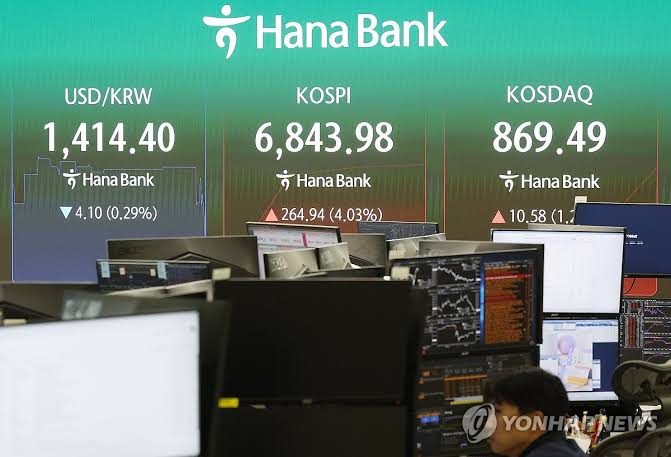
South Korea’s KOSPI bull market has become one of Asia’s most closely watched equity stories in August 2026 as the benchmark rebounds sharply from its July selloff. The recovery has been led by Samsung Electronics and SK Hynix, whose exposure to high-bandwidth memory, AI servers and next-generation semiconductor demand has helped restore investor confidence in Korean technology stocks. Stronger foreign buying, improving memory-market fundamentals and expanding AI infrastructure investment have added support, although the KOSPI remains vulnerable to global interest rates, currency movements and another shift in technology-sector sentiment. Similar changes in global risk appetite can also be tracked through real-time crypto market data, where technology-sensitive digital assets often react to broader liquidity and investor sentiment. Understanding what is driving the rally is therefore important for investors assessing whether the rebound can develop into a broader and more durable South Korean stock-market recovery.
Why the KOSPI Entered a Technical Bull Market After Its July 2026 Selloff
South Korea’s KOSPI moved back into a technical bull market in August 2026 after rebounding more than 20% from its July 30 low, marking a sharp reversal from the heavy selling that had hit technology and semiconductor stocks only weeks earlier. The recovery accelerated as investors returned to Samsung Electronics, SK Hynix and other large-cap Korean shares, while stronger AI-memory demand, improving semiconductor fundamentals and renewed foreign buying helped restore confidence. Although the technical threshold confirms a significant shift in market momentum, the rebound is better understood as the result of several overlapping factors rather than a simple reaction to lower prices.
Samsung and SK Hynix Led the Recovery After the July Selloff
Samsung Electronics and SK Hynix played an outsized role in both the July decline and the subsequent KOSPI rebound because the two semiconductor companies carry significant weight in South Korea’s benchmark index. Their shares had been hit hard as investors reduced exposure to crowded AI trades and leveraged positions were unwound, but sentiment improved when fresh earnings and industry data continued to show strong demand for high-bandwidth memory, server DRAM and enterprise storage. As investors reassessed whether the July correction had gone too far relative to the companies’ underlying earnings outlook, buying returned quickly to the semiconductor sector and helped push the broader market above the 20% technical bull-market threshold.
Several developments strengthened the case that the recovery was not driven entirely by short-term sentiment:
- AI memory demand remained resilient, with HBM increasingly important for advanced accelerators and data-centre infrastructure.
- Demand for server DRAM and enterprise SSDs broadened the semiconductor recovery beyond a single memory product category.
- Continued investment in next-generation memory capacity suggested that Korean chipmakers were preparing for sustained AI-related demand rather than a brief cyclical spike.
This combination of stronger fundamentals and sharply lower valuations after the July selloff created a more supportive environment for Korean semiconductor shares. Because Samsung and SK Hynix have such a large influence on the KOSPI, their recovery quickly translated into stronger performance for the overall index.
Foreign Buying and Improving Global Risk Sentiment Added Momentum
Foreign investors became another important force behind the KOSPI’s August recovery. International funds often concentrate their Korean equity exposure in large, liquid companies such as Samsung Electronics and SK Hynix, so a return of overseas capital can have a noticeable impact on the benchmark. By August 14, foreign investors had reportedly recorded about 2.86 trillion won in net KOSPI purchases, adding momentum after the index had already crossed into technical bull-market territory. The renewed demand suggested that some global investors viewed the July decline as an opportunity to rebuild positions in Korean technology and semiconductor stocks.
The improvement in foreign flows also reflected broader financial-market conditions rather than company-specific news alone. Investors were monitoring U.S. inflation, bond yields, monetary-policy expectations and currency movements, all of which can affect demand for South Korean equities. Three factors are particularly important for the next phase of the market:
- A relatively stable Korean won can make local equities more attractive to overseas investors by reducing currency-related uncertainty.
- Lower global bond yields may improve the relative appeal of growth and technology stocks, including semiconductor companies.
- Continued foreign demand for Korean large caps could broaden the KOSPI rebound beyond domestic retail participation and short-covering.
These influences can support the market when global risk appetite improves, but they can also reverse quickly. That makes foreign capital flows an important indicator for investors assessing whether the KOSPI bull market is developing into a more durable trend. The distinction between a short rebound and a lasting expansion is also central to understanding bull markets and market cycles, where momentum, liquidity and investor positioning can change significantly across different phases.
AI-Memory Demand Gave the KOSPI Rally a Stronger Fundamental Base
The most important difference between a purely technical rebound and a potentially more sustainable recovery is the underlying earnings environment. South Korea remains a major supplier of advanced memory products used in AI infrastructure, and recent corporate results and export data have reinforced the importance of that position. Samsung has expanded its next-generation HBM business, while SK Hynix continues to benefit from strong demand for AI-related memory and server products. South Korea’s semiconductor exports have also accelerated sharply, providing broader evidence that global demand for memory chips remains strong despite the volatility seen in equity markets.
That fundamental backdrop helps explain why the KOSPI was able to recover so rapidly after the July selloff. Investors were not only reacting to oversold conditions; they were also reconsidering the earnings potential of companies exposed to AI data centres, advanced computing and memory-intensive workloads. Even so, a technical bull market does not eliminate downside risks. The KOSPI remains below its earlier 2026 record high, while semiconductor pricing, global AI capital spending, foreign fund flows and renewed leverage could still create volatility. The durability of the recovery will therefore depend increasingly on whether AI-memory demand and semiconductor earnings remain strong enough to support the higher valuations created by the August rebound.
How Samsung and SK Hynix Are Driving the KOSPI AI Chip Rally
Samsung Electronics and SK Hynix are giving the KOSPI AI chip rally something more substantial than improving market sentiment: rapidly expanding semiconductor profits, next-generation HBM products and large investments designed for the AI infrastructure cycle. Both companies sit at critical points in the global memory supply chain, supplying the high-performance DRAM, HBM and enterprise storage increasingly required by AI accelerators and data centres. Their latest results therefore offer investors a direct way to assess whether South Korea’s AI-driven stock rally is being supported by actual business growth.
Record Samsung and SK Hynix Earnings Strengthen the AI Chip Rally
Samsung Electronics reported record consolidated revenue of KRW 171.5 trillion in Q2 2026, up 28% from the previous quarter, while operating profit reached KRW 89.5 trillion. Its semiconductor-focused Device Solutions division generated KRW 127.5 trillion in revenue and KRW 89.2 trillion in operating profit, with Samsung saying its memory business achieved record quarterly revenue and profit as server demand and industry-wide memory prices strengthened.
SK Hynix produced similarly powerful numbers. The company reported Q2 revenue of KRW 79.32 trillion and operating profit of KRW 60.54 trillion, representing year-over-year increases of 257% and 557%, respectively. Its operating margin reached 76%, while first-half revenue exceeded KRW 100 trillion for the first time. The company attributed much of that performance to higher-value products such as HBM, AI-server DRAM and enterprise SSDs, showing how AI infrastructure spending is increasingly translating into semiconductor revenue rather than remaining only a market narrative.
Several figures help explain why the two companies have become so important to the broader Korean AI trade:
- Samsung’s memory business recorded an all-time quarterly high as server products took a record share of its sales mix.
- SK Hynix ended the quarter with KRW 88 trillion in cash and cash equivalents while reducing total debt to KRW 18.6 trillion, strengthening its ability to finance future AI-memory expansion.
- Rising DRAM and NAND prices added another earnings driver, meaning profitability has benefited from both stronger AI demand and tighter memory-market conditions.
For the KOSPI, these earnings matter because Samsung Electronics and SK Hynix are not small speculative AI companies. They are major Korean corporations generating increasingly large profits from the infrastructure required to train and run AI models, giving investors a clearer fundamental connection between the global AI investment cycle and South Korean equities.
HBM4 and HBM4E Are Moving the Competition Into Next-Generation AI Memory
The semiconductor story is also shifting from how much memory the companies can sell to which company can lead the next generation of high-bandwidth memory. HBM sits alongside advanced AI processors and allows huge amounts of data to move rapidly between memory and computing units. As AI models become larger and inference workloads expand, memory bandwidth, power efficiency and packaging are becoming increasingly important parts of overall AI-system performance.
Samsung said it increased HBM4 sales during the second quarter and shipped what it described as the industry’s first HBM4E samples to major customers. The company also expects demand for server DRAM, enterprise SSDs and HBM to accelerate in the second half of 2026, while continued supply constraints could keep advanced memory capacity tight. Samsung’s foundry business is becoming relevant to the same theme because demand for HBM base dies and high-performance computing chips is increasing the overlap between advanced logic manufacturing and memory.
SK Hynix, meanwhile, began mass shipments of HBM4 during Q2 2026 and plans to increase production through the second half. It has also completed HBM4E sample shipments and reached long-term agreements with around 10 important customers as it responds to what the company describes as structural growth in AI-memory demand. This competition matters for KOSPI investors because future semiconductor valuations may increasingly depend not simply on general DRAM sales, but on technological leadership, customer qualification, power efficiency and the ability to deliver advanced HBM at scale.
New AI Memory Capacity Could Extend Korea’s Semiconductor Growth Cycle
Both current production and future supply capacity are becoming important to the Samsung and SK Hynix AI investment story. SK Hynix announced approximately KRW 54 trillion of additional investment in August, including KRW 35.2 trillion for its Yongin Y2 fab and KRW 19.1 trillion for the Cheongju M17 facility. Y2 is intended to produce HBM and other next-generation DRAM products, while M17 will expand NAND capacity as enterprise SSD demand grows with AI inference. The first M17 cleanroom is targeted for December 2028 and Y2 for June 2029, indicating that the company is planning for AI-related memory demand well beyond the current market cycle.
South Korea’s latest trade figures provide additional evidence that this semiconductor expansion is already affecting the wider economy. Government data showed July 2026 ICT exports reaching a record $53.36 billion, up 140.6% year over year, while semiconductor exports increased 178.8%. Chip exports have now grown by more than 100% for seven consecutive months, supported by AI-inference server memory and expanding enterprise SSD shipments.
Other developments could shape how strongly this trend feeds into the KOSPI:
- SK Hynix plans to expand production in stages rather than install all equipment immediately, allowing capacity additions to follow actual customer demand and reducing some risk of uncontrolled oversupply.
- The company’s cited industry outlook projects both DRAM and NAND demand growing at a 19% compound annual rate through 2030, although forecasts remain subject to changes in AI spending and the semiconductor cycle.
- Korean ICT exports accounted for 54% of the country’s total exports in July, highlighting how semiconductor and technology demand can influence not only chip stocks but also earnings expectations, trade conditions and sentiment toward the wider Korean market.
Together, these developments explain why Samsung Electronics and SK Hynix have become central to the KOSPI’s AI narrative. Their contribution increasingly comes from record semiconductor earnings, HBM4 development, long-term customer contracts and expanding production capacity, rather than AI enthusiasm alone. That gives the current rally a stronger fundamental foundation, although future performance will still depend on memory pricing, customer spending, execution of new fabs and whether global AI infrastructure investment remains strong.
Can the KOSPI Bull Market Continue as AI Memory Demand and Foreign Buying Grow?
The outlook for the KOSPI bull market now depends less on the technical rebound itself and more on whether the forces supporting South Korean equities can remain durable. Continued demand for AI memory, improving semiconductor profitability and sustained participation from overseas investors could support the market, but investors are also watching global interest rates, technology valuations and the risk of renewed volatility after the rapid recovery.
AI Memory Demand Could Keep Supporting Korean Semiconductor Stocks
The strongest fundamental support for the KOSPI comes from the expanding role of South Korea in the global AI infrastructure supply chain. Demand for high-bandwidth memory, server DRAM and enterprise storage remains closely tied to investment in AI accelerators and data centres, giving Samsung Electronics, SK Hynix and related suppliers exposure to a structural technology trend rather than a purely domestic market cycle. If cloud providers and chip designers continue increasing AI infrastructure spending, Korean semiconductor companies could benefit from stronger orders, tighter advanced-memory supply and continued investment in next-generation products. However, the outlook will depend on whether AI spending remains broad enough to support memory pricing and capacity expansion without creating excess supply later in the cycle.
Foreign Buying Could Determine Whether the KOSPI Rally Broadens
Foreign investor participation may be equally important in determining whether the KOSPI rally can continue beyond its semiconductor leaders. Sustained overseas buying can improve liquidity and support valuations across large-cap Korean companies, particularly when global investors are seeking exposure to AI, technology and Asian export markets. A broader rally would become more convincing if capital begins spreading into financials, industrial companies, battery makers and other sectors instead of remaining concentrated mainly in Samsung Electronics and SK Hynix. At the same time, foreign flows can reverse quickly when global bond yields rise, the Korean won weakens or investors reduce exposure to risk assets. Similar changes in speculative positioning can also be observed through spot market trading activity, where shifts in liquidity and risk appetite can quickly affect asset prices. International capital movements therefore remain an important signal to watch as the KOSPI attempts to build a more durable bull-market trend.
Conclusion
The KOSPI technical bull market in 2026 reflects more than a mechanical rebound from the July selloff. Samsung Electronics and SK Hynix are benefiting from strong demand for HBM, server memory and enterprise storage, while large semiconductor investments and rising AI infrastructure requirements are strengthening South Korea’s position in the global technology supply chain. Foreign buying has added another layer of support, helping the recovery extend beyond a simple short-term bounce.
Whether the KOSPI can sustain its momentum will depend on how these fundamentals develop. Continued AI-memory demand, healthy semiconductor pricing and broader participation across Korean equities could support the market, while weaker global technology spending, higher bond yields, currency pressure or another buildup of leverage could challenge the rally. For investors, the key question is therefore no longer whether the KOSPI has technically entered a bull market, but whether earnings growth and capital flows can justify a longer-lasting expansion.
FAQs
Could stronger AI demand benefit Korean companies beyond Samsung and SK Hynix?
Yes. A sustained AI infrastructure cycle could also support semiconductor equipment manufacturers, materials suppliers, data-centre infrastructure companies and businesses involved in advanced packaging, power systems and electronics components. This broader participation would be important because it could reduce the KOSPI rally’s dependence on only a few heavyweight stocks.
Why does the Korean won matter to foreign KOSPI investors?(h3)
International investors earn returns in Korean won before converting those gains back into their home currencies. A sharply weaker won can reduce foreign-currency returns even when Korean share prices rise, while a more stable currency can make Korean equities easier to hold. Currency movements can therefore influence both foreign fund flows and overall market sentiment.
What could cause foreign investors to reduce exposure to Korean stocks?
Foreign investors may cut Korean equity positions if global interest rates rise, the U.S. dollar strengthens significantly, geopolitical risks increase or earnings expectations weaken. Changes in global semiconductor demand can also affect positioning because South Korea is heavily exposed to technology exports and the memory-chip cycle.
Is a semiconductor shortage always positive for Samsung and SK Hynix?
Not necessarily. Tight supply can support memory pricing and margins, but prolonged shortages can also encourage aggressive capacity expansion across the industry. If supply later grows faster than demand, pricing pressure can return. Investors therefore tend to monitor production plans, inventories and customer demand rather than treating every period of constrained supply as permanently bullish.
What indicators can investors watch to judge the strength of the KOSPI rally?
Useful indicators include semiconductor export trends, memory prices, foreign net buying, movements in the Korean won, corporate earnings revisions and the performance of sectors outside technology. A rally supported by improving earnings and broader sector participation may appear healthier than one driven mainly by short covering or a small number of large-cap stocks.
Disclaimer: This article is for educational purposes only and does not constitute financial advice. Conduct thorough research and consider your personal risk tolerance before participating in any financial activities.
