

If you have spent any time researching IPTV over the past year, you already know the market is crowded, confusing, and – if you pick the wrong service – deeply frustrating. Buffering at 9 pm on a Friday, channels that simply vanish after a week, support tickets that go unanswered for days. It happens more often than providers would like to admit. After testing more than a dozen services across different price points and regions, I want to share what I have actually learned about separating the good from the bad.
Let us start with the basics, because a lot of people still conflate IPTV with piracy or shady grey-market apps. IPTV – Internet Protocol Television – simply means television delivered over your internet connection rather than through a satellite dish or a cable line. Your device sends a request, the provider’s servers stream the content back to you, and you watch. That is it. It works on Smart TVs, Amazon Firestick, Android boxes, smartphones, tablets, and regular computers. No dish on your roof, no engineer visit, no long-term contract with a telecom giant. The appeal is obvious.
What Makes an IPTV Service Worth Paying For
The single most important metric is server uptime. A provider can advertise 80,000 channels, but if their infrastructure buckles under load, none of those channels matter. Look for services that can demonstrate or credibly claim 99% uptime or higher. The best providers in 2026 are hitting 99.4% to 99.9%, which translates to fewer than nine hours of unplanned downtime per year. That is the standard worth holding them to.
Beyond raw uptime, pay attention to stream quality. Genuine HD and 4K streams require proper encoding, adequate bandwidth on the provider’s end, and well-maintained content delivery infrastructure. A lot of services advertise 4K but deliver upscaled 720p. If you can test a service before paying – and you should, more on that shortly – run streams on multiple channels at the same time and watch for compression artifacts, audio sync issues, and how quickly channels load when you switch between them. That last point, sometimes called zapping speed, is a surprisingly reliable indicator of server health. A snappy, sub-two-second channel switch usually means the backend is well-resourced.
Customer support matters more than people expect. When something breaks – and at some point, something always does – you want a response within hours, not days. Live chat is preferable to email-only support. Ask a pre-sales question before subscribing and time the response. That interaction tells you a great deal about how the company operates.
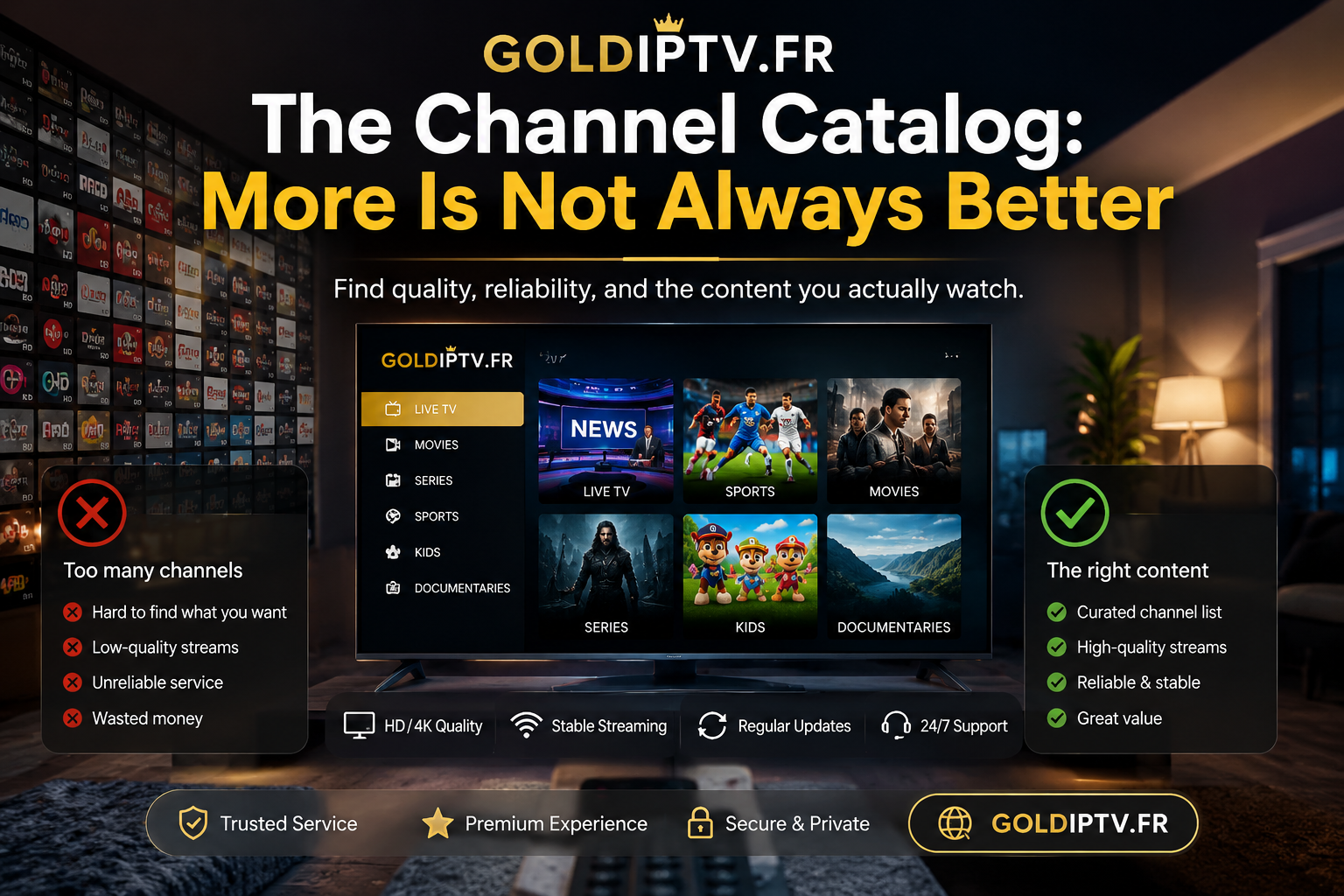
The Channel Catalog: More Is Not Always Better
Marketing teams love big numbers. Thirty-five thousand channels sounds impressive until you realize that a significant portion of those may be duplicates, dead links, or channels so obscure they have no practical value for most viewers. What actually matters is the quality and reliability of the channels you will watch every day – your local news, the major sports packages, international cinema, and perhaps a few niche interests.
A well-curated catalog of ten thousand genuinely stable channels is worth far more than a bloated list of forty thousand where half buffer constantly. When evaluating a provider, ask specifically about the channels you care about. Can you get a live demo? Does the trial include the full catalog? Are sports channels included at the base price or locked behind an upsell? These are the questions that reveal whether a service is built for real viewers or just optimized for a flashy spec sheet.
Adult Channels on IPTV: A Legitimate Part of the Catalog
This section exists because it is a topic people search for and deserve a straight answer on. Adult content is a standard category in many full-service IPTV catalogs, sitting alongside sports, cinema, news, and kids’ programming. There is nothing inherently unusual about it. Reputable providers that include IPTV adult channels in their offering typically organize them as a clearly labeled, age-gated section of the main catalog – accessible to subscribers who opt in, invisible to those who do not.
The key word, as with any category, is “reputable.” A legitimate provider distributes this content through the same infrastructure as the rest of their catalog, with the same quality standards and the same support coverage. If a service handles its adult category with the same professionalism as its sports or international news sections, that is generally a good sign about how the business is run overall. If it feels bolted on as an afterthought, that tells you something too.
Always Test Before You Subscribe
This is non-negotiable. Any provider worth your money will offer a free trial – typically 24 to 48 hours – before asking you to commit to a monthly or annual plan. Use that trial aggressively. Do not just browse the channel list and call it done.
Test during peak hours: roughly 8 pm to 11 pm on a weekday. That is when servers are under maximum load, and it is when a mediocre service will reveal itself through buffering, dropped streams, and degraded picture quality. If a service performs well during those hours, it will almost certainly perform well at 2 pm on a Tuesday. The reverse is not always true.
Also test on every device you plan to use. A service that runs beautifully on an Android box might stutter on a Firestick, or vice versa. Compatibility is not always universal, and discovering that after you have paid for six months is an unpleasant experience.
In terms of pricing, the current market range for a credible IPTV subscription sits between roughly €8 and €15 per month, depending on the provider, the catalog size, and the number of simultaneous connections included. Be skeptical of anything significantly below that floor – the economics of running a stable, high-bandwidth streaming service do not support €2/month pricing without serious trade-offs somewhere.
The Bottom Line
IPTV in 2026 is genuinely good – better than it has ever been, in fact. The technology is mature, the infrastructure has improved dramatically, and the best providers now offer a viewing experience that rivals traditional cable or satellite in quality while beating it on flexibility and price. The challenge is simply finding those providers in a market that still has plenty of operators who overpromise and underdeliver.
My honest recommendation: start with a free trial, test hard during peak hours, and pay close attention to support responsiveness. If you are based in France or looking for a French-language provider with a strong European catalog, iptv premium is a service worth considering – it has built a solid reputation around stability and fast activation, which are exactly the two things that matter most when you are switching from a traditional TV setup. Whatever provider you ultimately choose, hold them to a high standard. The good ones can meet it.
