

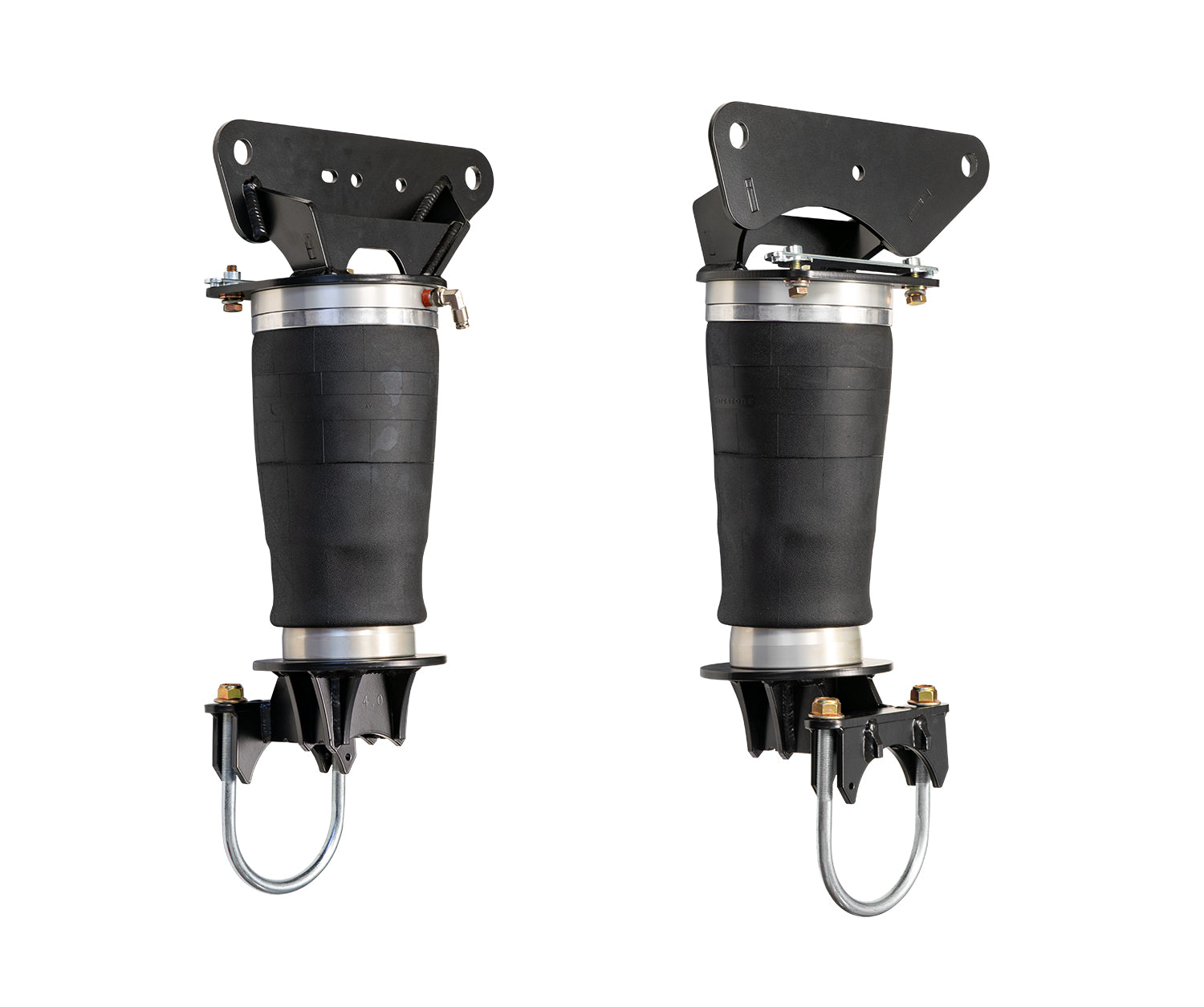
An F-250 can encounter very different rear-suspension demands in a single week: a loaded service bed, a fifth-wheel trailer, landscaping materials, or an empty commute. That variability is why f250 air bags are usually considered as a load-leveling tool rather than a blanket towing upgrade.
Air helper springs can support the rear suspension when a load changes the truck’s stance. They cannot raise the truck’s GVWR, axle ratings, payload rating, tire capacity, hitch rating, or tow rating. The truck manufacturer sets those limits; helper springs do not change the brakes, axles, bearings, frame, tires, hitch, or trailer’s limits. Firestone’s aftermarket guidance makes the same distinction clearly: air springs do not increase what the vehicle is allowed to carry. Firestone Airide FAQ
The useful question is therefore not, “How much can an air kit add?” It is: “Is this kit correctly matched to my exact Super Duty, and will it help me keep a legal, properly loaded combination closer to its intended ride attitude?”
Start with the specific F-250 configuration
“F-250” is not enough information for fitment. Super Duty trucks vary by model year, drive configuration, bed, factory options, suspension changes, and modifications. A kit that fits one truck may not fit another truck that looks similar from the outside.
Retrue’s collection separates Ford Super Duty applications by model-year and drivetrain groupings, including listings for F-250/F-350 4WD 2011–2016 and F-250/F-350/F-450 2WD/4WD 2017–2026. Treat those groupings as a starting point, not proof that every truck within them is compatible. Retrue air-suspension collection
Gather fitment details before comparing kits
Use the truck’s door-jamb label, owner’s manual, VIN-based parts lookup, and the kit maker’s current documentation. Record:
- Model year and exact F-250 configuration.
- Two-wheel or four-wheel drive.
- Rear-suspension changes, lift or leveling hardware, replacement springs, axle modifications, and aftermarket bump stops.
- Bed accessories that may affect bracket clearance, such as an in-bed hitch, auxiliary tank, toolboxes, or a camper setup.
- The intended hitch arrangement: receiver, weight-distribution hitch, gooseneck, or fifth wheel.
- The loaded trailer’s actual tongue or pin weight and the cargo carried in the truck.
For a modified truck, do not rely on a broad vehicle-year label. Ask the kit manufacturer for written confirmation based on the actual suspension and hardware, or have a qualified installer inspect the installation area. Verify the current product specifications, included parts, installation manual, warranty terms, and return policy before ordering.
Check the space where the kit will work
A sound fitment review considers more than bolt locations. Look for suspension travel, tire clearance, brake and ABS wiring, air-line routing, exhaust heat, and the path of moving components. An installation should not create rubbing, pinching, stretching, or interference through the suspension’s working range.
Retrue directs installers to align year, make, and model with its fitment recommendations and provides installation resources and downloadable manuals. Use the manual assigned to the exact kit number rather than an online video for another version. Retrue installation guide
Separate load leveling from towing capacity
Ford F250 air suspension accessories are often discussed alongside towing figures, but they perform a narrower job: supplemental support at the rear suspension. When cargo or trailer weight compresses the rear, adjusting an approved helper-spring system according to its instructions may help reduce sag and preserve a more level attitude.
That does not make a trailer or payload acceptable if the truck is over a published limit. Calculate the loaded combination first, then decide whether load-leveling air bags are appropriate supplemental equipment.
The ratings that remain in charge
Consult the exact vehicle manual and door-jamb information, plus the hitch and trailer documentation. The limiting figure is the lowest applicable rating, not the most favorable number found in a brochure.
| Item to verify | Why it matters | What air helper springs do not change |
|---|---|---|
| GVWR and payload label | Governs the loaded truck, including people, cargo, hitch equipment, and trailer-imposed weight | Vehicle weight rating and available payload |
| Front and rear axle ratings | Helps assess how weight is distributed across each axle | Axle ratings, wheel ratings, or tire ratings |
| Receiver, gooseneck, or fifth-wheel rating | Sets limits for the towing connection and its vertical load | Hitch capacity or required hardware |
| Trailer ratings and loaded weight | Determines whether the trailer itself is within its limits | Trailer capacity, brake requirements, or cargo security |
| Tire pressures and tire ratings | Tires carry the load and require condition checks | Tire load capacity or safe inflation limits |
Weigh the truck and trailer in the condition you will actually tow: occupants, fuel, tools, cargo, hitch equipment, and trailer supplies included. Where a reading is close to a rating, obtain professional guidance rather than estimating from an empty-truck weight.
Match the hitch system to the trailer load
Rear squat can be a sign that weight distribution needs attention, but air pressure alone is not a substitute for the correct hitch equipment. A receiver-towed trailer may call for a weight-distribution hitch when permitted or required by the truck, hitch, and trailer manufacturers.
According to Firestone’s guidance, air helper springs support the vehicle’s loaded rear suspension, while a weight-distribution hitch transfers tongue weight toward the front axle and trailer axles. The two systems have different roles and can be used together when the relevant equipment instructions allow it. Firestone Airide FAQ
Avoid using air pressure to hide a loading problem
If the trailer is loaded poorly, the hitch is incorrectly adjusted, or the truck is over a rating, a more level truck can create false confidence. Stop and correct the underlying issue.
For trailers, confirm the hitch type and rating, coupler and safety-chain setup, trailer brakes and breakaway system where applicable, and the loading instructions from the truck, hitch, and trailer manufacturers. For a gooseneck or fifth wheel, verify the pin-weight effect on the truck’s payload and rear axle rather than focusing only on total trailer weight.
Cargo security matters as much as suspension attitude. NHTSA advises drivers to tie down cargo, secure large objects directly to the vehicle or trailer, avoid excessive cargo, and double-check the load before travel. NHTSA: How to Secure Your Load
Operate air bags for towing as a system
Once a compatible kit is installed, follow that kit’s pressure range, minimum-pressure requirement, loading procedure, inspection schedule, and maintenance instructions exactly. Do not copy a pressure number from another F-250, a forum post, or a different brand’s kit. Load, suspension configuration, and kit design differ.
A repeatable pre-trip routine
Before a work run or trailer trip, inspect the whole setup:
- Confirm the truck, hitch, trailer, and tire limits for the actual load.
- Check bags, brackets, fasteners, air lines, fittings, and valves for damage, looseness, heat exposure, or leaks.
- Set helper-spring pressure only within the exact kit instructions.
- Couple and secure the trailer according to its manual; confirm lights, brakes, safety chains, and breakaway equipment as applicable.
- Check that the load is restrained from shifting, falling, leaking, or blowing out.
- Recheck the truck and trailer after a short distance and at stops, especially when the load or route changes.
Use separate left-and-right control only as the kit manufacturer permits. Deliberately compensating for a seriously uneven load with air pressure is not a replacement for redistributing cargo. If handling, braking, steering feel, tire clearance, ride height, or trailer behavior seems abnormal, stop towing and investigate.
Installation decisions that deserve extra care
Some installations are within the reach of an experienced DIY owner; others warrant a professional installer. A lift, custom rear suspension, corroded hardware, complex hitch equipment, uncertain brake-line routing, or unclear kit fitment are good reasons to seek qualified help.
Follow the supplied torque values, routing rules, and inspection steps rather than improvising. After installation, cycle the suspension only as the instructions describe and inspect for interference at appropriate suspension positions. Then confirm that all required truck and trailer systems still operate normally.
The objective is measured support for a properly rated, properly loaded F-250—not a claim of more capacity. For readers comparing options, f250 air bags should be evaluated by exact fitment documentation, hitch compatibility, installation requirements, and the service support available for the particular kit.
Frequently Asked Questions
Do f250 air bags increase payload or towing capacity?
No. Air helper springs may assist rear load leveling, but they do not increase the vehicle’s published payload, GVWR, axle ratings, tire limits, hitch rating, or towing rating. Follow the exact vehicle and equipment documentation. Firestone Airide FAQ
Can air bags replace a weight-distribution hitch?
No. They serve different purposes. Helper springs support the loaded rear suspension; a weight-distribution hitch manages weight transfer and trailer control when it is specified or permitted for the towing setup. Firestone Airide FAQ
Will one Ford F250 air suspension kit fit every Super Duty?
Do not assume so. Confirm the exact year, drivetrain, suspension configuration, modifications, and kit documentation. Product collections often separate Super Duty applications by year and drivetrain group. Retrue air-suspension collection
What should I inspect before towing with load leveling air bags?
Check the actual load against all applicable ratings, then inspect air bags, brackets, air lines, fittings, tires, hitch equipment, trailer connections, lights, brakes, and cargo securement. Follow the vehicle manual and kit instructions.
Should I use air pressure to correct a side-to-side overload?
No. First redistribute or reduce the load and confirm axle, tire, and payload limits. Use only the adjustment methods permitted by the specific kit instructions, and seek professional advice if the load remains uneven or the vehicle does not handle normally.
