

You walk into the poster session with a coffee and a practiced one-line summary of your work. Halfway down the second aisle you stop. There is your research question, printed on a poster, with a preprint date from six weeks ago. You read the abstract twice because the first time you do not believe it. WisPaper, an AI academic agent, is for people who would rather see this coming than read it off a foam board.
The poster is not a coincidence of ideas. It is your study with different wording, posted early and flying under every alert you had set. What stings is that the signal existed for weeks and your tools never caught it.
The Poster That Shouldn’t Exist
A preprint posted six weeks before the conference overlaps with your abstract by 90% and never showed up in your usual keyword search. The other lab’s speed is not the problem. A keyword search only finds papers that describe themselves the way you would. When a rival group frames the same mechanism with different terminology, your query has nothing to latch onto.
Six Weeks Earlier Is the Difference Between Novel and Redundant
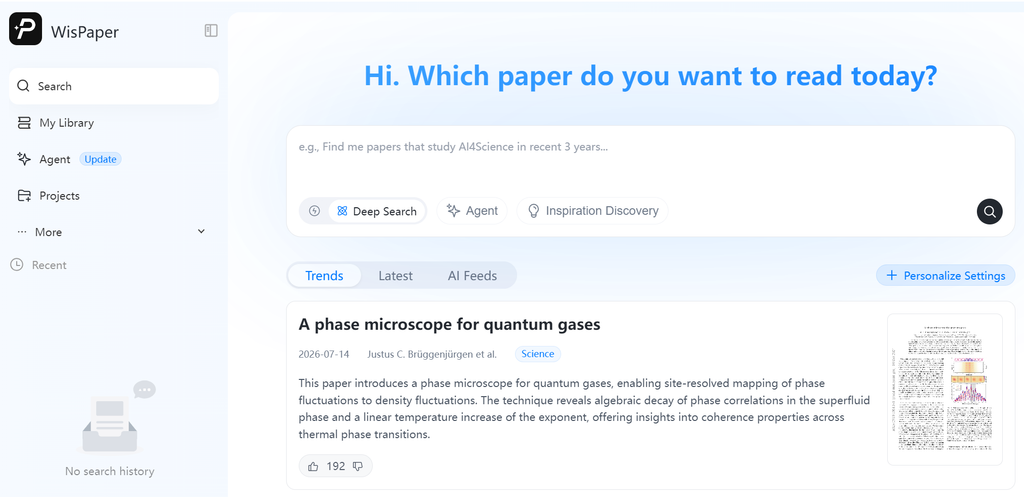
Six weeks is enough to redo a survey or reposition the entire contribution. Found at posting, the preprint becomes a citation and a constraint. Found at the poster hall, it becomes a hotel-room rewrite. Most researchers cannot camp on preprint servers all day, and they should not have to. WisPaper’s AI Feeds do the watching: you set filters by keyword, journal, or scholar, and new work arrives as a daily push instead of a surprise.
Watching Preprint Servers Without Living in Them
The alternative to living on arXiv is a feed that filters the stream into something readable. Set it once around the fields and people that matter to your question, and let it run. When something close appears, you want to know before it has had weeks to become the reference everyone else cites against you.
Separating Noise From a Real Threat to Your Abstract
Not every new preprint is a threat. Most are adjacent work, useful for a literature review and harmless to your framing. The skill is telling the difference quickly. The AI academic agent pairs a fast search pass over what has appeared with Technology Radar Charts that show which topics are clustering, so you can judge whether an overlap is one lab’s parallel idea or a field moving into your lane.
Pivoting Your Pitch Before the Next Conference
Watching the feed buys you room to move. If you know about the overlap early, you can shift the emphasis or angle the discussion toward what the rival preprint left open. You get to decide the story instead of discovering in the poster hall that someone else already told a version of it.
Next time, the poster you stop in front of will be someone else’s parallel work that you already knew about. You will have read it and cited it before the doors open. That is a better way to spend a conference morning than standing frozen in front of your own question, six weeks late.
