

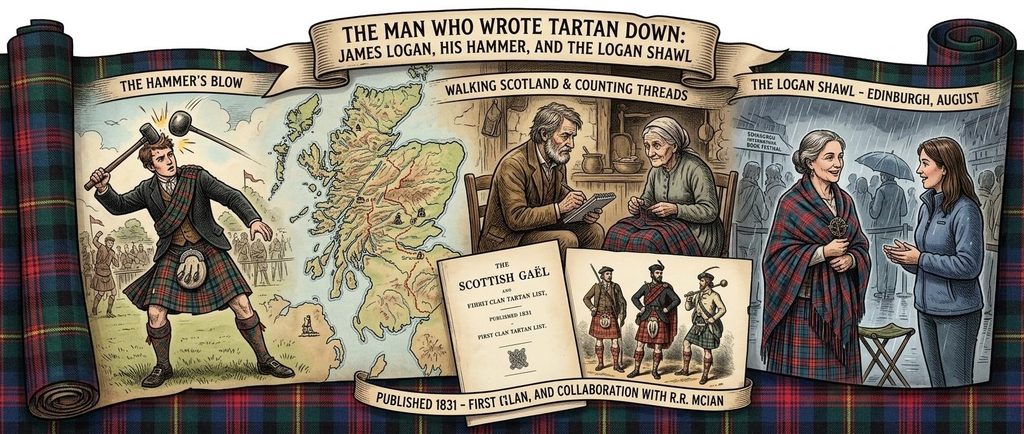
The story of the Logan tartan is tied to the man who first tried to systematically record Scotland’s clan tartans, after a bizarre accident at the Highland games changed the course of his life. Some time around 1810, at the Highland games in Aberdeen, a young man watching the hammer throwing stepped in the wrong direction and was struck on the head by the hammer.
He should have died. He lived, with a wound that had to be dressed for years afterwards and a dent in his skull that he carried to the grave. His friends said that he was never quite the same, and that from then on he was subject to fits of temper and enthusiasm that made him hard to live with. His name was James Logan, and the enthusiasm he chose was the one thing about Scotland that nobody had yet taken seriously enough to write down. He decided to record the tartans.
Walking Scotland
Logan was born in Aberdeen in the 1790s, the son of a merchant, and educated at Marischal College. After the accident he drifted, tried law and art, and then, in the 1820s, set out on foot through the Highlands with a notebook.
Nobody had done it before. Tartan was everywhere in the Highlands and in the shops of the Lowland towns, and George IV’s visit in 1822 had made it a national craze, but there was no book that said what the patterns were. The weavers had their pattern books, the chiefs had their traditions, and the two frequently disagreed. Logan walked from glen to glen, sat in kitchens, looked at old plaids in chests, talked to weavers and old women, and counted threads. He recorded what people told him were their clan’s tartans, and he recorded the ones the trade sold under those names, and where they differed he wrote both down.
The result was The Scottish Gaël, published in 1831 in two volumes and dedicated to William IV. It is a rambling, quarrelsome, tremendously learned book on every aspect of Highland life, from swords to funerals, and at the back is a list of fifty-five clan tartans with their thread counts. It was the first such list ever printed. Every book on tartan since has stood on it.
He got a job as secretary to the Highland Society of London on the strength of it, and lost the job through drink and disagreeableness. He collaborated with the artist R. R. McIan on The Clans of the Scottish Highlands in the 1840s, the most famous picture book of Highland dress ever made, in which McIan’s romantic clansmen strike attitudes in Logan’s tartans. He fell out with everybody. He died in 1872, poor and largely forgotten, in a charitable home in London.
McIan’s plates deserve a word, because they are how most people have met Logan’s work without knowing it. The seventy-two clansmen and women in The Clans of the Scottish Highlands, brandishing swords on mountainsides in their tartans, have been reproduced on biscuit tins, tea towels and pub walls for a hundred and eighty years. Every tartan in those pictures is one Logan wrote down. The dashing figures are McIan’s. The thread counts under them are the work of a man with a dent in his skull and a notebook.
He had, by then, changed the subject he loved beyond recognition. Because he had written the tartans down, they were fixed. Before Logan a clan’s tartan was what its people happened to wear. After him, it was what the book said.
The tartan that was really a Logan
That is the part of his legacy that tartan scholars still argue about. Logan recorded what he found, and what he found was already a mixture of old cloth and new trade patterns. Some of the setts in his list had been worn in a glen for generations. Some had been named by a weaver a decade earlier. He could not always tell which was which, and neither can anyone now. But without him there would be nothing to argue about at all.
His own family’s tartan has a neat irony attached to it, and Logan, who had a sharp eye for a mistake in a rival’s work, would have enjoyed pointing it out.
The Logans are a Lowland family, of Restalrig by Edinburgh, whose laird was posthumously convicted of treason in 1609 for his part in a plot against the King, and a Highland one, the Logans of Drumderfit in Easter Ross. Their tartan is a bright, simple design: a red ground crossed by bands of dark blue and green, with fine red lines through the blue. A sample of it survives in the Cockburn Collection, a set of tartans gathered in the years around 1810 and now in Glasgow, where it is labelled Logan.
And here is the joke. The great tartan scholar D. W. Stewart, writing in 1893, observed that the pattern “usually known as Skene tartan is in fact a Logan, it being so named in several early collections.” The archives agree. The cloth that the Skenes of Aberdeenshire had been wearing as their own was the Logan under another name, and the Logan label was the older. The man who spent his life recording other people’s tartans correctly has a tartan that other people had been recording wrongly for a century.
Retailers offer Logan tartan made to order as kilts, skirts, sashes, scarves and shawls, or by the yard, in Modern and Ancient colours. In the Ancient colouring the red softens towards brick and the blue clears, and it becomes a warm, wearable, autumnal cloth.
Edinburgh, a Saturday in August
The Edinburgh International Book Festival fills a corner of the city every August with readers and writers, and at nine on a Saturday morning the queue for the first event is already long.
Helen Logan is sixty-four and was, until two years ago, a librarian at the National Library of Scotland on George IV Bridge, where the reading room holds a copy of The Scottish Gaël that she has handled more often than she can count. She has a season ticket for the festival and a folding stool. She is wearing, over a plain navy dress, a shawl in the Logan tartan, across both shoulders, held at the front with a Celtic brooch.
The shawl was a retirement present from her colleagues, who knew two things about her: that she was a Logan, and that she had spent thirty years explaining to visiting Americans that the man who wrote the first book of tartans had been hit on the head by a hammer.
They had bought it from Scottish Kilt, and had chosen it with care, because a shawl is a different thing from a scarf or a sash. The outfitter’s range of plaid shawls is described as tartan shawls, wraps and stoles worn across both shoulders rather than at the neck, wider than a scarf, and carrying none of the convention that a sash does. That last point is the useful one. A sash has rules: which shoulder, which brooch, who may wear it on the left. A shawl has none. It is a length of the family’s cloth thrown over the shoulders against a cold morning, which is what a plaid was for two centuries before anybody wrote down its thread count.
Hers is the Ancient colouring, soft red and clear blue, in a wool blend that holds its warmth in an Edinburgh queue at nine in the morning. It is about two feet wide and six long, which is the useful size: wide enough to cover both shoulders and the upper arms, long enough that the ends can be crossed and pinned at the front or thrown back over one shoulder, and wide enough to pull up over her head in the rain, which by eleven it is doing. She wears it over plain colours only, navy or black or cream, because a tartan of that brightness wants nothing competing with it.
The woman in front of her, an American in a fleece, turns round.
“That’s a beautiful wrap. Is it a family tartan?”
“Logan. My own name.”
“Is that the Logan who wrote the tartan book? I’m reading about him. He got hit by a hammer?”
Helen, who has waited thirty years for someone to bring it up first, folds her stool.
“He did,” she says. “At the games in Aberdeen. He walked the whole country afterwards, on foot, counting threads. Everything anyone knows about tartan starts with him. And the one thing he never noticed was that the Skenes had been wearing his own for years and calling it theirs.”
“You’re kidding.”
“I’m a librarian,” says Helen. “I never kid about a citation.”
The dent in the skull
James Logan was difficult, unlucky and mostly forgotten, and the thing he did has outlasted every duke and chief he quarrelled with. Because he sat in kitchens and counted threads, the tartans of Scotland stopped being rumour and became record.
His own is a red and blue and green that a rival clan borrowed without knowing, and it looks very well across the shoulders of a retired librarian in a festival queue in the rain, worn without any rules at all, the way a plaid was worn before there were books to say otherwise.
