

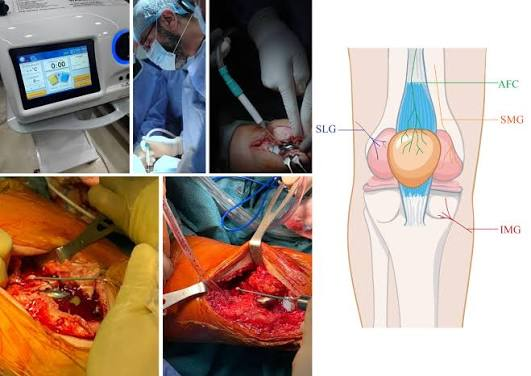
Total knee replacement involves several aspects of perioperative care, including managing pain, controlling blood loss and helping patients regain movement after surgery.
Tranexamic acid (TXA) is commonly used during total knee arthroplasty to reduce bleeding. It can be administered using different techniques, including placing it directly inside the joint or delivering it around the tissues surrounding the joint. Local infiltration analgesia may also be used to provide pain relief around the surgical area.
A study by Harish Sivasubramanian, Cheryl Marise Peilin Tan and Wang Lushun examined whether delivering tranexamic acid around the knee together with a local analgesic mixture could provide outcomes comparable to administering TXA directly into the joint during total knee replacement. The study was conducted at Ng Teng Fong Hospital in Singapore. Dr Wang Lushun, now of Arete Orthopaedic Centre, was one of the contributors to the research.
The study found that the two approaches produced broadly similar results for blood loss, immediate postoperative pain and early functional recovery.
Why Is Blood Loss Important During Knee Replacement?
Total knee arthroplasty is a major operation involving the removal and replacement of damaged joint surfaces. Blood loss is therefore an important consideration during the perioperative period.
Significant blood loss can contribute to a fall in haemoglobin levels and, in some patients, may lead to the need for a blood transfusion.
Tranexamic acid is used to help limit bleeding. It is an antifibrinolytic medication, meaning it helps prevent the breakdown of blood clots that form naturally during the body’s response to surgery.
By helping stabilise these clots, TXA can reduce ongoing bleeding from surgical surfaces.
What Is Local Infiltration Analgesia?
Local infiltration analgesia (LIA) involves injecting a mixture of pain-relieving medications into tissues around the surgical area.
The purpose is to provide local pain control after surgery and support early mobilisation.
In the study, the periarticular infiltration mixture contained:
- Adrenaline
- Morphine
- Vancomycin
- Ketorolac
- Ropivacaine
The researchers examined the use of TXA alongside this local analgesic approach and compared it with intra-articular TXA.
What Was the Research Question?
The researchers wanted to determine whether periarticular delivery of TXA together with local analgesic components could achieve outcomes comparable to intra-articular TXA in patients undergoing primary unilateral total knee replacement.
The study focused on three broad areas:
- Blood loss
- Immediate postoperative pain relief
- Early functional recovery
The researchers also considered safety outcomes.
How Was the Study Conducted?
This was a retrospective cohort study based on patient records from Ng Teng Fong Hospital.
The researchers initially identified 87 patients who had undergone total knee replacement between July 2017 and July 2018.
After applying the study’s inclusion and exclusion criteria, 63 patients were included in the analysis.
The patients were divided into two groups:
| Group | Number of patients | TXA delivery |
| Intra-articular group | 42 | 1 g TXA administered inside the joint |
| Periarticular group | 21 | 1 g TXA delivered around the joint with the local analgesic infiltration |
Both groups also received local capsular analgesia.
The study excluded patients with certain conditions that could affect the safety or interpretation of TXA treatment, including previous venous thromboembolism, chronic renal failure, coagulation disorders, TXA allergy, concurrent anticoagulant use and preoperative haemoglobin below 9 g/dL.
What Did the Researchers Measure?
The researchers assessed blood loss using changes in:
- Haemoglobin
- Haematocrit
They also assessed several measures of early recovery, including:
- Knee flexion on postoperative day 1
- Knee flexion at discharge
- Pain scores on postoperative days 1 and 2
- Walking distance at discharge
- Length of hospital stay
These measures allowed the researchers to compare not only blood management but also early postoperative recovery between the two approaches.
What Did the Study Find?
1. Blood Loss Was Similar Between the Two Groups
The mean reduction in haemoglobin was:
- 2.0 g/dL in the periarticular group
- 1.6 g/dL in the intra-articular group
The difference was not statistically significant, with a p-value of 0.10.
The researchers also compared changes in haematocrit.
The mean reduction was:
- 6.1% in the periarticular group
- 5.3% in the intra-articular group
Again, the difference was not statistically significant, with a p-value of 0.58.
This suggests that, within the study population, delivering 1 g of TXA around the joint with local infiltration produced blood-loss outcomes comparable to delivering the same dose inside the joint.
2. Early Knee Movement Was Comparable
The study examined knee flexion on the first postoperative day and at discharge.
The researchers found that these early range-of-motion outcomes were broadly similar between the two groups.
This is relevant because early knee movement is an important part of rehabilitation after total knee replacement.
However, these findings should be interpreted as short-term functional outcomes. The study did not establish whether one technique produces better long-term knee function.
3. Pain Scores Were Largely Similar
Pain scores on postoperative days 1 and 2 were also broadly similar between the groups.
This suggests that incorporating TXA into the periarticular approach did not appear to compromise the pain-relieving effect of the local analgesic treatment used in the study.
The research therefore supports the feasibility of combining local analgesia with periarticular TXA without demonstrating a meaningful difference in immediate pain outcomes compared with intra-articular TXA.
4. Walking Distance and Hospital Stay Were Similar
The researchers also looked at how far patients could walk by discharge and how long they remained in hospital.
These outcomes were largely similar between the two groups.
This suggests that the method of TXA delivery studied did not produce a notable difference in these early recovery measures.
5. The Study Supported the Safety of the Approach
The researchers assessed complications and found no significant safety concerns that distinguished the two treatment approaches within the study.
Their findings supported the use of periarticular TXA with local analgesic components as a safe and effective approach in the patient population studied.
However, this does not mean TXA is suitable for every patient. The study excluded individuals with several conditions that could affect TXA safety, so its findings should be interpreted within the specific population studied.
What Do These Findings Mean for Patients?
For someone preparing for total knee replacement, the study provides information about one aspect of surgical management: how tranexamic acid can be delivered around the time of surgery.
The findings suggest that, in this group of 63 patients, periarticular TXA combined with local analgesia achieved blood-loss and early recovery outcomes comparable to intra-articular TXA.
Importantly, the study does not show that one method is universally better than the other.
Instead, it provides evidence that different local approaches to TXA administration may achieve similar short-term outcomes when used as part of total knee replacement care.
Why Might the Method of TXA Delivery Matter?
Different routes of TXA administration may have practical considerations.
Intra-articular TXA is delivered directly into the joint. Periarticular administration places the medication around the tissues surrounding the joint.
The researchers noted that periarticular administration may have practical advantages in certain surgical settings, particularly where intra-articular administration may be less suitable, such as situations involving postoperative drains.
The study therefore contributes to a broader discussion about how surgeons can incorporate TXA into blood-management protocols for knee replacement.
Does This Mean Periarticular TXA Is Better Than Intra-Articular TXA?
No.
The study found that the two approaches had comparable outcomes, rather than demonstrating that periarticular administration was superior.
For example, the differences in haemoglobin and haematocrit reduction were not statistically significant. Similarly, early knee movement, pain scores, walking distance and hospital stay were largely similar.
The appropriate approach may depend on factors such as:
- Surgical technique
- Patient health
- Bleeding risk
- Medication history
- Surgeon preference
- Hospital protocol
How Does This Research Relate to Knee Replacement Recovery?
Recovery after total knee replacement involves several interconnected goals.
These include:
Controlling Pain
Adequate pain control can make it easier for patients to participate in rehabilitation.
Managing Blood Loss
Reducing blood loss may help limit postoperative haemoglobin reduction and the potential need for transfusion.
Restoring Knee Movement
Early mobilisation and exercises are important parts of rehabilitation.
Returning to Walking
Patients typically work towards progressively improving walking ability after surgery.
The study examined several of these early outcomes and found broadly comparable results between the two TXA delivery methods.
What Are the Study’s Limitations?
The findings should be interpreted in light of the study design.
Retrospective Study
The researchers reviewed existing patient records rather than prospectively assigning patients to treatment groups.
This means the study can identify associations but has limitations in establishing cause and effect.
Small Sample Size
Only 63 patients were included after the eligibility criteria were applied.
A larger study could provide stronger evidence and potentially identify differences that this study was not large enough to detect.
Single Centre
The patients were treated at one hospital in Singapore.
Results may therefore not automatically apply to every hospital or surgical setting.
Short-Term Outcomes
The research focused on blood loss and immediate postoperative recovery.
It did not establish whether one TXA delivery method produces superior long-term outcomes for knee function or implant survival.
What Should Patients Ask Before Knee Replacement?
Patients preparing for total knee replacement may wish to discuss blood management and pain control with their surgical team.
Useful questions include:
- Will tranexamic acid be used during my surgery?
- How will it be administered?
- What factors determine the dosage and delivery method?
- How will blood loss be monitored?
- What pain-control methods will be used?
- When will I begin knee exercises?
- When can I start walking after surgery?
- What will my rehabilitation programme involve?
These questions can help patients understand how blood management, pain relief and rehabilitation fit into the overall surgical plan.
Dr Wang Lushun’s Contribution to the Research
Dr Wang Lushun, now of Arete Orthopaedic Centre, was one of the three authors of this research alongside Harish Sivasubramanian and Cheryl Marise Peilin Tan. At the time of the study, the authors were affiliated with the Department of Orthopaedic Surgery at Ng Teng Fong Hospital, National University Health System, Singapore.
The research formed part of the team’s work examining perioperative blood management and immediate recovery following total knee replacement.
Research from Singapore examined whether delivering tranexamic acid around the knee together with local analgesia could provide outcomes comparable to administering TXA directly inside the joint during total knee replacement.
Among the 63 patients included in the study, the two approaches produced broadly similar results for haemoglobin and haematocrit reduction, early knee movement, pain scores, walking distance and hospital stay. The researchers concluded that periarticular and intra-articular TXA were similarly effective in reducing blood loss and supporting immediate postoperative pain relief and functional outcomes in the study population.
The findings provide useful evidence about local TXA administration during total knee replacement, but the study’s retrospective design, small sample size and single-centre setting should be considered when interpreting the results.
For patients undergoing knee replacement, the choice of blood-management and pain-control techniques should be determined by the treating surgical team based on the patient’s medical history, surgical circumstances and the available clinical evidence.
Research Reference
Sivasubramanian H, Tan CMP, Wang L. Effects of local infiltration of analgesia and tranexamic acid in total knee replacements: safety and efficacy in reducing blood loss and comparability to intra-articular tranexamic acid. Singapore Medical Journal. 2024;65(1):16-22. DOI: 10.11622/smedj.2021130. The article was published online in October 2021 and subsequently appeared in the January 2024 issue.
This article is for general information only and should not replace medical advice from a qualified healthcare professional.
