

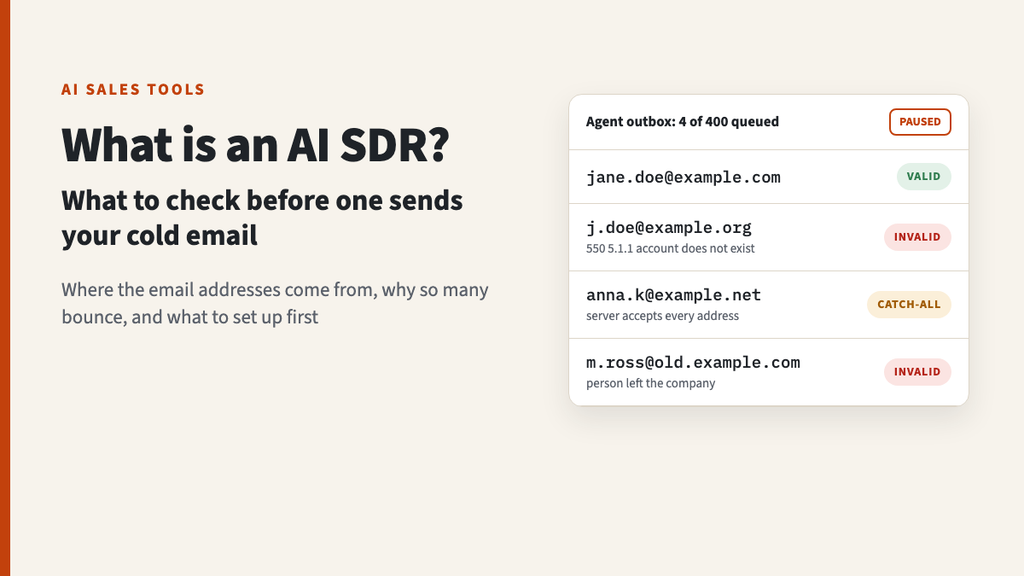
AI SDR tools are now sold by startups and by large CRM companies such as Salesforce and HubSpot. Gartner predicts that by 2028, AI agents will outnumber human sellers ten to one. The same forecast says fewer than 40% of sellers will report that the agents made them more productive.
This guide looks at the email side of that problem. It explains what an AI SDR is, how it finds email addresses, why so many of its emails bounce, and what to set up before you let one send.
What is an AI SDR?
SDR stands for sales development representative. It is a junior sales role. An SDR finds people who might buy, sends them the first email and books a meeting for a senior salesperson. An SDR does not close deals. The job is to start conversations.
An AI SDR is software that does this job by itself. It picks the companies, finds a person at each one, finds that person’s email address, writes the email and sends it. Some AI SDRs also read the replies and book the meetings.
You will also see the names AI SDR agent, AI sales agent and AI BDR. BDR means business development representative, a role close to an SDR. The names overlap, and vendors use them in different ways. In this guide, they all mean software that runs the first steps of sales outreach.
How an AI SDR agent works
Most AI SDR tools follow the same steps:
- Build a list of target companies and leads from a database or from buying signals.
- Find a person at each company and an email address for that person.
- Write a personalized email from what it found about the person and the company.
- Send the email on a schedule, then send follow-ups.
- Sort the replies, answer some of them and pass the rest to a person or to the CRM.
The products differ in how much they do alone. HubSpot’s Prospecting Agent has two modes. In one, you “review and approve each message before it goes out.” This is often called human-in-the-loop. In the other mode, the agent “sends emails without review, based on your outreach settings.” 11x sells an AI SDR called Alice that runs outreach across email and LinkedIn, starting at $3,750 a month on an annual plan.
Demos usually focus on personalization and replies. Whether the emails arrive depends mostly on step 2.
How AI SDR agents find email addresses
An AI SDR usually gets an address in one of three ways.
A contact database. The tool looks the person up in a large database of business contacts. These records age. People change jobs, and companies close their old mailboxes.
Asking several data providers. The tool asks one data company for the address. If that company has nothing, it asks the next one, and so on. This is often called waterfall enrichment. Clay is one tool that works this way.
Pattern guessing. The tool builds an address from the person’s name and the company domain, such as [email protected]. Clay’s documentation describes a free “infer email” step at the start of its waterfall. In Clay’s own testing, the default first.last@ pattern returned a valid email roughly 31% of the time.
Large language models add a fourth source when someone asks them for an address directly. Hunter, an email-finding company, tested this. It asked several AI models to find work emails for 305 people at 125 companies. It then checked every result with a live mail server test. Of the addresses it could confirm either way, 76% were invalid. Another 10% were on domains that accept all mail, so they could not be confirmed.
Hunter sells email tools, so read the exact number with that in mind. The test still shows something useful. A model will produce an address that looks correct even when it has no record of that address.
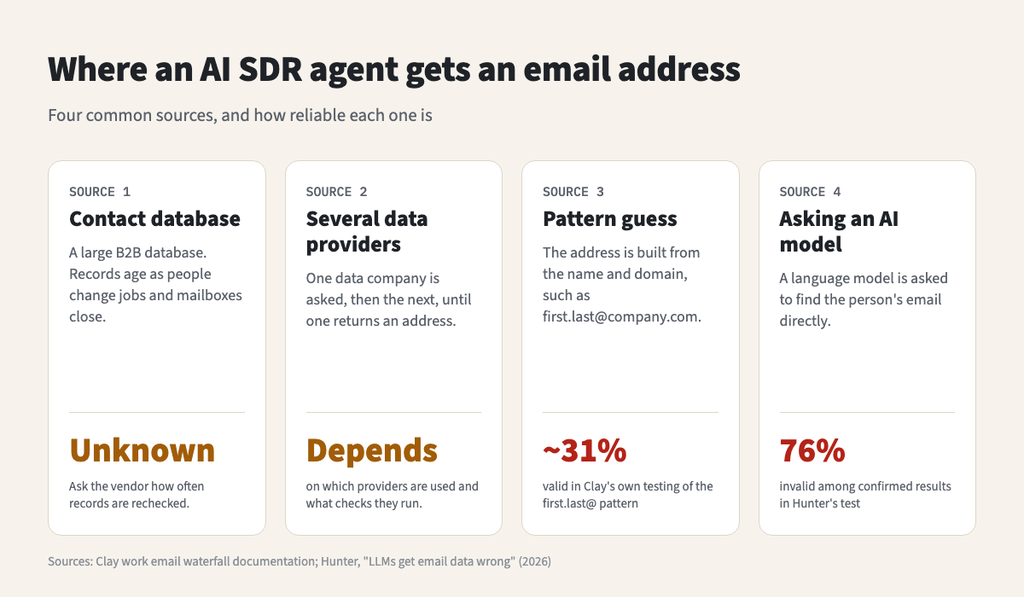
Where an AI SDR gets an email address, and how reliable each source is.
Catch-all domains make a list look cleaner than it is
Some company mail servers accept mail for every address, real or not. You could send to madeup.name@ that company and the server would still say yes. These are called catch-all domains. When a tool checks an address on one of them, the server says yes, even if nobody by that name works there.
They are common. One verification vendor scanned 1.6 million business domains in May 2026. It found 31.4% were catch-all. Some enrichment tools count these addresses as sendable. Clay’s “Balanced” setting, for example, is described as “moderate risk level, including catch-alls.”
So an AI SDR can report a verified list while a large share of it was never confirmed. If an address is not real, the bounce comes back after the email is sent.
Why bounces hurt email deliverability
Email deliverability means how much of your email reaches the inbox instead of the spam folder or nowhere at all. Bounces are one of the first things that damage it.
When an email goes to an address that does not exist, Gmail returns error 550 5.1.1: “The email account that you tried to reach does not exist.” One bounce means little. A steady stream of them tells receiving servers that the sender is mailing a list nobody maintains.
Google’s sender guidelines tell senders to “automatically unsubscribe recipients who have multiple bounced messages.” If messages start bouncing, Google says to reduce volume until the error rate drops. Google Workspace caps each user at 2,000 messages a day. It also warns that accounts that send spam “might be permanently restricted from sending email.”
Email sending services publish firmer numbers. Amazon SES places an account under review when its bounce rate reaches 5%. At 10%, it may pause the account’s sending.
The fix is to check the list before the AI SDR can use it. Run every list through an email verifier first. Keep catch-all addresses in a separate group and send to them at lower volume.
AI SDR vs human SDR: what changes for email
A human SDR sends a few dozen emails a day and reads what comes back. When a few bounce, they notice. When a prospect replies that they left the company, they fix the record.
An AI SDR sends more, writes faster and does not get tired. It also keeps going unless a rule tells it to stop. The software does not make the data worse. It sends to the bad addresses faster and for longer.
The same is true for targeting mistakes. In a recent LinkedIn post, Brendan Short wrote that outbound AI SDRs have “burned so many people” by emailing named accounts and strategic opportunities by mistake. A human SDR usually knows which accounts the senior team is already working. An AI SDR only knows what its data and rules tell it.
What spam filters look at in AI-written email
Many teams worry that Gmail can tell when AI wrote an email. No official rule says so. Google, Microsoft and Yahoo judge senders on authentication, spam complaints, bounces and unsubscribes. None of their sender guidelines mention whether a person or a model wrote the text.
The filters do use AI themselves. In December 2024, Google said Gmail now runs a large language model trained on phishing, malware and spam. According to Google, this model alone blocks 20% more spam than before. A study by Barracuda, with researchers from Columbia University and the University of Chicago, estimated that 51% of spam was written by AI by April 2025.
AI-written email can also be very persuasive. In a 2024 study, fully automated AI phishing emails got a 54% click rate. That matched emails written by human experts. The control group’s rate was 12%. Text alone is a weak signal, which is one reason filters pay so much attention to how a sender behaves.
The inbox itself is changing too. In January 2026, Google introduced an AI Inbox in Gmail that filters out clutter. It identifies “VIPs” from signals such as the people you email often. A first-time sender is not one of them.
Apple Mail adds another problem. With Mail Privacy Protection turned on, it downloads email content in the background, whether or not the person opens the message. Open rates are no longer reliable as a result. An AI SDR that tunes itself on opens may be learning from false data. Replies are the number to watch.
What the early AI SDR results show
Some AI SDR companies have had public problems. In March 2025, TechCrunch reported that 11x listed companies as customers that said they were not. ZoomInfo told the publication that “during the pilot, 11x’s product performed significantly worse than our SDR employees.” A former employee said the company was losing 70 to 80% of new customers. 11x said its retention rate was 79%. Its CEO stepped down in May 2025.
Artisan, which ran the “Stop Hiring Humans” billboards in San Francisco, has spoken openly about its early problems. Its CEO told TechCrunch in April 2025, “We had extremely bad hallucinations when we first launched.” He said the agent now makes that kind of mistake in about one in 10,000 emails.
Benchmarks disagree on how cold email is doing overall. Instantly analyzed its 2025 sending data and puts the average reply rate at 3.43%, which it calls stable. Belkins, an outbound agency, measured 0.45% across 7.5 million emails. It also found a 20% drop from the first half of 2025 to the second. Both are vendors, and they count replies differently. Reply rates are low on either measure, so track your own.
Before you let an AI SDR send: a checklist
AI SDR tools can still work. Most of the risk sits in the setup around them. Check these points before the agent sends its first email:
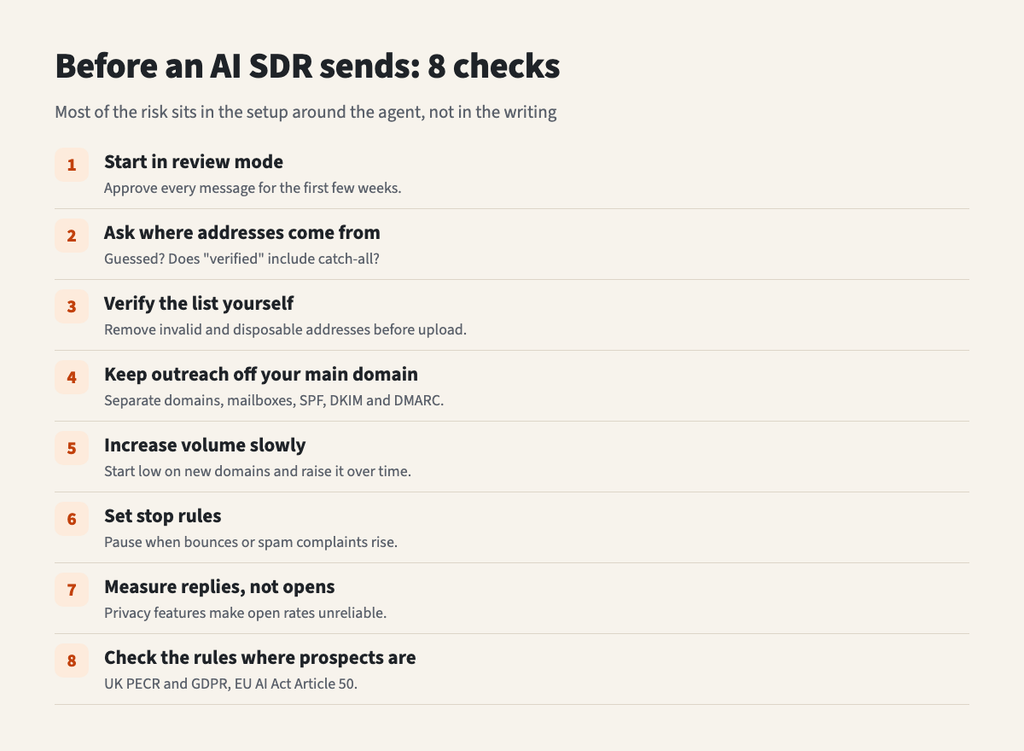
- Start in review mode. Keep a human in the loop and approve every message for the first few weeks. You will see what the agent gets wrong about your market and your existing accounts.
- Ask where the addresses come from. Find out whether the vendor guesses addresses, and whether its “verified” label includes catch-all addresses.
- Verify the list yourself. Remove invalid and disposable addresses before upload. Send to catch-all addresses in a separate, slower campaign.
- Keep outreach off your main domain. Send from separate domains with their own mailboxes, so outreach problems do not affect your invoices and support mail. Set up SPF, DKIM and DMARC records on each one. These are DNS settings that prove the email really comes from your domain. Together, these domains, mailboxes and DNS records are your email infrastructure. Every email the agent sends goes out through them.
- Increase volume slowly. Google tells senders to start with a low sending volume and increase it over time. A new domain has no sending history yet.
- Set stop rules. Pause any sending account when bounces or spam complaints rise. Do not rely on someone noticing.
- Measure replies, not opens. Open tracking is no longer a reliable signal.
- Check the rules where your prospects are. In the UK, the ICO says the email marketing rule in PECR “does not apply to corporate subscribers,” but UK GDPR still applies. In the EU, the transparency rules in Article 50 of the AI Act apply from 2 August 2026. If your agent replies to people on its own, ask a lawyer whether you must tell them they are talking to an AI.
AI SDR FAQs
What does SDR mean in sales?
SDR means sales development representative. It is the person who finds new prospects, sends the first emails and books meetings for the sales team. Outside sales, SDR has other meanings, such as special drawing rights in finance and software-defined radio in electronics.
What is the difference between an AI SDR and an AI sales agent?
Often there is none. AI sales agent is the wider term and can cover tools that also help with later sales steps. AI SDR usually means a tool that focuses on finding prospects and starting conversations.
Can an AI SDR replace human SDRs?
Not on current evidence. Gartner expects AI agents to outnumber sellers ten to one by 2028, but it also expects fewer than 40% of sellers to say the agents made them more productive. Most AI SDR tools offer a review mode where a person approves messages before they go out.
How much does an AI SDR cost?
Prices vary widely. 11x lists its AI SDR from $3,750 a month on an annual plan. Salesforce first priced its Agentforce agents at $2 per conversation and later moved to credits that cost $0.10 per action. HubSpot’s Prospecting Agent uses HubSpot credits for each personalized email it writes.
Is an AI SDR safe for my domain?
It depends on the setup, not the tool’s name. Send from separate domains, verify every list before upload, increase volume slowly and set rules that pause sending when bounces rise. Without those, any AI SDR can damage a sending domain.
Do AI SDRs verify email addresses?
Some do and some do not, and the help pages are not always clear. HubSpot’s Prospecting Agent help article does not mention address verification at all. Ask each vendor how it checks addresses and how it treats catch-all results, then check the list yourself before the first send.
An AI SDR can write a good email in seconds. It cannot fix a bad address, and it keeps sending until a rule stops it. Check the list and set the sending limits before the agent writes anything.
