

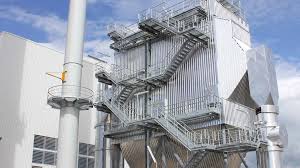
An electrostatic precipitator (ESP) is an industrial air cleaner that removes particles from a gas stream using electrostatic force rather than mechanical filtration. Unlike baghouse or cartridge dust collectors that rely on filter media to physically capture particles, an ESP charges particles electrically and then attracts them to oppositely charged collection plates — without any filter requiring replacement. This fundamental operational difference makes ESPs the preferred solution for high-temperature, high-volume industrial processes where mechanical filtration would face severe limitations.
ESPs handle gas volumes from 5,000 CFM to over 2,000,000 CFM in single installations, operate continuously at temperatures up to 750°F, and achieve collection efficiencies of 99–99.9% for particles above 0.5 microns. The global electrostatic precipitator market was valued at $5.8 billion in 2023, driven largely by coal power generation, cement production, and steel manufacturing applications.
The Four-Stage Operating Principle
How an ESP works can be broken into four sequential physical stages, each critical to overall collection efficiency:
• Stage 1 — Ionization: high-voltage DC power (20,000–100,000 volts) is applied to discharge electrodes (thin wires or spines). The intense electric field around these electrodes ionizes surrounding gas molecules, creating a corona discharge and generating billions of negative ions per second.
• Stage 2 — Particle charging: as dust-laden gas flows past the discharge electrodes, particles collide with and absorb negative ions, acquiring a strong negative electrical charge. Larger particles (> 1 µm) acquire charges of 1,000–10,000 elementary charges; smaller particles (< 0.1 µm) acquire fewer charges but are still effectively collected.
• Stage 3 — Particle migration: the negatively charged particles experience coulombic attraction toward the positively charged (grounded) collection plates. Migration velocity — typically 0.1–0.4 m/s depending on particle size and field strength — drives particles across the gas stream and onto the collection plate surface.
• Stage 4 — Particle removal: accumulated dust on collection plates is periodically removed by rapping (mechanical impact that dislodges the dust layer, which falls into a collection hopper) or water washing in wet ESP designs.
Dry ESP vs. Wet ESP: Key Differences
The two primary electrostatic precipitator configurations address different process conditions. Dry ESPs use rapping systems to dislodge and collect dry dust from plates — suitable for cement kiln exhaust, fly ash from coal boilers, and metallic fume from electric arc furnaces. Wet ESPs continuously irrigate the collection plates with water, washing collected material into a sump — ideal for sticky, hygroscopic, or water-soluble particulate where dry rapping would re-entrain collected dust back into the gas stream.
| Parameter | Dry ESP | Wet ESP | Baghouse (Comparison) |
| Max operating temperature | 750°F (400°C) | 200°F (95°C) liquid limit | 450°F with high-temp media |
| Collection efficiency | 99–99.7% | 99.5–99.9% | 99.9% (HEPA cartridge) |
| Pressure drop (in. w.c.) | 0.1–0.5 (very low) | 0.5–2.0 | 3.0–8.0 (much higher) |
| Particle size range | 0.5–100+ µm (best > 1 µm) | 0.1–100+ µm | 0.3–100+ µm |
| Filter media cost | None | None (water treatment cost) | $3,000–$80,000/change-out |
| Best application | Power plant fly ash, cement | Acid mist, sticky fume | General industrial dust |
When an ESP Outperforms Other Technologies
The electrostatic precipitator delivers its greatest performance advantages in three specific operating scenarios. First, high-temperature processes: cement kilns exhaust gases at 300–450°F continuously. At these temperatures, standard polyester filter bags degrade within weeks, and even high-temperature aramid bags face limited service life. An ESP installed on a cement kiln operates at 400°F indefinitely with no media replacement cost. Second, very high gas volumes: power plant boiler exhaust volumes of 500,000–2,000,000 CFM at an ESP system pressure drop of 0.2–0.4 in. w.c. translates to fan energy costs 85–90% lower than equivalent baghouse systems. Third, sticky or electrically conductive particulate: carbon black, tar fume, and acid mist collect on ESP plates and wash off easily but would permanently blind mechanical filter media.
Case Study: Cement Plant ESP — $1.2 Million Annual Savings
A cement manufacturing facility in Texas was operating a reverse-air baghouse on kiln exhaust at 380°F. High-temperature fiberglass bags required replacement every 14 months at $320,000 per change-out, with two change-outs per year costing $640,000 annually. The 0.8 in. w.c. system pressure drop required a 450 kW fan motor drawing $175,000/year in energy costs.
Following conversion to a dry ESP sized for the same gas volume and temperature, filter media costs dropped to zero, and system pressure drop fell to 0.15 in. w.c. — reducing fan motor requirements to 95 kW and annual energy cost to $36,800. Total annual operating cost reduction: $778,200 in filter savings plus $138,200 in energy savings — $916,400 per year. Including ESP capital cost of $2.8 million, simple payback was achieved in 3.1 years.
| Operating Cost | Reverse-Air Baghouse | Dry ESP | Annual Saving |
| Filter media replacement | $640,000 | $0 | $640,000 |
| Fan energy (annual) | $175,000 | $36,800 | $138,200 |
| Total annual operating cost | $815,000 | $36,800+maint. | $778,000+ |
Senotay – Heavy-Duty Industrial Filtration & Dust Collection Expert
