

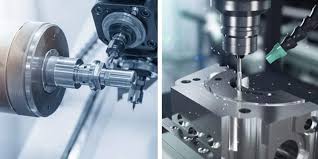
The Fundamental Distinction
CNC milling and CNC turning are the two foundational processes in precision machining, and they are not interchangeable. Each is optimized for a different class of part geometry. Using the wrong process for a given design adds cost, reduces accuracy, and extends lead time without any benefit. Understanding the difference between milling and turning — and the specific conditions that favour each — is one of the most practical pieces of knowledge any design engineer or procurement manager can have.
| Attribute | CNC Milling | CNC Turning (CNC Lathe) |
| Part motion during cutting | Part is stationary; cutting tool rotates and moves | Part rotates; cutting tool is stationary |
| Ideal part geometry | Prismatic: blocks, plates, enclosures, complex contours | Cylindrical / round: shafts, bushings, flanges, fittings |
| Primary axes | X, Y, Z (3-axis minimum; up to 5-axis) | X and Z axes (with C-axis for live tooling) |
| Surface finish achievable | Ra 0.4-1.6 µm standard | Ra 0.2-0.8 µm standard (excellent on OD/ID) |
| Typical tolerance | ±0.025 mm standard | ±0.013 mm on diameter (tighter possible) |
| Best for | Cavities, pockets, complex 3D surfaces, flat parts | Precise diameters, threads, bores, OD/ID features |
Tolerance capabilities per ISO 2768 and Metalworks Plus process capability documentation.
When to Choose CNC Milling
• Choose milling for any part that is fundamentally prismatic in shape: enclosures, brackets, plates, manifolds, tool bodies, and housings. Milling excels at generating flat surfaces, pockets, complex contours, and through-features (slots, holes, cutouts) on a non-round workpiece.
• Complex 3D surface geometry requires milling: freeform surfaces like impeller blades, mold cavities, or aerodynamic profiles are only producible by CNC milling (or 5-axis CNC milling for complex compound angles). A CNC lathe cannot generate these geometries.
• Multi-feature parts on multiple faces require milling: when a component has features on 4-6 faces — holes on top, slots on the side, counterbores on the bottom — milling on a 4 or 5-axis machining center is the correct process. CNC lathe services are limited to rotationally symmetric features.
When to Choose CNC Turning (CNC Lathe Services)
• Choose turning for any part whose dominant geometry is cylindrical: shafts, pins, bushings, spacers, threaded fittings, valve bodies, and nozzles. Turning produces perfectly round features — bores, outer diameters, tapers, threads — with tighter diameter tolerances than milling at significantly lower cycle time and cost.
• Turned parts are faster and cheaper when the geometry fits: a 50mm diameter x 200mm long stainless steel shaft costs 60-70% less to produce on a CNC lathe than on a machining center, because the lathe is optimized for exactly this geometry. Using milling for this part would be an expensive mistake.
• Live tooling lathes bridge the gap: modern CNC lathes with live tooling (rotating tool heads) can mill flats, cross-drill holes, and cut keyways on a turned part without a secondary setup. For parts that are primarily cylindrical but have some prismatic features, a live tooling lathe is frequently the most cost-effective single-setup solution.
The Decision Matrix: Which Process for Your Part?
| Part Feature Profile | Recommended Process | Why | Cost Indicator |
| Shaft, pin, bushing, round fitting | CNC Turning | Cylindrical geometry; fast cycle times | Lowest cost option |
| Block, plate, bracket, housing | CNC Milling (3-axis) | Prismatic geometry; multi-face features | Moderate cost |
| Complex housing with round features | Milling + Turning (two ops) | Mixed geometry requires both processes | Moderate-high cost |
| Cylindrical part with cross-holes / flats | Live tooling lathe | One setup covers all features | Moderate cost |
| Complex 3D contour or compound angle | 5-axis CNC Milling | Only process that can generate geometry | Higher cost; justified by capability |
Hybrid and Multi-Process Strategies
Many precision mechanical components require both milling and turning in sequence. A hydraulic manifold body, for example, is milled to create the block geometry, pocket features, and bolt patterns — then transferred to a lathe for precision bore finishing of the port holes. Understanding which process handles which features, and sequencing them correctly, is the core competency of any capable machine parts manufacturer. Always discuss your full part drawing with your CNC supplier before assuming a single-process approach will be sufficient.
Metalworks Plus – Precision Manufacturing & CNC Machining Expert
Metalworks Plus is a precision manufacturing company specializing in high-quality CNC machining and custom metal fabrication solutions from prototype to full-scale production. Founded in China, the company combines advanced technology with rigorous quality control to serve industries such as aerospace, automotive, medical, electronics, and industrial equipment.
💡 Learn more: https://metalworksplus.com
Services Offered
- Precision CNC Machining (3-axis, 4-axis, 5-axis, and Swiss-type)
- CNC Milling & Turning for complex geometries and tight tolerances
- Micro-Machining and Swiss Machining capabilities
- Electric Discharge Machining (EDM) for intricate features
- CNC Prototyping with rapid turnaround
- Design support and manufacturability feedback
- Material selection and engineering assistance
Products & Precision Components
- High-precision CNC machined parts for critical applications
- Machine parts for automation, construction, and manufacturing industries
- Custom connector pins and machined pins
- Components in a wide range of materials, including metals and engineering plastics
Why Clients Choose Metalworks Plus
- Tight tolerances and certified quality control
- Rapid prototyping to high-volume production scalability
Worldwide delivery and logistics support.
