

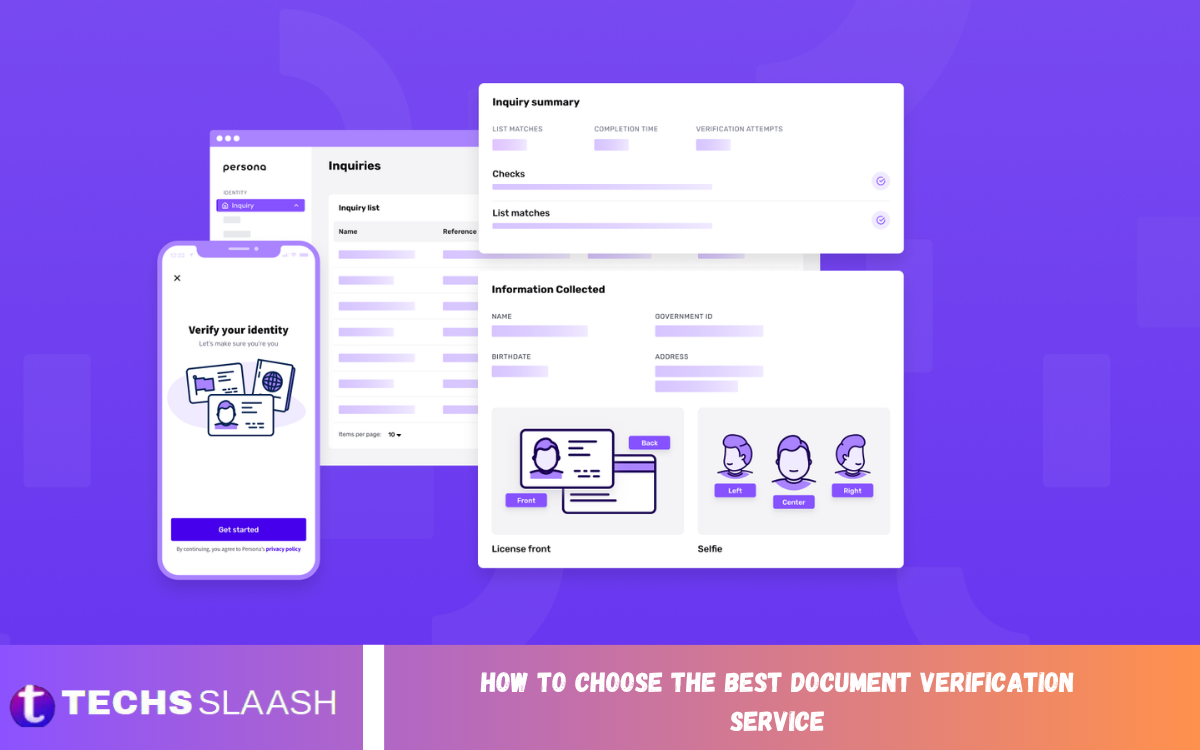
Businesses handle thousands of customer documents every day, making document verification essential to secure onboarding and compliance. Whether you’re operating in finance, healthcare, e-commerce, education, or online marketplaces, choosing the right document verification service helps protect your organization from fraud, identity theft, and regulatory risks.
With numerous providers offering AI-powered verification, optical character recognition (OCR), biometric authentication, and real-time identity checks, selecting the best service can be challenging. Each business has unique requirements based on its industry, customer base, and compliance obligations.
What Is a Document Verification Service?
A document verification service is a digital solution that authenticates government-issued identity documents such as:
- Passports
- Driver’s licenses
- National ID cards
- Residence permits
- Visa documents
- Employee IDs
- Business registration documents
Modern verification platforms use Artificial Intelligence (AI), Machine Learning (ML), Optical Character Recognition (OCR), and biometric technologies to determine whether submitted documents are genuine.
Many providers also compare the document with a live selfie using facial recognition to ensure the person presenting the document is its legitimate owner.
Why Document Verification Matters?
Identity fraud continues to increase every year, costing businesses billions of dollars globally. Fraudsters use stolen identities, forged documents, and synthetic identities to bypass security systems.
An effective document verification solution helps businesses:
- Prevent identity fraud
- Reduce financial losses
- Improve customer trust
- Accelerate onboarding
- Meet regulatory compliance
- Protect sensitive customer information
- Reduce manual verification costs
Organizations that invest in reliable verification systems significantly reduce operational risks while creating better customer experiences.
Understand Your Business Requirements
Before comparing vendors, identify your organization’s needs.
Ask questions such as:
- How many verifications will you perform monthly?
- Which countries do your customers come from?
- Which documents must be verified?
- Do you require biometric verification?
- Do you need age verification?
- Will verification occur on mobile devices?
- What regulations apply to your business?
Your answers will help narrow your options and prevent paying for unnecessary features.
Prioritize Verification Accuracy
Accuracy is one of the most important factors when selecting a provider.
A high-quality solution should detect:
- Forged documents
- Edited images
- Counterfeit IDs
- Expired documents
- Screen captures
- Fake templates
- Identity mismatches
Look for providers with high verification success rates and continuously updated fraud detection models.
Higher accuracy reduces manual reviews and minimizes false approvals.
Evaluate AI and Automation Capabilities
Artificial Intelligence has transformed document verification.
Leading services use AI to:
- Analyze document authenticity
- Detect manipulated images
- Read information using OCR
- Verify security features
- Compare facial biometrics
- Identify suspicious activity
- Reduce human error
Automation speeds up the verification process while improving consistency and reducing operational costs.
Ensure Global Document Support
If your customers are located internationally, choose a provider that supports thousands of document types from multiple countries.
Global coverage should include:
- National identity cards
- Passports
- Driver’s licenses
- Residence permits
- Tax documents
- Immigration documents
A provider with extensive international coverage allows businesses to expand into new markets without changing verification systems.
Look for Strong Security Standards
Customer identity information is highly sensitive.
The best document verification service should include:
- End-to-end encryption
- Secure cloud infrastructure
- Data encryption at rest
- Multi-factor authentication
- Secure APIs
- Regular security audits
- Access control policies
Security certifications such as ISO 27001 and SOC 2 demonstrate that providers follow internationally recognized security practices.
Verify Compliance With Regulations
Compliance is essential in industries handling customer identities.
Choose providers that support:
- Know Your Customer (KYC)
- Anti-Money Laundering (AML)
- GDPR
- CCPA
- eIDAS
- Financial regulatory requirements
Compliance features help businesses avoid legal penalties while building customer confidence.
Read Also: What Is the Main Equipment Used for Coil Winding
Consider User Experience
Security should never create unnecessary friction.
Customers expect verification to be:
- Fast
- Simple
- Mobile-friendly
- Accurate
- Intuitive
An excellent verification process typically takes less than two minutes.
A complicated verification process increases customer abandonment and reduces conversions.
Mobile Compatibility Is Essential
Most users now verify identities using smartphones.
Choose a solution that supports:
- Android devices
- iPhones
- Tablets
- Mobile browsers
- In-app verification
Mobile optimization significantly improves customer completion rates.
Review API Integration Options
Businesses often integrate verification services into existing platforms.
Look for providers offering:
- REST APIs
- SDKs
- Webhooks
- CRM integration
- Banking platform integration
- Payment gateway compatibility
Easy integration reduces implementation time and development costs.
Processing Speed Matters
Customers dislike waiting.
The best providers verify documents within seconds while maintaining high accuracy.
Fast verification benefits:
- Banks
- Online marketplaces
- Cryptocurrency exchanges
- Insurance providers
- Gaming platforms
- Healthcare providers
Speed improves customer satisfaction without sacrificing security.
Scalability for Future Growth
Your business will grow.
Choose a provider capable of handling increasing verification volumes.
Scalable platforms support:
- Higher transaction volumes
- Multiple business locations
- Global customer expansion
- Enterprise-level infrastructure
- Cloud scalability
A scalable solution eliminates the need to migrate providers as your business grows.
Compare Pricing Models
Pricing structures vary widely.
Common pricing options include:
- Pay per verification
- Monthly subscriptions
- Enterprise plans
- Usage-based billing
- Custom pricing
Don’t choose solely based on the lowest price.
Instead, evaluate the value offered through security, automation, fraud prevention, and customer support.
Customer Support Quality
Technical issues can occur at any time.
Reliable providers offer:
- 24/7 support
- Live chat
- Email assistance
- Phone support
- Dedicated account managers
- Technical documentation
Responsive support minimizes downtime and ensures smooth operations.
Analytics and Reporting
Advanced reporting tools help monitor verification performance.
Useful reports include:
- Approval rates
- Rejection reasons
- Fraud attempts
- Verification trends
- Processing times
- Geographic insights
These analytics help businesses optimize onboarding processes and identify emerging fraud patterns.
Customization Options
Every business has different workflows.
Choose a provider that allows customization of:
- Verification steps
- Branding
- User interface
- Risk scoring
- Approval rules
- Notification settings
Customization creates a consistent customer experience while meeting business-specific requirements.
Test Before Making a Final Decision
Most providers offer:
- Free trials
- Sandbox environments
- Product demonstrations
- Pilot programs
Testing allows businesses to evaluate:
- Speed
- Accuracy
- API quality
- User experience
- Integration complexity
A trial helps identify potential issues before full deployment.
Common Mistakes to Avoid
Many businesses choose document verification services without proper evaluation.
Avoid these mistakes:
- Selecting the cheapest provider only
- Ignoring compliance requirements
- Overlooking security certifications
- Choosing limited document coverage
- Failing to test the platform
- Ignoring scalability
- Underestimating customer experience
- Not reviewing customer support quality
Avoiding these mistakes leads to a more secure and efficient verification process.
Industries That Benefit From Document Verification
Document verification is valuable across many sectors, including:
- Banking
- Fintech
- Cryptocurrency
- Healthcare
- Insurance
- Online marketplaces
- Education
- Human resources
- Travel and hospitality
- Telecommunications
- Gaming
- Government services
Each industry relies on accurate identity verification to reduce fraud and meet compliance requirements.
Future Trends in Document Verification
Technology continues to improve identity verification.
Emerging trends include:
- AI-powered fraud detection
- Passive liveness detection
- Deepfake identification
- Blockchain-based identity verification
- Digital identity wallets
- Continuous identity authentication
- Behavioral biometrics
- Automated compliance monitoring
Businesses adopting these innovations will strengthen security while delivering better customer experiences.
Frequently Asked Questions
How does AI improve document verification?
AI detects forged or altered documents, automates data extraction, compares facial biometrics, and continuously improves fraud detection accuracy.
What is OCR in document verification?
Optical Character Recognition (OCR) extracts text and data from identity documents, reducing manual entry and improving processing speed.
Can document verification services support international customers?
Yes. Leading providers verify thousands of document types from multiple countries, making them suitable for global businesses.
How long does document verification take?
Most modern platforms complete verification within a few seconds to two minutes, depending on the complexity of the checks.
Are document verification services compliant with KYC and AML regulations?
Reputable providers are designed to support KYC, AML, GDPR, CCPA, and other regulatory requirements, helping businesses remain compliant.
How do I choose the best document verification service?
Evaluate accuracy, security, compliance, global coverage, integration options, pricing, customer support, scalability, user experience, and reporting features before making your decision.
Conclusion
Choosing the right identity verification solution is a strategic decision that affects security, compliance, customer experience, and business growth. Understanding how to choose the Best Document Verification Service enables organizations to invest in a platform that balances speed, accuracy, and regulatory compliance while protecting against evolving fraud threats.
