

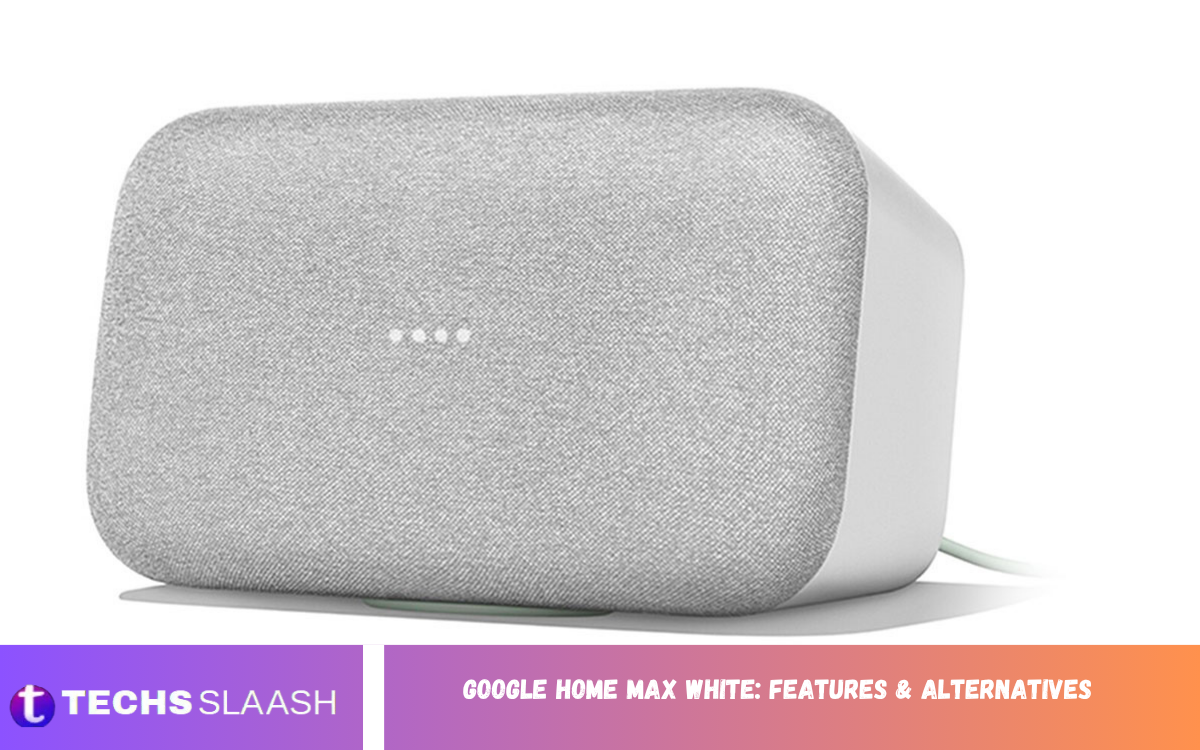
Google Home Max White, officially listed by Google in its Chalk color, was designed as a premium smart speaker for users who wanted powerful sound alongside Google Assistant features. Its large body, fabric finish, and high-performance speaker system made it substantially bigger and more powerful than Google’s smaller smart speakers. Google lists the Home Max in Chalk and Charcoal.
The speaker was created for larger rooms where compact smart speakers might struggle to deliver strong audio. It supports Google Cast, multi-room audio, wireless stereo pairing, Wi-Fi, Bluetooth, and hands-free voice recognition, making it more than a conventional wireless speaker. However, Google now states that the Home Max is no longer for sale.
Google Home Max White Design
The Google Home Max White has a large rectangular design covered with acoustically transparent fabric, giving it a clean and modern appearance. The rigid polycarbonate housing and silicone base provide stability, while the Chalk finish gives the speaker a bright, neutral look that can fit easily into many home interiors.
Its size is one of the most noticeable differences compared with smaller Google speakers. The Home Max measures 13.2 inches wide, 7.4 inches high, and 6 inches deep, while its weight is approximately 11.68 pounds, making it a substantial desktop, shelf, or entertainment-room speaker.
Google Home Max White Sound Quality
Sound performance is the biggest reason the Google Home Max became popular among people looking for a Google-powered speaker with serious audio capability. It contains two 4.5-inch high-excursion dual voice-coil woofers and two 0.7-inch custom tweeters inside a sealed rigid housing.
This hardware allows the speaker to deliver powerful bass, clear vocals, and detailed higher frequencies across a large listening area. It also supports formats including MP3, WAV, Opus, and FLAC, with high-resolution FLAC streams supported up to 24-bit/96 kHz.
Smart Features and Google Assistant
Google Home Max White was built around hands-free voice control, allowing users to interact with Google Assistant by using commands such as “Hey Google.” Its six far-field microphones were designed to recognize voice commands from across a room, even when the speaker was playing music.
The smart speaker could answer questions, control compatible smart-home products, manage everyday tasks, and provide information through voice commands. Google also documents the Home Max as supporting Google Cast, allowing compatible entertainment services and devices to work within the Google ecosystem.
Connectivity Options
Google Home Max White offers several connectivity choices, making it flexible for different entertainment setups. It supports Wi-Fi on both 2.4 GHz and 5 GHz networks, Bluetooth 4.2, Google Cast, and multi-room audio functionality.
One particularly useful feature is its physical connectivity. Google lists both a USB-C port and a 3.5 mm jack with analog audio input, which can be useful when connecting compatible wired audio equipment. This gives the Home Max an advantage over some newer compact smart speakers that focus almost entirely on wireless connections.
Room-Filling Audio Performance
The Google Home Max White was engineered for people who wanted more volume and stronger sound than a small smart speaker could provide. Its dual woofer and dual tweeter configuration gives it considerably more physical speaker hardware than compact Google Home models.
The large enclosure is also important because speaker size can influence how much air the system can move. For living rooms, open spaces, offices, and entertainment areas, the Home Max can provide a much more substantial audio presentation than Google’s smaller legacy speakers.
Multi-Room and Stereo Pairing
Another important feature is multi-room audio. Google lists the Home Max as compatible with multi-room audio, allowing users to create a broader listening setup with compatible Google Cast speakers throughout a home.
The Home Max also supports wireless stereo pairing. Two compatible units can be configured as a stereo pair, creating separate left and right channels for a wider listening experience. For music-focused users, this can provide a more immersive setup than using a single speaker.
Google Home Max White Controls
Although voice control is a major part of the Home Max experience, the speaker also includes capacitive touch controls. Users can interact with the device without always needing to speak a command, providing a convenient way to adjust playback or volume.
The device also includes a physical microphone switch. Google explains that when the microphone is turned off, the assistant cannot detect “Hey Google” or respond to voice commands. The status lights provide additional information about listening, responding, setup, updates, and microphone status.
Google Home Max White Advantages
One of the strongest advantages of the Google Home Max White is its audio hardware. The two large woofers and two tweeters make it considerably more capable for high-volume listening than many compact smart speakers, while its Google Assistant integration adds useful smart-home functionality.
Its connectivity is another advantage. Wi-Fi, Bluetooth, Google Cast, multi-room support, stereo pairing, USB-C, and a 3.5 mm audio input give the Home Max several ways to fit into an existing entertainment setup. This combination remains attractive for users who find a used unit at a reasonable price.
Google Home Max White Disadvantages
The biggest disadvantage in 2026 is availability. Google officially states that the Google Home Max is no longer for sale, meaning new units are not part of the company’s current speaker lineup. Buyers considering one will therefore generally be looking at previously owned or remaining old stock rather than a current Google product.
Its size and weight can also be inconvenient. At 11.68 pounds, the Home Max is not designed for frequent movement around the house, and its large footprint requires more shelf or desk space than products such as Nest Audio or the newer Google Home Speaker.
Read Also: Blackboard DCCCD Account Guide 2026
Best Google Home Max White Alternatives
The Google Nest Audio is one of the most obvious alternatives for users who want to stay within Google’s smart-speaker ecosystem. Google lists a 75 mm woofer, 19 mm tweeter, three far-field microphones, Google Assistant, Wi-Fi, Bluetooth, Google Cast, and stereo-pairing capabilities for Nest Audio.
The newer Google Home Speaker is another option for people who want a current Google smart speaker. Google currently lists it with a 58 mm full-range driver, three far-field microphones, Gemini for Home, Wi-Fi 6, Bluetooth 5.4, Matter support, and Thread connectivity.
Google Nest Audio vs Google Home Max White
Nest Audio is smaller and easier to place around the home, making it a practical choice for bedrooms, offices, kitchens, and medium-sized rooms. Its 75 mm woofer and 19 mm tweeter provide a balanced speaker design while keeping the overall device much smaller than the Home Max.
The Home Max remains more attractive when maximum speaker hardware and physical audio output are the priority. Its dual 4.5-inch woofers and dual 0.7-inch tweeters give it a fundamentally larger acoustic platform, although buyers must also consider its discontinued status and used-market condition.
Google Home Speaker vs Google Home Max White
The newer Google Home Speaker represents Google’s current direction for smart speakers. It includes Gemini for Home, Matter compatibility, Thread connectivity, Wi-Fi 6, Bluetooth 5.4, and a compact 58 mm full-range driver, making it more focused on modern smart-home functionality and everyday voice assistance.
The Home Max, in contrast, remains more focused on large-scale audio performance. Therefore, the better choice depends on the buyer’s priorities: the Home Speaker is more appealing for current smart-home technology, while a properly functioning Home Max can still appeal to someone who prioritizes larger, more powerful audio.
Is Google Home Max White Still Worth Buying?
A used Google Home Max White can still make sense for an audio-focused buyer who finds one in excellent condition at an attractive price. Its strong speaker configuration, wired audio input, Google Cast support, and stereo capabilities remain useful despite the product’s age.
However, buying discontinued hardware requires more caution than purchasing a current speaker. Buyers should check the physical condition, microphones, Wi-Fi connectivity, touch controls, power cable, audio input, and ability to complete setup before committing to a used unit.
What to Check Before Buying a Used Home Max
Before purchasing a second-hand Google Home Max White, inspect the fabric and housing for damage, check that the speaker powers on normally, and confirm that the microphones respond correctly. It is also sensible to test Wi-Fi, Bluetooth, Google Assistant, Cast functionality, and the 3.5 mm audio input.
Potential buyers should also verify that the speaker can be factory-reset and added to the Google Home environment. Because the Home Max is no longer sold by Google, purchasing from a reputable seller with a reasonable return policy can reduce the risk associated with older hardware.
Google Home Max White for Music Lovers
For music listeners, the Home Max remains an interesting product because it combines smart-speaker functionality with a much larger acoustic system. Its dual-woofer, single-tweeter arrangement provides the physical hardware necessary for powerful playback, while support for high-resolution FLAC adds appeal for users with quality-focused music libraries.
Its 3.5 mm analog input is also useful for people who want to connect another audio source. Combined with wireless connectivity and Google Cast, this flexibility makes the Home Max more versatile than a simple voice-controlled speaker.
Google Home Max White for Smart Homes
The Home Max can also serve as part of a Google-based smart-home environment. Voice commands can be used for supported smart-home controls, while the Google Home ecosystem provides a centralized way to manage compatible connected products.
For people building a new smart home today, however, newer Google products may offer a more future-oriented platform. Google’s current Home Speaker includes Matter and Thread support, technologies that are particularly relevant to modern smart-home setups.
Frequently Asked Questions
Is Google Home Max White still available?
Google Home Max is no longer sold by Google. The company identifies the product as no longer for sale, so buyers looking for a Home Max White generally need to consider used or remaining old-stock units.
What color is Google Home Max White officially called?
Google officially lists the light version of the Home Max as Chalk, while the darker version is called Charcoal. The Chalk model is commonly described as the white Google Home Max.
Does Google Home Max have good sound quality?
Yes. The Home Max was designed as a large, high-performance smart speaker and includes two 4.5-inch woofers and two 0.7-inch tweeters. Its hardware is considerably larger than that of compact Google smart speakers.
Can Google Home Max be used as a stereo pair?
Yes. Google lists wireless stereo pairing as one of the Home Max’s features. Two compatible Home Max speakers can therefore be configured for stereo playback.
Does Google Home Max support Bluetooth?
Yes. Google Home Max supports Bluetooth 4.2 and includes several Bluetooth profiles for audio and device communication.
Does Google Home Max have an AUX input?
Yes. Google lists a 3.5 mm jack with analog audio input. This allows compatible wired audio sources to be connected directly to the speaker.
Does Google Home Max support Wi-Fi?
Yes. The Home Max supports 802.11b/g/n/ac Wi-Fi on both 2.4 GHz and 5 GHz networks, allowing it to connect to compatible home networks for streaming and smart features.
What is the best alternative to Google Home Max White?
Google Nest Audio is a strong alternative for users who want a smaller Google smart speaker, while the current Google Home Speaker is better suited to people seeking Google’s latest smart-home and assistant features.
Is Google Nest Audio better than Google Home Max?
They serve different purposes. Nest Audio is smaller and easier to place, while Home Max has a substantially larger speaker system with two 4.5-inch woofers and two tweeters, making the Max more suitable for users who prioritize larger-scale audio.
Should I buy a used Google Home Max White?
It can be worthwhile if you find a well-maintained unit at a sensible price and your main priority is powerful Google-connected audio. Because Google no longer sells the Home Max, carefully testing a used unit before purchase is especially important.
Conclusion
The Google Home Max White: Features & Alternatives story is ultimately about a premium smart speaker that still has impressive hardware despite being discontinued. Its Chalk finish, large enclosure, dual woofers, dual tweeters, Google Assistant, Google Cast, stereo pairing, multi-room audio, Bluetooth, Wi-Fi, and wired audio input make it an unusually capable device.
For buyers who already own one, the Home Max can remain a powerful part of a Google-based audio system.
