

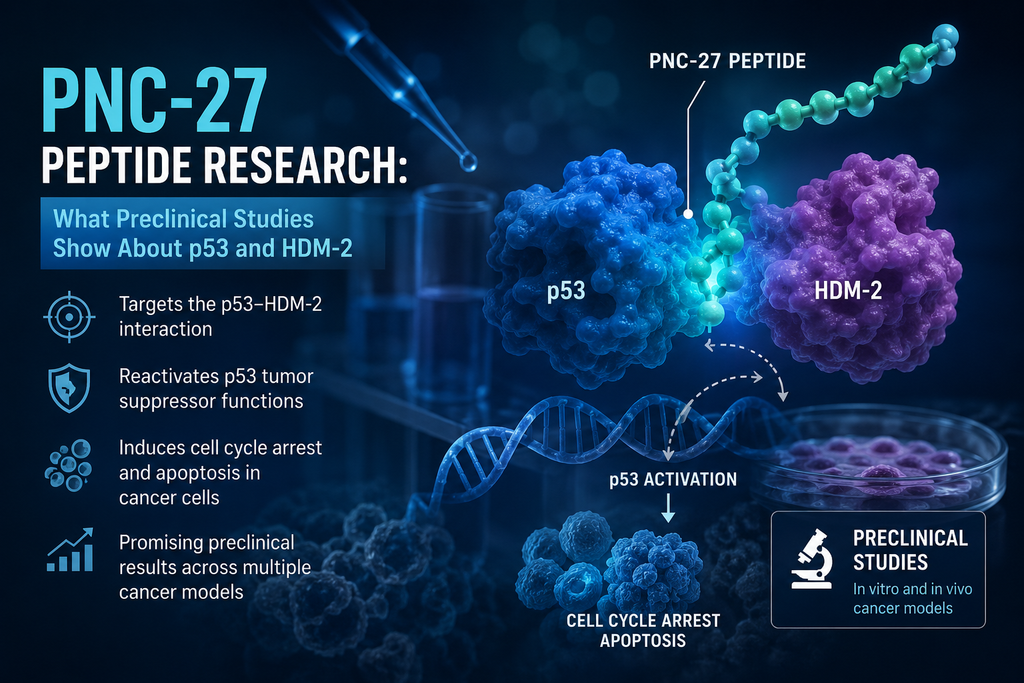
Modern molecular research increasingly investigates engineered peptides designed to interact with specific protein interfaces and cellular membranes. Rather than relying solely on traditional small molecules, biochemists explore synthetic peptide structures that target precise protein-protein interactions within malignant cells. Among these experimental constructs, interest in the PNC-27 peptide centers on its unusual design and its reported interaction with HDM-2 across various cancer-cell models.
What Is PNC-27 Peptide?
PNC-27 is a 32-residue chimeric peptide developed to target specific cellular mechanisms associated with oncogenesis. Its primary structure consists of two distinct functional regions: an amino-terminal domain derived from the human p53 tumor-suppressor protein (residues 12–26) linked to a carboxyl-terminal cell-penetrating leader sequence.
Biologically, p53 acts as a crucial tumor suppressor, regulating cell-cycle arrest in response to cellular stress. Its negative regulator, HDM-2 (the human homolog of MDM2), binds to p53 to promote its degradation. In many transformed cells, overexpressed HDM-2 suppresses normal p53 function, facilitating unregulated proliferation. What is the PNC-27 peptide intended to model here? Initially, researchers designed this sequence to competitively bind HDM-2, attempting to restore native p53 signaling pathways.
What Makes the Proposed PNC-27 Mechanism Unusual?
As laboratory investigation progressed, researchers observed that the biological activity of PNC-27 differed significantly from traditional p53/HDM-2 binding inhibitors. Rather than acting exclusively as an intracellular signaling modulator, published experimental studies reported that the peptide interacts directly with cellular membranes in transformed cells.
In tested cancer-cell models, investigators reported that HDM-2 is expressed not only in the nucleus and cytoplasm, but also within the plasma membrane of certain malignant cell lines. According to the proposed mechanism, the p53-derived domain of PNC-27 binds to membrane-associated HDM-2, while the membrane-active leader region is proposed to participate in assembly of transmembrane pores. This interaction is reported to induce rapid cell lysis and necrosis in specific experimental models. Importantly, these findings reflect observations in cell culture and animal models rather than demonstrated clinical outcomes in human patients.
What Preclinical Research Actually Shows
Literature searches addressing PNC-27 peptide benefits frequently surface discussions regarding experimental cancer models. Published studies have evaluated the construct across a variety of preclinical systems, including solid-tumor cell lines such as breast, prostate, and pancreatic cancer models, as well as hematologic systems including acute myeloid leukemia (AML) cell cultures.
However, interpreting search queries related to PNC-27 benefits or PNC-27 clinical trials requires strict scientific qualification. The peer-reviewed efficacy evidence remains predominantly preclinical:
- In Vitro Observations: Experimental assays demonstrate membrane disruption and cytotoxicity in selected transformed cell lines under controlled laboratory conditions.
- In Vivo Animal Models: Small-scale animal studies have examined tumor growth inhibition in xenograft models, though results remain preliminary.
The available literature does not establish clinical safety or efficacy for PNC-27 in human cancer treatment.
Why “Selective” Requires Careful Interpretation
A central focus of preclinical literature involves evaluating whether PNC-27 exhibits selective toxicity toward transformed cells compared to non-transformed control cells. Some experimental studies reported limited cytotoxicity in selected non-transformed comparator cells under specific assay conditions, attributing this difference to lower levels of membrane-bound HDM-2 in normal tissue.
However, scientific selectivity in a laboratory dish must be interpreted cautiously. Target expression, membrane composition, peptide concentration, assay duration, and model choice vary significantly across experimental setups. Consequently, laboratory observations of selectivity cannot be generalized into broad claims that a compound is universally non-toxic to healthy human cells.
Why Molecular Identity and Purity Matter in PNC-27 Research
Because PNC-27 is a 32-amino-acid chimeric construct with specific structural requirements, experimental outcomes depend heavily on compound integrity. Sequence errors, degradation products, or poorly characterized material can introduce variables that complicate interpretation of molecular and cellular experiments.
For laboratory investigation, researchers rely on analytical tools to verify material quality. Techniques such as High-Performance Liquid Chromatography (HPLC) and Mass Spectrometry (MS) allow scientists to assess purity, characterize impurities, and confirm important aspects of molecular identity before initiating biological assays. Sourcing a properly characterized PNC-27 research peptide can help support experimental consistency across molecular and cellular studies.
Research Materials From Generic Peptides
Evaluating complex membrane interactions requires analytical precision and reproducible materials. Laboratory suppliers such as Generic Peptides provide research-grade compounds intended exclusively for laboratory and analytical applications. By prioritizing compound transparency, analytical characterization, and batch consistency, standardized materials support rigorous investigation across preclinical oncology and cellular biology. As researchers continue examining the structural mechanisms governing p53-derived sequences, strict adherence to analytical standards remains essential for advancing understanding of p53/HDM-2 interactions.
