


A bright orange ball rolls across a wide image, touches a blue block, and knocks over a row of small shapes. The action is easy to follow until the clip is cropped into a tall frame. Now the ball arrives from nowhere, the block sits outside the picture, and only the falling shapes remain visible.
The vertical version contains movement, but it has lost the cause of that movement. This is the difference between changing a file’s proportions and redesigning a scene for another frame.
For creators using AI video across a website, a presentation, and a phone-sized post, the useful question comes early: can the same arrangement work in each shape, or does the action need to be staged differently?
Keep the relationship, not every inch of the picture
In the fictional ball-and-block scene, three things matter: the ball approaches, it touches the block, and the row falls. The empty floor at either side is expendable. The contact between the ball and the block is not.
Write down that relationship before choosing which part of the image to retain. A crop centred on the largest object may still remove the smaller object that explains the scene. Following the most colourful element is not necessarily the same as preserving the story.
When building the scene with Seedance 2.5 on XMK, use the available aspect-ratio controls alongside a description of where the action takes place. Choosing a format does not, by itself, tell the generator which relationship must remain visible. The prompt still needs to describe the approach, contact, and result.
Sometimes the answer is to keep the wide clip and accept borders in the final layout. Sometimes a separate vertical composition is more useful. There is no need to make every frame fill every screen if doing so removes important information.
Turn a sideways journey into a route through the frame
A wide arrangement naturally gives the ball room to travel from left to right. In a tall version, the same journey could run from the lower foreground toward a block farther back. The row of shapes continues behind it, so the sequence unfolds into the depth of the picture.
This is a proposed restaging, not an automatic crop operation. It changes the viewpoint and placement while preserving the underlying event. A diagonal arrangement is another option, provided the contact and falling row stay readable.
For a simpler visual, a floating shape could rise rather than move sideways. But avoid changing direction merely to fill the frame when direction carries meaning. A process diagram, a real demonstration, or a sequence with an established reading order needs its relationships preserved, not casually rearranged.
A short planning note can distinguish what stays from what changes:
- Keep: the ball, the block, and the cause-and-effect sequence.
- Reconsider: the camera position, spacing, and route across the image.
- Remove if unnecessary: decorative objects that compete with the contact point.
The note is for the creator. It does not imply that the generator offers a built-in restaging tool or that a second output will exactly reproduce the first.
A reference image should suit the new composition
If an original wide sketch places the ball at one edge and the block at the other, it may be an awkward reference for a tall scene. Before uploading, draw a separate vertical layout that brings the important elements into the intended view.
The drawing can be basic. Use coloured circles and rectangles to indicate placement, then add a plain-language description of the action. Keep private production notes and unrelated screenshots out of the reference.
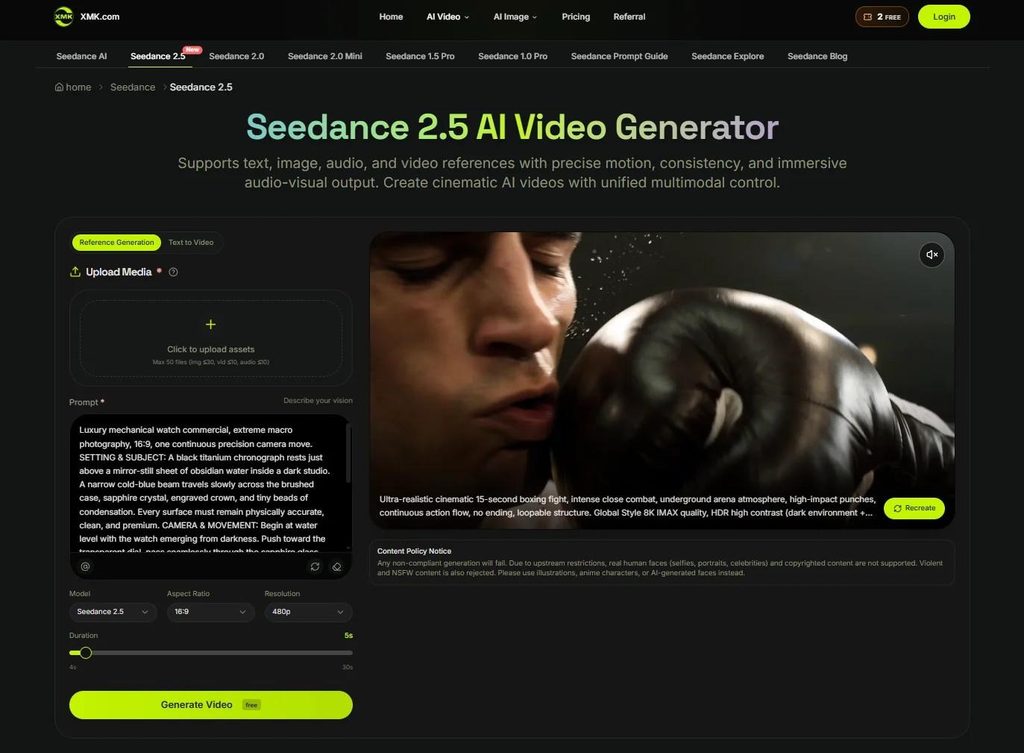
XMK states that real human faces and copyrighted content are not supported in this workflow, while violent and NSFW content is rejected. Rights clearance and platform eligibility are separate checks; having permission for a reference does not override the platform’s restrictions.
For this fictional exercise, simple original geometric material avoids the need to bring a real person or recognisable third-party design into the scene. Confirm that the actual upload is eligible before generating.
Leave space for the words the viewer actually needs
A tall composition may retain the whole action yet leave nowhere comfortable for a headline or captions. If the text covers the point where the ball touches the block, the scene becomes confusing again.
Reserve a quiet area while designing the shot, then add exact wording in an editor. Do not assume a blank corner stays blank throughout the clip. The moving subject, a shadow, or a changing camera view may enter it later.
A revised layout can also guide the Seedance reference workflow: show where the important objects belong and describe which area should remain visually quiet. Treat the reference as guidance, then check the result. It is not a guarantee of a fixed text-safe region.
Preview the final edit in the destination’s actual layout. Playback controls, captions, and other interface elements vary, so a universal margin is not a substitute for seeing what covers the video. If speech carries information, review synchronized captions rather than relying on automatic transcription alone.
Watch the edges while the action moves
A still preview can conceal a framing problem. The first image may look balanced even though the ball leaves the view halfway through its approach. Watch the entire sequence and pay particular attention to entrances, contact points, and the last object in the falling row.
Ask whether someone seeing only this version can understand what caused the result. If the answer depends on remembering the wide clip, the adaptation has not done its job. Either reposition the action, use a wider view inside the vertical layout, or generate another composition.
For a real product or physical process, generated contact is not evidence that the mechanism works. Use accurate footage for that purpose. The geometric scene here is an illustrative composition exercise.
A good vertical version does not need to preserve every object in the wide image. It needs to preserve what makes the action understandable. Keep the cause, the response, and enough room to see both; let the frame change around that.
