

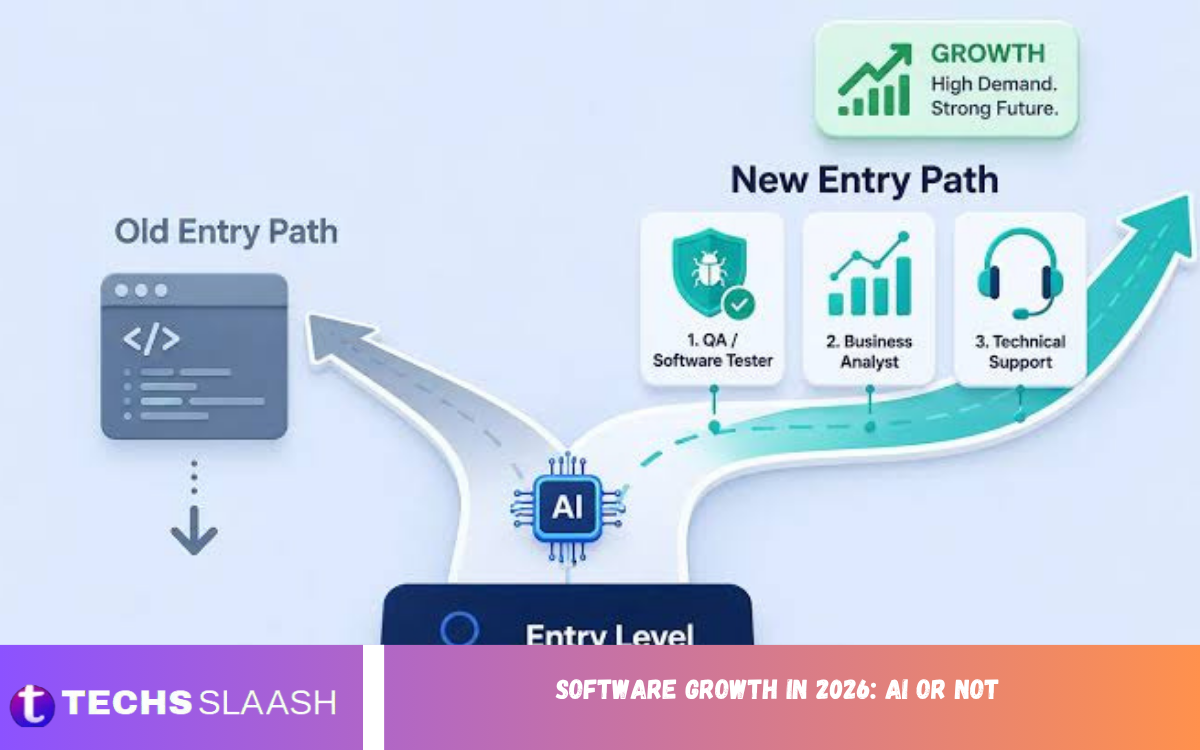
Software growth in 2026 is being shaped by a major question: is artificial intelligence the primary driver of the industry’s expansion, or can software continue to grow without relying heavily on AI? The answer is more balanced than either extreme. Traditional software remains essential, while AI is rapidly becoming an important layer across development, operations, security, analytics, and customer experiences.
Current industry research shows strong momentum. Gartner forecasts worldwide AI spending of about $2.52 trillion in 2026, while ISG reports that software demand remains resilient and has raised its 2026 software-industry growth forecast to 25%. This suggests that AI is contributing significantly to software growth, but the broader software economy is much larger than AI alone.
Why Is Software Growth Accelerating in 2026?
Software has become a fundamental part of nearly every modern business. Companies increasingly depend on cloud platforms, cybersecurity applications, business intelligence, workflow automation, mobile applications, enterprise systems, and digital customer experiences to compete effectively.
AI is adding another layer of growth by enabling software to handle tasks that previously required significant human effort. At the same time, conventional software development continues to expand because organizations still need reliable databases, APIs, operating platforms, accounting systems, communication tools, security products, and industry-specific applications.
The Growing Role of Artificial Intelligence
AI is undoubtedly one of the strongest forces behind Software Growth in 2026: AI or Not. Developers can use AI systems to generate code, explain unfamiliar codebases, create tests, identify potential errors, and accelerate repetitive development tasks. This can reduce the time required to move from an idea to a working product.
However, AI does not remove the need for professional software engineering. Research from Gartner indicates that only 35% of software engineering leaders reported significant ROI from AI within the software development life cycle in 2026, highlighting the difference between adopting AI and actually creating business value from it.
AI-Powered Software Development
Software development is moving beyond basic autocomplete tools toward agent-based workflows. Modern AI coding systems can assist with multiple files, testing, debugging, documentation, and other parts of the development process, allowing developers to focus more heavily on architecture, requirements, validation, and complex decisions.
This shift can increase development capacity without necessarily reducing the importance of engineers. Morgan Stanley research expects software spending to increase in 2026 and argues that AI can help developers move toward more strategic responsibilities as applications become more complex.
Traditional Software Is Still Growing
Despite the rapid expansion of AI, traditional software is not disappearing. Businesses still require applications that perform clearly defined functions without artificial intelligence, particularly where predictability, reliability, compliance, and straightforward workflows are more valuable than intelligent automation.
For example, payroll systems, inventory platforms, project management tools, accounting applications, databases, content management systems, and enterprise resource planning software can deliver substantial value without making AI the central feature. In many cases, adding AI unnecessarily can increase costs and complexity rather than improve the product.
Cloud Computing and SaaS Growth
Cloud computing remains another major contributor to software expansion in 2026. Software-as-a-Service platforms allow organizations to access applications through the internet without maintaining large amounts of on-premises infrastructure, making digital tools more accessible to businesses of different sizes.
AI is increasingly being incorporated into SaaS products, but cloud software can succeed without advanced AI. Collaboration platforms, accounting software, customer relationship management systems, and productivity applications continue to generate value through connectivity, automation, integrations, and centralized data management.
AI Agents Are Changing Software
One of the most important developments in 2026 is the growth of AI agents. Instead of simply responding to individual prompts, agents can perform sequences of tasks, interact with software systems, analyze information, and work toward defined objectives under human supervision.
IDC describes a broader shift toward developers working with autonomous agents while also designing and governing those agents. This means software professionals are increasingly becoming orchestrators of intelligent systems rather than focusing exclusively on manually writing every component of an application.
Human Developers Still Matter
The rapid growth of AI does not eliminate the importance of human developers. Software requires judgment about business requirements, security, user experience, architecture, performance, ethics, compliance, and long-term maintenance. AI can produce an answer, but professionals must determine whether that answer is appropriate.
There is also a growing need for people who can review AI-generated code and identify weaknesses. As AI increases the volume of generated software, testing, security reviews, code quality, and governance become increasingly important. The future, therefore, looks more like human-AI collaboration than a complete replacement.
Software Quality Becomes More Important
Faster code generation can create a surprising challenge: producing software is becoming easier, but producing high-quality software remains difficult. AI can generate a large amount of code quickly, yet that code still needs to be tested, secured, integrated, documented, and maintained.
This creates new opportunities for software testing, observability, application security, quality assurance, and developer tooling. Growth will therefore not come only from applications that use AI. It will also come from products that help organizations safely manage the increasing amount of software being created.
The Importance of Cybersecurity
Cybersecurity is becoming increasingly important as software systems become more interconnected and AI becomes integrated into applications. Organizations need stronger identity management, access controls, vulnerability detection, data protection, monitoring, and secure development practices.
AI can support security teams by identifying suspicious patterns and helping analyze large quantities of information. Nevertheless, cybersecurity cannot depend entirely on automated decisions. Human oversight remains important because attackers constantly adapt, and security incidents can involve business, legal, and operational consequences.
Software Growth Without AI
The phrase “Software Growth in 2026: AI or Not” should not be interpreted as a choice where one technology must replace the other. Software can continue growing without AI when it solves a real problem effectively. A simple application with excellent usability can outperform a complicated AI product if customers find it more reliable and valuable.
Businesses should therefore begin with the problem rather than the technology. If AI improves accuracy, speed, personalization, or automation, it can be an excellent addition. If it provides little practical benefit, traditional software may remain the better solution.
Read Also: How to Create Human Content in an AI-Heavy Feed
AI-Native Products Are Creating New Markets
At the same time, AI is enabling software categories that were previously difficult or impossible to build. Intelligent assistants, automated research tools, AI-powered customer service, natural-language interfaces, intelligent analytics, and autonomous workflow systems are opening new opportunities.
The AI software market itself is expanding rapidly. Grand View Research estimates that the global AI-in-software-development market could grow from approximately $1.3 billion in 2026 to more than $15.7 billion by 2033. These figures demonstrate how AI is becoming a meaningful software category rather than simply a feature added to existing products.
The Economics of AI Software
AI can lower certain development costs, but it also introduces new expenses. Businesses may need to pay for model usage, data processing, infrastructure, security controls, monitoring, and specialized engineering talent. Therefore, lower coding costs do not automatically mean lower total software costs.
Successful companies will focus on measurable outcomes rather than AI adoption alone. The key questions should include whether AI increases revenue, reduces operating costs, improves customer satisfaction, speeds delivery, or creates capabilities that competitors cannot easily reproduce.
Developers Need New Skills
Software professionals in 2026 need broader skills than traditional programming alone. Understanding AI-assisted development, prompt design, system architecture, testing, security, data management, and AI governance can provide significant advantages.
However, fundamental programming knowledge remains valuable. Developers who understand algorithms, databases, APIs, networking, software architecture, and debugging are better positioned to evaluate AI-generated solutions and correct problems when automated systems make mistakes.
The Future of Software Business Models
AI is also changing how software products may be priced and delivered. Traditional subscription models remain common, but companies are experimenting with usage-based pricing, outcome-based pricing, hybrid subscriptions, and AI-consumption models.
This shift creates both opportunities and challenges. A software product that completes valuable work automatically may be able to charge based on usage or business outcomes rather than simply the number of users. However, companies must carefully manage unpredictable AI infrastructure costs to protect margins.
What Businesses Should Expect in 2026?
Businesses should expect software development to become faster, more automated, and increasingly connected to AI. Teams will likely spend less time on repetitive coding and more time defining requirements, reviewing outputs, managing architecture, testing systems, and improving customer experiences.
Organizations should also avoid adopting AI simply because competitors are doing so. A focused implementation that solves a measurable problem is usually more valuable than an AI-first strategy with no clear business objective. The strongest approach is to combine proven software practices with AI where AI genuinely improves results.
Is AI Necessary for Software Growth?
AI is not technically necessary for software growth, but it is becoming increasingly difficult to ignore. Companies can still build successful non-AI products, particularly when their value comes from reliability, workflow management, specialized functionality, or strong user experience.
Nevertheless, AI is changing customer expectations and the economics of development. As intelligent features become more common, software companies that completely ignore AI may eventually face competitive pressure. The sensible approach is not to make every product AI-first, but to understand where AI can create defensible value.
The Balanced Future of Software
The future of software will probably not be entirely AI-driven or entirely traditional. Instead, the two approaches will increasingly work together. Traditional software will provide the underlying systems, while AI will add intelligence, automation, prediction, personalization, and natural-language interaction.
This hybrid model offers businesses flexibility. Companies can preserve reliable software foundations while introducing AI gradually in areas where it provides measurable benefits. That approach can reduce unnecessary risk while allowing organizations to participate in the next phase of software innovation.
Frequently Asked Questions
Is AI driving Software Growth in 2026?
AI is one of the strongest drivers of software growth in 2026, particularly in development tools, automation, analytics, cybersecurity, and intelligent applications. However, traditional software and cloud services remain important contributors to overall industry growth.
Can software companies grow without AI?
Yes. Software companies can grow without AI by solving valuable problems through reliable applications, robust workflows, integrations, cloud services, security, or specialized functionality.
Will AI replace software developers?
AI is more likely to change software development roles than completely eliminate developers. Developers increasingly need to review AI output, manage architecture, define requirements, test applications, and make complex technical decisions.
Why is AI important for software development?
AI can accelerate coding, testing, debugging, documentation, research, and other repetitive activities. This can help teams spend more time on high-value engineering and product decisions.
Is traditional software still relevant in 2026?
Yes. Traditional software remains essential for many business processes where reliability, predictability, compliance, and specialized functionality are more important than intelligent automation.
What are AI agents in software development?
AI agents are systems designed to perform multi-step tasks with a degree of autonomy. In software development, they can assist with coding, testing, debugging, documentation, and other engineering activities under appropriate human oversight.
Will AI make software cheaper?
AI can reduce the time needed for some development activities, but overall costs depend on infrastructure, model usage, testing, security, maintenance, and human oversight. Faster coding does not automatically mean cheaper software.
What skills will developers need in 2026?
Developers benefit from strong programming fundamentals combined with skills in AI-assisted development, architecture, cybersecurity, testing, data management, and system design.
Should every software product include AI?
No. AI should be included when it provides a meaningful benefit to users or the business. Adding AI without a clear purpose can increase complexity, costs, and security risks.
What is the future of software growth?
Software growth is likely to come from a combination of AI, cloud computing, cybersecurity, automation, specialized applications, developer tools, and traditional enterprise software. Human expertise will remain central to building and governing these systems.
Conclusion
Software Growth in 2026: AI or Not is ultimately not an either-or question. AI is accelerating development, creating new software categories, improving automation, and changing how developers work, while traditional software continues to provide the dependable foundations businesses need.
The most successful software companies will focus on solving genuine customer problems rather than following technology trends blindly.

1 Comment
Pingback: Safe 3D Printing at Home - Techsslaash.com