

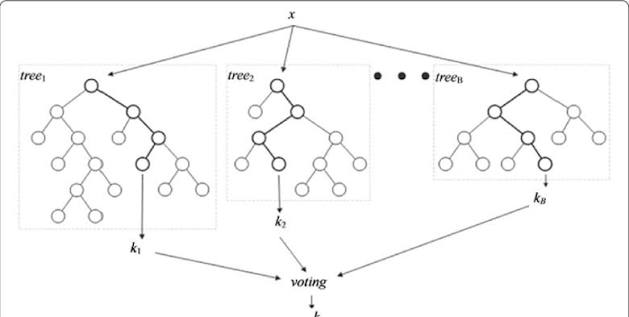
Decision trees are popular since they are easy to understand and are capable of dealing with complex, non-linear relationships. However, a single decision tree can be unstable because even slight changes to the training data may result in a completely different tree and different predictions. Random Forests are used to overcome this issue by training a large number of decision trees on different sections of the dataset and then combining the results to obtain a more reliable outcome. For students taking a data scientist course in pune, Random Forests represent a key aspect since they illustrate how combining models can improve accuracy and reduce overfitting.
What a Random Forest Actually Does
At a high level, Random Forests use two kinds of randomness to build a stronger model:
- In the case of bootstrap sampling (also known as bagging): each tree is trained using a random sample of the training data, with the samples being drawn with replacement. As a result, each tree works with a slightly different dataset, some rows appearing more than once and others being omitted.
- When carrying out feature selection at each split in a tree, the algorithm looks only at a random subset of the features rather than at all the features available. This stops all the trees from repeatedly choosing the same strong predictors at the top and thus helps to ensure that the trees are diverse.
When the trees have all been trained, the forest combines their predictions. In the case of classification, the final result is generally the class that is selected by a majority vote; in regression, it is the average of the predictions of the trees. This combination stage is simple yet effective in that the trees, since they make different kinds of errors, have their errors averaged in such a way that the overall performance is usually better than that of a single tree.
Why Random Forests Generalise Well
Random Forests have a good performance as a starting point on a wide variety of datasets since they decrease variance without increasing bias by a large amount. A single decision tree is capable of fitting in noise and thus produces rules that are too confident. The forest becomes less sensitive to the particular features of the data because it trains a number of trees on sub-samples and at each split restricts the number of features considered.
A good way of looking at it is that each tree represents a “reasonable but imperfect” opinion. The forest then gives you the collective consensus. As long as the trees are diverse, their errors won’t all occur in the same place and the final prediction ends up being more stable. Which is why Random Forests are usually suggested when you need a reliable model quickly, in particular in business applications.
When a data scientist is taking a course on model selection in Pune, Random Forests usually act as a solid benchmark model against which simpler algorithms (such as logistic regression) and more complex ones (such as gradient boosting) can be compared.
Key Training Concepts: Sub-Samples, Depth, and Splits
Even though Random Forests can work well out of the box, the following ideas directly affect performance:
Number of trees (n_estimators):
While more trees generally lead to improved stability, the time required for training increases, and the benefits level off after a certain point.
Tree depth and minimum samples:
While deep trees are capable of capturing complex patterns they can also pick up noise. In many cases you can limit the maximum depth or be required to have a minimum number of samples per leaf. These options have an effect on overfitting and interpretability.
Feature subset size (max_features):
By selecting a smaller number of features at each split, the trees become more diverse. If the number of features is too small, the predictive ability will decrease, whereas if too many features are used, the trees will appear to be similar.
Class imbalance handling:
When a particular class is rare—for example, in fraud detection or churn prediction—a forest tends to predict the majority class. The performance can be improved using techniques such as class weighting, selecting the threshold carefully, and using balanced sampling.
These training controls are practical levers which help you to adapt the forest to situations involving noisy datasets, limited data, or strict performance constraints.
Interpreting Random Forests in Practice
Random Forests are less interpretable than a single decision tree, but they still offer useful tools for understanding predictions:
Feature importance:
A great many implementations determine feature importance by calculating how much each feature reduces impurity throughout the forest, thus providing a rapid ranking of the important variables. Yet impurity-based importance can show a bias in favour of features with a high number of different values, and so it must be interpreted with care.
Permutation importance:
A more dependable method is to randomise the values of a feature and then see what happens to performance; if there is a sharp drop in performance then the feature is important.
Partial dependence and local explanations:
If you want a deeper understanding, partial dependence plots can illustrate how predictions change with a feature, and local explanation methods can be used to explain particular predictions.
In professional situations trust often depends on interpretability and it is also important for debugging since the importance of features can show leakage, spurious correlations, or data quality problems.
Where Random Forests Are a Good Fit
Random Forests are widely used because they handle many real-world complexities:
- They deal with both numerical and categorical features that are encoded.
- They are able to capture interactions without the need for manual feature engineering.
- Trees are not generally very sensitive to outliers.
- Strong baseline pTypical examples of its use are customer churn prediction, credit risk modelling, medical risk scoring (with appropriate validation), demand classification, and quality inspection; in a great many of these tasks Random Forests can offer a fast and reliable model that works well before committing the time to more specialised methods. performs wellRandom Forests are a practical meta-estimator since they train a number of decision tree classifiers on different sub-samples of the dataset and then combine the predictions they make. This approach helps to reduce overfitting, increases stability, and usually leads to good results even with little tuning. In order to use them effectively, one should choose reasonable values for the number of trees, the depth, the size of the feature subset, and how to deal with class imbalance. For people who are developing their basic machine learning skills by taking a data science course and for professionals who are improving their practical modelling judgement in a data scientist course in Pune, Random Forests are still one of the most useful and broadly applicable algorithms to master.one of the most valuable and widely applicable algorithms to master.
Contact Us:
Name: Elevate Data Analytics
Address: Office no 403, 4th floor, B-block, East Court Phoenix Market City, opposite GIGA SPACE IT PARK, Clover Park, Viman Nagar, Pune, Maharashtra 411014
Phone No.: 095131 73277
Email: [email protected]
