

Picture a country road having only one lane, with one car passing at a time and all the vehicles having to come to a complete stop before the next one is allowed to proceed. That was the kind of highway system that the web used for many years—though it was courteous and well-organized, it became extremely slow when there was an increase in the amount of traffic. Now imagine that the same town renovating its infrastructure by introducing a multilane motorway with smart traffic signals that enable dozens of cars to move simultaneously without any collisions, and subsequently creating a system in which vehicles no longer need the traditional roads at all but instead travel freely through the open air on their own individual routes. This is the story of HTTP/1.1 being replaced by HTTP/2, and then HTTP/2 moving on to HTTP/3. Anyone who is getting into the field of backend performance, especially someone who is enrolled in a full stack developer course in Pune, will soon realize that it is necessary to understand this development if one is to understand why modern websites appear so fast when compared to their earlier versions.
The Single-Lane Bottleneck of the Old Highway
Prior to these improvements, browsers asking a server for resources acted in the same way as impatient drivers who had to adhere to a strict rule allowing only one car at a time. Even though there was technically the capacity for multiple lanes, each request had to wait until the one before it had been completely processed before the next could start. In order to overcome this, developers came up with clever roundabout solutions—such as establishing multiple parallel connections, similar to constructing several small side roads—but this merely dealt with the symptom and not the real cause of the congestion. The basic design still required a queue, and whatever method was used to manage the queue always resulted in waiting.
The Multi-Lane Expressway of HTTP/2
HTTP/2 was developed in a way analogous to a city planner who tore down the old highway and replaced it with a wide, well-managed motorway. Its main feature, multiplexing, allows a number of requests and responses to be transmitted at the same time over a single connection, the various streams flowing smoothly past one another like cars which gradually merge from one lane into another without colliding. One request need not wait behind another simply because it arrived first. Moreover, HTTP/2 included header compression, which cut down on the repetitive paperwork that each vehicle had to carry, and server push, which is similar to a delivery truck leaving packages at your door before you had realised that you needed them. The result was a considerable reduction in the kind of delays and idling that had plagued the previous system.
The Hidden Pothole: Head-of-Line Blocking at the Transport Level
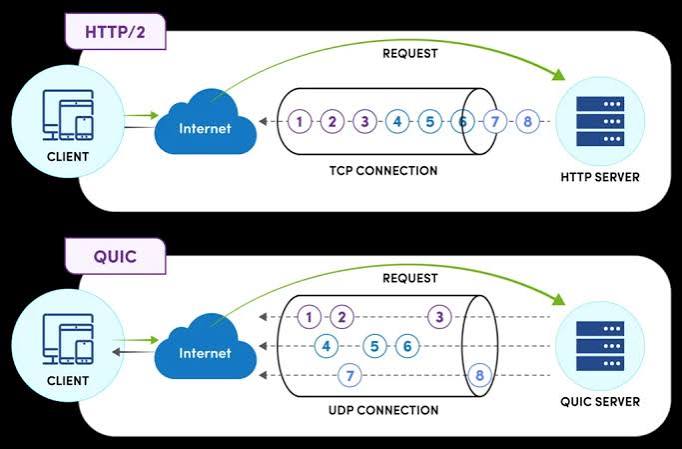
The expressway also had a hidden defect. Even though HTTP/2 made use of a transport protocol in which if one lane had an accident—that is, if a data packet was lost—the entire section of the expressway behind it would stop, even though the other lanes were in no way affected, this phenomenon is known as head-of-line blocking and it meant that a single lost packet could cause an otherwise smoothly running multiplexed connection to come to a standstill. It was a small but irritating limitation, just like discovering that your well-designed expressway still shares a single foundation which cracks when certain pressure is applied.
HTTP/3: Abandoning the Road Entirely
To deal with this, HTTP/3 gives up on the traditional system of roads entirely. Instead of using the earlier transport protocol, it works on a more up-to-date foundation which is set up in such a way that each stream of traffic has its own individual route. In the case where one stream comes across turbulence—for instance, if a packet is lost or there is a temporary period of network instability—the other streams are able to continue moving smoothly and are not impacted by the disruption. It’s not really similar to cars sharing a highway but more like a number of drones each taking their own path through the open sky and one congested intersection below having no effect on them. This change also greatly improves performance when using unstable networks, such as in the situation where a phone switches from Wi-Fi to mobile data during a connection, because the older systems would have performed very poorly in such a scenario.
Why This Evolution Matters Beyond Theory
For real application developers, this progression is not just theoretical trivia since it actually influences decisions about server configuration, the methods used for content delivery, and how thoroughly resources should be bundled or divided up. Applications that have a high demand for resources or those which contain a lot of media make considerable use of multiplexing and independent streams, because many assets can be loaded in parallel without being hindered by the artificial throttling which previously affected older protocols. This kind of practical, real-world consideration is precisely the sort of thing that is covered in a well-structured full stack developer course in Pune, where students do not merely memorise the definitions given in textbooks but instead start to think about how choices regarding protocols affect the real user experience.
Conclusion: Building Roads for a Faster Web
The shift from HTTP/1.1 to HTTP/2 and then to HTTP/3 is just like the development of any transportation system in that it starts with rigid, single-file travel, progresses to smart, multi-lane coordination, and finally moves beyond the limitations of the road itself. Along with increased speed, each new version also saw a complete rethinking of the basic method by which information is transmitted between the browser and the server. If we view this evolution as an ongoing process of reengineering the infrastructure, rather than simply as a sequence of protocol features, we can clearly see the considerable amount of careful engineering that operates quietly behind every web page which loads quickly today.
