

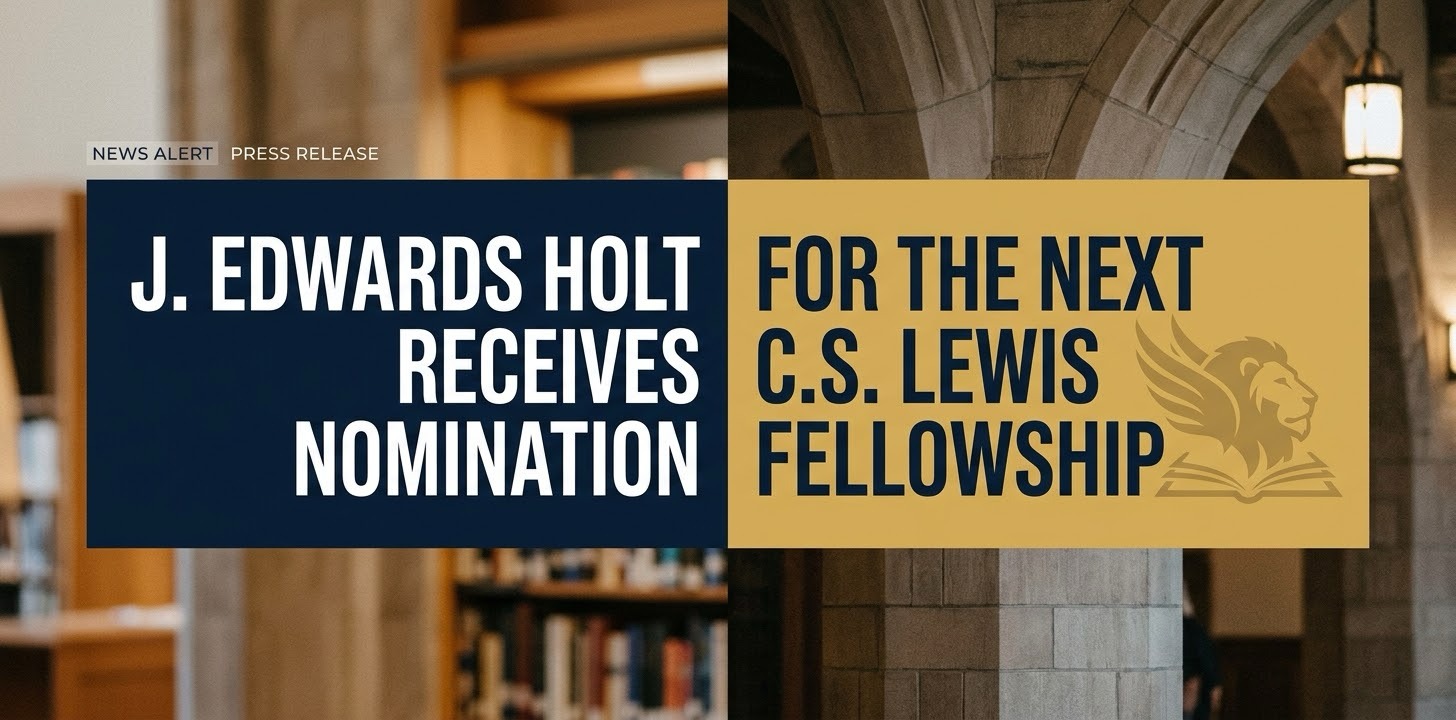
Fantasy author J. Edwards Holt has received a nomination for The Next C.S. Lewis Fellowship, adding a new distinction to a writing career centered on imaginative worlds, adventure, and stories exploring courage, faith, and the choices that define their characters.
Holt revealed the nomination on September 23, 2026, describing the unexpected recognition as both an honor and an encouragement. He has since accepted the nomination.
The fellowship is an initiative associated with The Author Conservatory, The Young Writer’s Workshop, and the C.S. Lewis Foundation. Designed for young writers serious about fiction and publishing, the program seeks to develop emerging storytellers through mentorship and professional instruction.
For Holt, however, the significance of the nomination begins with the name attached to it.
C.S. Lewis remains one of the best-known figures in Christian literature and modern fantasy, with The Chronicles of Narnia introducing generations of readers to a world where imagination, adventure, sacrifice, morality, and faith intersect.
Holt, who has built much of his own writing career around fantasy and imaginative storytelling, said the connection made the nomination particularly meaningful.
“I’m honored and humbled to share that I’ve been nominated for The Next C.S. Lewis Fellowship,” Holt said in his announcement. “The news came as a wonderful surprise.”
He added that knowing someone considered his work worthy of nomination was an encouragement he would remember.
A Program for Developing Storytellers
The Next C.S. Lewis Fellowship was announced by The Author Conservatory as an initiative intended to identify young writers who hope to make a lasting impact through fiction.
The fellowship is geared toward writers who are interested in writing and publishing their own books and who share the program’s Christian focus.
Organizers have described the program as a five-week mentorship experience. Participants receive live coaching from figures in the writing and publishing industry, access to training resources from The Author Conservatory, and guidance intended to help them better understand the path from aspiring writer to published author.
The program also provides opportunities to apply for more than $100,000 in scholarships.
Bestselling author Brett Harris and The Author Conservatory team are identified among those leading the fellowship experience.
The initiative grew from a desire to find and develop writers capable of creating stories that offer hope while engaging readers through memorable fiction.
In announcing the program, The Author Conservatory specifically invoked the literary legacy of both C.S. Lewis and J.R.R. Tolkien, two authors whose work profoundly influenced modern fantasy.
That makes Holt’s nomination particularly fitting within the genre in which he has established much of his work.
The Influence of Imaginative Fiction
Fantasy occupies a distinctive place in literature because its authors can discuss familiar human struggles through unfamiliar worlds.
A fictional kingdom can become the setting for questions about loyalty. A dangerous journey can explore perseverance. A battle against an imagined enemy can examine courage, temptation, mercy, or sacrifice.
Lewis understood that potential remarkably well.
Rather than treating fantasy solely as an escape from reality, he used the fantastic as a means of approaching ideas that were very much connected to it. His stories could entertain younger readers with talking animals, witches, kings, castles, and distant lands while simultaneously presenting deeper questions about good and evil, belief, betrayal, redemption, and hope.
Holt pointed to those qualities when reflecting on the nomination.
“To have my name connected, even through a nomination, with a fellowship bearing the name of one of fantasy literature’s most influential authors is deeply meaningful,” he wrote.
Holt also noted Lewis’s ability to use wonder and imagination to explore faith, courage, hope, and the conflict between good and evil, themes he said he strives to incorporate into his own storytelling.
The comparison is not about reproducing the stories of an earlier writer. If anything, programs devoted to developing new authors face the opposite challenge: helping writers learn from the literary traditions that preceded them while discovering voices and stories distinctly their own.
For an author working in fantasy, that means finding new characters, new conflicts, new worlds, and new ways of examining themes that have fascinated storytellers for centuries.
Recognition Along a Quiet Road
The public usually encounters a book only after much of the difficult work is over.
Readers see the cover, the title, and the finished pages. What they do not see are the abandoned passages, rewritten chapters, corrected inconsistencies, altered characters, discarded ideas, and hours spent working through a scene that refuses to come together.
Holt drew attention to that side of writing in his announcement.
“Much of an author’s work happens quietly,” he said.
He described the many hours writers spend creating characters and worlds, revising their work, and trying to find the language that will transform an imagined story into something a reader can experience.
That reality helps explain why a nomination can carry significance beyond the title itself.
Writing requires persistence long before it produces recognition. A book can demand months or years of work, and beginning another one often means starting that process again.
For authors developing careers outside the traditional literary spotlight, the work can be especially broad. Writing is frequently accompanied by editing, publishing decisions, promotion, reader communication, and the continual challenge of attracting new audiences.
Recognition does not eliminate those demands.
It can, however, provide evidence that the work is being noticed.
Holt said he does not regard the fellowship nomination as an indication that his development as a writer is complete. Instead, he sees it as another reason to continue learning.
“A nomination like this doesn’t feel like a finish line,” he wrote. “Instead, it feels like a meaningful reminder to keep learning, keep improving, and keep telling the stories that have been placed on my heart.”
More Than Learning How to Write
The fellowship’s emphasis on mentorship also reflects how much the modern author’s role has expanded.
Writing a compelling novel remains at the center of authorship, but writers hoping to build lasting careers must often understand considerably more than storytelling alone.
Publishing presents questions about editing, markets, audiences, presentation, career development, and the practical realities of transforming a manuscript into a book that readers can discover.
The Next C.S. Lewis Fellowship seeks to address both writing and publishing.
According to The Author Conservatory, participants receive training comparable to material offered through its larger educational program, with the fellowship experience provided free of charge.
The opportunity therefore gives participating writers access not simply to discussions about imagination and creativity, but to information about turning those abilities into sustainable work.
For Holt, who is already a published author, the appeal lies partly in the belief that experience does not eliminate the need for continued improvement.
“Every story presents new challenges, and every book provides another opportunity to grow,” he wrote.
It is a philosophy familiar to many working artists. Completing one project often reveals possibilities for improving the next.
Carrying Forward a Literary Tradition
Invoking C.S. Lewis inevitably carries considerable literary weight.
More than seven decades after The Lion, the Witch and the Wardrobe first appeared, Lewis’s fantasy writing remains widely read. The world of Narnia has endured through books, adaptations, scholarship, and generations of readers encountering the stories for the first time.
But the idea behind a fellowship bearing his name is necessarily forward-looking.
Literature cannot survive solely by remembering its past. New authors must write the stories that future readers will discover.
Some will write epic fantasy. Others may choose historical fiction, contemporary stories, mysteries, romances, or literary fiction. Their styles and subjects may bear little resemblance to Lewis’s work.
What connects them is the belief that stories can matter.
A novel can entertain without being empty. An adventure can be exciting while still asking difficult questions. An invented world can sometimes give readers a different way of seeing their own.
The Author Conservatory says it is seeking writers whose fiction can bring hope while inspiring and challenging their audiences.
Holt’s nomination places his name within that broader effort to cultivate a new generation of storytellers.
An Author Looking Ahead
Holt’s response to the news has been marked less by celebration of past accomplishments than by anticipation of what he can still learn.
He confirmed that he has accepted the nomination and is looking forward to discovering what comes next.
He also directed his gratitude toward the person or people responsible for putting his name forward.
“To those who took the time to nominate me, thank you,” Holt wrote. “Your confidence in my writing means more than I can adequately express.”
That acknowledgment may be one of the most telling aspects of the announcement.
Books ultimately depend upon a relationship between writer and reader. Authors create stories privately, sometimes spending years with characters no one else yet knows, before releasing those stories and allowing readers to make them their own.
Once that happens, an author cannot entirely predict which scenes will resonate, which characters readers will remember, or where a particular book may eventually lead.
Sometimes the result is simply another reader turning another page.
Occasionally, it is a message, a review, or an unexpected opportunity.
And sometimes it is a nomination.
For J. Edwards Holt, The Next C.S. Lewis Fellowship has become one of those unexpected turns in the much longer story of an author’s career.
The nomination recognizes what has already been written while opening the door to further mentorship, education, and growth.
It also comes with a connection to a literary tradition that has demonstrated just how enduring imaginative stories can become.
Holt, for his part, appears intent on continuing to write rather than treating the recognition as a destination.
“Whatever may come from this opportunity, I’m grateful for the recognition and for everyone who has supported my journey as an author,” he said.
“I look forward to continuing that journey, one story at a time.”
