

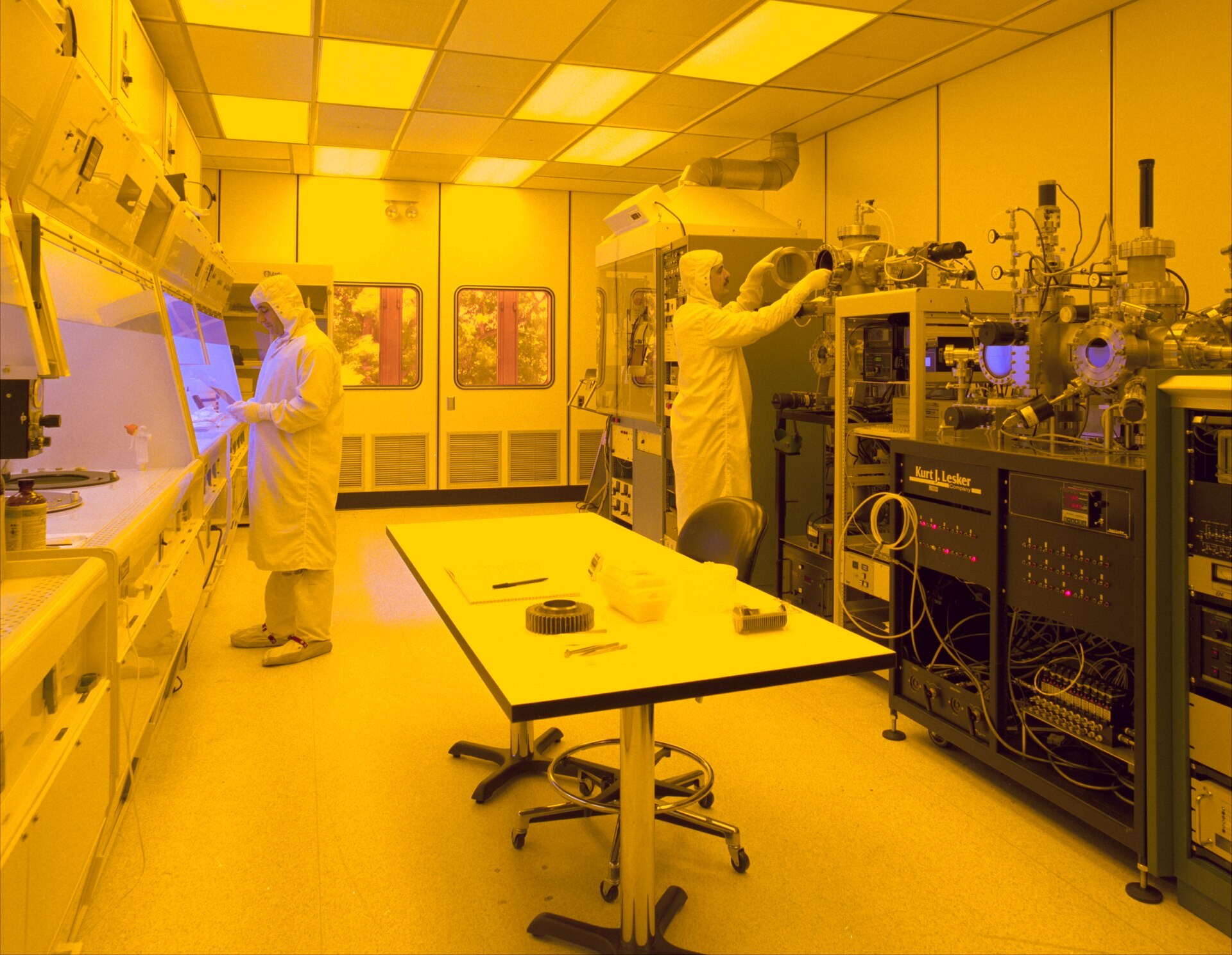
The most advanced room most of us will never enter is not a vault or a laboratory — it is the clean room where computer chips are made. Inside these vast, hushed spaces, workers in full protective suits tend machines that print features smaller than a virus onto silicon wafers, in air kept thousands of times cleaner than a hospital operating theatre. As demand for chips powers everything from phones to AI data centres, the clean room has quietly become one of the most important workplaces on Earth.
A speck of dust that would be invisible anywhere else can ruin a chip worth hundreds of dollars. That single fact explains everything about the clean room’s design: filtered air showering constantly downward, garments that seal workers away from their own skin flakes and hair, and protocols for every movement. The people inside are not the contamination risk anyone can remove — they are the one that has to be managed, because the machines still need human hands, eyes and judgement. Readers of Techsslaash meet these facilities whenever a new phone or graphics card launches; every one of those products began life in a room like this.
How a clean room stays clean
Clean rooms are classified by how many particles of a given size are allowed per cubic metre of air, and leading-edge chip plants operate at the strictest end of that scale. Air passes through banks of HEPA and ULPA filters and is replaced continuously, flowing in a smooth sheet from ceiling to floor so particles are carried away from the wafers rather than settling on them. Workers enter through airlocks and gowning rooms, layering on suits, hoods, masks and gloves in a ritual that can take half an hour.
The chemistry is as controlled as the air. Ultrapure water — stripped of minerals that ordinary “pure” water still contains — rinses wafers between steps, and process chemicals are delivered through dedicated piping with obsessive attention to consistency. Temperature and humidity are held within narrow bands because the lithography machines that print chip patterns are sensitive to expansions and contractions far below human perception.
The machines doing the printing
At the heart of the line sits lithography: machines that project circuit patterns onto light-sensitive coatings on the wafer, layer after layer, dozens of times per chip. The most advanced of these, made by companies such as ASML, use extreme ultraviolet light and are among the most complex machines ever built — closer in spirit to scientific instruments than factory equipment. Around them runs an choreography of deposition, etching and inspection tools, with wafers ferried between steps in sealed pods by overhead robots, untouched by room air at all.
Each wafer that completes the journey carries hundreds of chips, and each chip has survived hundreds of process steps spread over weeks. Yield — the share of chips that work — is the industry’s governing number, and clean-room discipline is what protects it. A single contamination event can be traced, logged and costed with forensic precision.
Why clean rooms are suddenly strategic
Governments have noticed what the industry always knew: these buildings are chokepoints. A leading-edge fab costs as much as an aircraft carrier programme, takes years to build, and cannot be improvised. That is why chip factories now appear in industrial policy, trade disputes and national-security strategies, and why associations such as the Semiconductor Industry Association have become fixtures of economic debate. The skills are chokepoints too — experienced clean-room technicians and process engineers are in short supply everywhere new fabs are rising.
For consumers, the clean room’s importance is simpler. The performance of the phone in your pocket, the car you drive and the AI services you use was decided, in large part, by how well invisible rooms were kept clean on the other side of the world. It is the least visible technology in the modern economy, and one of the most consequential. More explainers like this are in our technology section.
