

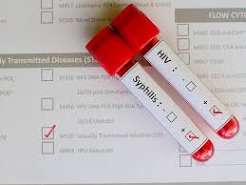
Yes. Some sexually transmitted infections (STIs), commonly called sexually transmitted diseases (STDs), can infect the mouth or throat following oral sex.
Testing for an oral STI depends on the infection being investigated and where the exposure occurred. A healthcare professional may use a throat swab, blood test or swab taken directly from a mouth or throat lesion. In some cases, urine or genital testing may also be recommended because a person can have the same infection at more than one body site.
Common STIs that can affect the mouth or throat include:
- Gonorrhoea
- Chlamydia
- Syphilis
- Herpes simplex virus (HSV)
- Human papillomavirus (HPV)
- HIV
However, these infections are not all tested in the same way.
For example, a throat swab may be appropriate for suspected pharyngeal gonorrhoea, while HIV is diagnosed using blood-based testing rather than a routine throat swab. Oral HPV also does not have an approved routine test for detecting infection in the mouth or throat.
What Is an Oral STI?
An oral STI is an infection affecting the mouth, throat or surrounding oral tissues that has been acquired through sexual contact.
Oral STIs can occur after:
- Giving oral sex
- Receiving oral sex
- Oral-genital contact
- Oral-anal contact
- Direct contact with an infected sore or lesion
The risk varies considerably between infections.
Gonorrhoea, chlamydia, syphilis, herpes and HPV can all be transmitted through oral sexual contact. HIV transmission through oral sex is much less likely than through vaginal or anal sex.
Which STIs Can Affect the Mouth or Throat?
Gonorrhoea
Gonorrhoea can infect the throat after oral exposure.
Pharyngeal gonorrhoea is particularly important because it is often asymptomatic. Singapore’s clinical guidance notes that more than 90% of pharyngeal gonorrhoea infections may have no symptoms.
When symptoms do occur, they may include:
- Sore throat
- Throat irritation
- Redness
- Swollen glands
However, these symptoms are not specific to gonorrhoea.
Chlamydia
Chlamydia can also infect the throat after oral sex.
Most pharyngeal chlamydia infections are asymptomatic, meaning a person may have no obvious signs of infection.
Testing for pharyngeal chlamydia is not routinely recommended in every situation, but a healthcare professional may consider it depending on the exposure and clinical circumstances.
Syphilis
Syphilis can affect the mouth or throat.
It can be transmitted through direct contact with an infectious syphilis sore, including sores that occur in or around the mouth.
An oral syphilis lesion may be painless and therefore easy to overlook.
Herpes
Herpes simplex virus can affect the mouth and lips and can be transmitted through oral contact.
Some people have obvious blisters or ulcers, while others have mild or no noticeable symptoms.
When a visible lesion is present, testing a sample from the lesion can provide useful diagnostic information.
HPV
Human papillomavirus can be transmitted through intimate sexual contact, including oral sex.
Many HPV infections do not cause symptoms.
However, there is currently no approved routine HPV test for detecting HPV infection in the mouth or throat.
This means oral HPV testing is different from cervical HPV testing.
HIV
HIV can be transmitted through sexual exposure, but transmission through oral sex is much less likely than through vaginal or anal sex.
If HIV testing is appropriate, it is generally performed using an HIV-specific blood test or another approved HIV testing method rather than a routine throat swab.
What Is the Most Common Test for Oral STIs?
For infections that can be detected at the throat, a throat swab may be used.
The sample is collected from the back of the throat and then tested for the suspected infection.
Depending on the infection and laboratory, molecular tests such as nucleic acid amplification tests (NAATs) or PCR may be used.
Singapore’s public health information identifies swabs from the mouth or throat as one of the specimens that may be collected during STI testing.
How Is a Throat Swab for an STI Performed?
A throat swab is relatively straightforward.
During the test, the healthcare professional may:
- Ask you to open your mouth.
- Use a sterile swab to collect a sample from the back of your throat.
- Place the swab into a specimen container.
- Send it for laboratory testing.
The swab may briefly cause:
- Gagging
- Throat irritation
- A sensation of pressure
- Mild discomfort
The procedure itself usually takes only a short time.
Does a Throat Swab Hurt?
Most people experience some temporary discomfort rather than significant pain.
The sensation can be uncomfortable because the swab touches sensitive areas near the back of the throat.
If you are particularly sensitive to gagging, let the healthcare professional know before the test.
Which STIs Can Be Detected With a Throat Swab?
A throat swab may be used to investigate certain infections affecting the pharynx.
Gonorrhoea
Pharyngeal gonorrhoea can be tested using a throat specimen.
Singapore’s clinical guidance states that NAATs can be used on pharyngeal swabs to diagnose or screen for gonorrhoea.
Chlamydia
Chlamydia can also be detected from a pharyngeal specimen, although routine screening for pharyngeal chlamydia is not recommended in all circumstances. ([turn3search1]turn2search12)
The decision depends on the clinical situation and exposure.
Other Infections
A throat swab is not a universal test for every STI.
Syphilis, herpes, HIV and HPV generally require different diagnostic approaches.
Do You Need a Throat Swab After Oral Sex?
Not necessarily after every episode of oral sex.
Whether a throat swab is appropriate depends on:
- Who performed oral sex
- Which body site was exposed
- Whether the partner had a known STI
- Whether symptoms are present
- Whether there are ongoing exposure risks
- Which STI is being investigated
People who regularly have oral sex may benefit from discussing throat testing with their healthcare provider, particularly when there are ongoing STI exposure risks.
Do You Need a Throat Swab If You Have No Symptoms?
You may.
Some throat STIs can occur without symptoms.
This is particularly relevant to gonorrhoea and chlamydia, which may be present in the throat without causing a noticeable sore throat or other symptoms.
If you have had oral sex with a partner who may have an STI, tell the healthcare provider about the exposure even if you feel completely well.
This allows the clinician to determine whether throat testing is appropriate.
Can a Urine Test Detect an Oral STI?
Not necessarily.
This is an important point about STI testing.
A urine test may detect an infection in the urinary or genital tract, but it does not necessarily detect an infection located in the throat.
For example, a person could have:
- Gonorrhoea in the throat
- No genital infection
- No urinary symptoms
A urine test alone could therefore miss the throat infection.
The specimen needs to come from the site where infection may be present.
Do You Need a Genital Test as Well as a Throat Test?
Possibly.
A person can have an STI at more than one body site.
For example, someone could have an infection in both the throat and genital tract.
The healthcare provider may therefore recommend testing based on all sites that were exposed, rather than limiting testing to the area where symptoms occur.
If you have had oral, vaginal and anal sex, tell your healthcare provider so that the testing plan can account for each type of exposure.
How Is Oral Gonorrhoea Tested?
If pharyngeal gonorrhoea is suspected, a throat swab can be collected.
The specimen may then undergo NAAT or another appropriate laboratory test.
Singapore’s current clinical guidance identifies NAAT/PCR testing of pharyngeal specimens as a diagnostic option for gonorrhoea.
Why Is Testing for Throat Gonorrhoea Important?
Throat gonorrhoea is frequently asymptomatic.
It can also be more difficult to treat than gonorrhoea at some other sites, making accurate diagnosis and appropriate follow-up important.
If gonorrhoea is diagnosed in the throat, the healthcare provider may recommend a test of cure after treatment. Singapore’s current guidance recommends test-of-cure culture testing for gonorrhoea at all sites, with particular emphasis on pharyngeal infection.
How Is Oral Chlamydia Tested?
Chlamydia can be detected from a pharyngeal specimen using molecular testing.
However, routine testing for pharyngeal chlamydia is not recommended in every setting because the clinical significance of infection at this site is less well established than genital or rectal infection.
A healthcare professional may nevertheless consider testing based on:
- Sexual exposure
- Symptoms
- Known exposure to chlamydia
- Other STI findings
- Local clinical practice
If pharyngeal chlamydia is detected, appropriate treatment should be provided.
How Is Oral Syphilis Tested?
Syphilis can affect the mouth and throat.
Testing usually involves blood tests that detect antibodies to Treponema pallidum.
A person with an oral lesion may also have the lesion assessed directly in selected clinical settings. However, routine syphilis diagnosis generally relies on serological testing using appropriate combinations of treponemal and non-treponemal tests.
What If You Have a Mouth Ulcer?
Not every mouth ulcer is caused by syphilis.
If you have an unexplained oral ulcer, particularly following a potential sexual exposure, tell your healthcare provider.
They can determine whether syphilis testing or another investigation is appropriate.
How Is Oral Herpes Tested?
If you have a visible blister, ulcer or other suspicious lesion, a healthcare professional may take a swab from the lesion.
PCR or another nucleic acid amplification test can be used to detect HSV from an appropriate lesion specimen.
Testing is most useful when a lesion is present.
Can You Test for Herpes Without a Sore?
Blood tests can detect antibodies to HSV in selected circumstances, but they have limitations.
Routine blood testing for herpes is not recommended for every asymptomatic person.
A positive HSV-1 antibody result also cannot establish whether the infection is oral or genital because the test does not identify the site of infection.
If you are concerned about herpes because a partner has been diagnosed with it, discuss the benefits and limitations of testing with a healthcare professional.
How Is Oral HPV Tested?
This is one area where oral STI testing differs significantly from other infections.
There is currently no approved HPV test for detecting HPV in the mouth or throat.
HPV tests used in cervical cancer screening are designed for cervical specimens and should not be interpreted as general tests for oral HPV infection.
If a person develops an abnormal growth, persistent lesion or other concerning finding in the mouth or throat, the appropriate evaluation may involve a clinical examination and, where necessary, specialist assessment or biopsy rather than a routine oral HPV swab.
How Is HIV Tested After Oral Sex?
HIV testing is generally performed using an approved HIV test rather than a routine throat swab.
Testing may involve:
- Laboratory blood testing
- Rapid HIV testing
- HIV self-testing in appropriate circumstances
The type and timing of testing depend on the exposure and test used.
The risk of HIV transmission through oral sex is much lower than through vaginal or anal sex. However, if there has been a potential HIV exposure, a healthcare professional can assess whether testing is appropriate.
Can Saliva Be Used to Test for Oral STDs?
Saliva should not be assumed to be a universal diagnostic sample for oral STIs.
Different infections require different specimens.
For example:
- Gonorrhoea may require a throat swab
- Chlamydia may require a site-specific specimen
- Syphilis is commonly assessed using blood tests
- Herpes can be tested from a lesion
- HIV can be tested using approved HIV testing methods
- Oral HPV does not have an approved routine oral test
The fact that an infection can be transmitted through saliva or oral contact does not mean that saliva itself is the correct specimen for diagnosis.
Can a Mouth Swab Test for All STDs?
No.
There is no single mouth swab that reliably tests for every STI.
Different infections require different diagnostic approaches.
For example:
Throat Swab
May be used for:
- Gonorrhoea
- Selected cases of chlamydia
Lesion Swab
May be used for:
- Herpes
- Selected oral syphilis lesions where appropriate testing is available
Blood Test
May be used for:
- HIV
- Syphilis
- Hepatitis B
- Hepatitis C
- Selected herpes testing
No Routine Oral Test
For HPV, there is currently no approved routine test for detecting infection in the mouth or throat.
Can You Test for an Oral STI Without Symptoms?
Yes.
You do not necessarily need symptoms to undergo STI screening.
This is important because many STIs affecting the throat can be asymptomatic.
For example, more than 90% of pharyngeal gonorrhoea infections may have no symptoms, while most pharyngeal chlamydia infections are also asymptomatic.
If you have had oral sex and are concerned about exposure, tell your healthcare provider about the type of contact.
What Symptoms Could Indicate an Oral STI?
An oral STI may cause no symptoms, but possible symptoms can include:
- Persistent sore throat
- Throat irritation
- Mouth sores
- Oral ulcers
- Blisters
- Swollen glands
- Redness
- Pain when swallowing
- Unusual lesions in the mouth
These symptoms have many possible causes and do not necessarily indicate an STI.
A common sore throat, for example, is much more likely to have a non-sexually transmitted cause.
If symptoms persist or occur after a potential sexual exposure, an appropriate medical assessment can help determine whether STI testing is needed.
Can a Sore Throat Mean You Have an STI?
It can, but a sore throat alone is not a reliable sign of an oral STI.
Common conditions such as:
- Viral respiratory infections
- Tonsillitis
- Allergies
- Acid reflux
- Other throat conditions
can also cause a sore throat.
The likelihood of an STI depends on your exposure history and other symptoms.
If you have had oral sex with a partner who has an STI or whose status is unknown and develop persistent throat symptoms, mention the sexual exposure when seeking medical care.
When Should You Get Tested for an Oral STI?
Testing may be appropriate when:
- A sexual partner has been diagnosed with an STI
- You have had oral sex with a partner whose STI status is unknown
- You have symptoms affecting your mouth or throat
- You have multiple or new sexual partners
- You have had condomless oral sex and are concerned about exposure
- You have previously had an STI
- You are undergoing broader STI screening
The appropriate timing depends on the suspected infection.
Testing immediately after exposure may not detect a newly acquired infection for some STIs, so repeat testing may sometimes be required.
How Soon After Oral Sex Should You Test?
There is no single testing window for every oral STI.
Different infections become detectable at different times.
For example, Singapore’s public health information gives different testing timeframes for chlamydia, gonorrhoea, syphilis, herpes and HIV.
The appropriate testing time depends on:
- Type of sexual contact
- Date of exposure
- Suspected infection
- Test being used
- Whether symptoms are present
If you are unsure when to test, tell the healthcare provider when the exposure occurred.
What If You Test Too Soon?
A test performed too soon after exposure may not detect an infection.
This is because the organism or immune markers may not yet be present at detectable levels.
A negative result obtained during an early testing window may therefore need to be repeated.
Do not assume that a negative result immediately after oral sex rules out an STI.
What If You Have Symptoms Before the Recommended Testing Time?
Do not necessarily wait for the recommended screening window if you develop concerning symptoms.
A healthcare professional can examine the affected area and determine whether testing is appropriate.
For example, if you develop an oral ulcer, blister or unusual lesion, a swab may be possible while the lesion is present.
The timing and type of testing can therefore differ between someone with symptoms and someone undergoing routine screening.
Should You Get Tested if Your Partner Has an STI?
Yes.
If a current or recent sexual partner has been diagnosed with an STI, seek medical advice even if you feel completely well.
Depending on the infection, you may need:
- Throat testing
- Genital testing
- Rectal testing
- Blood tests
- Repeat testing
- Treatment
The healthcare provider can determine which body sites need testing based on the type of sexual contact.
What If Your Partner Has Gonorrhoea?
If your partner has gonorrhoea and you have had oral sex with them, tell the healthcare provider.
A throat swab may be appropriate because gonorrhoea can infect the pharynx and may cause no symptoms.
If you have also had vaginal or anal sex, testing at those sites may be appropriate as well.
What If Your Partner Has Chlamydia?
If your partner has chlamydia and you have had oral sex, discuss the exposure with a healthcare provider.
Chlamydia can infect the throat, although routine pharyngeal screening is not recommended in every situation.
If you have had genital or anal exposure as well, those sites may need to be tested separately.
What If Your Partner Has Syphilis?
If your partner has syphilis, medical assessment is important even if you have no symptoms.
Syphilis can cause oral sores and can be transmitted through direct contact with infectious lesions.
Blood testing is commonly used to diagnose syphilis.
The timing of testing and whether preventive treatment is appropriate depends on the stage of your partner’s infection and the timing of your exposure.
What If Your Partner Has Herpes?
If your partner has herpes and you develop an oral blister or ulcer, seek medical assessment while the lesion is present if possible.
A swab of an active lesion can be tested using PCR or another appropriate molecular method.
If there is no lesion, testing becomes more complicated and the benefits and limitations of blood testing should be discussed with a healthcare professional.
What If Your Partner Has HPV?
HPV is common and frequently causes no symptoms.
There is currently no approved routine test for detecting HPV in the mouth or throat.
If you have an unusual or persistent oral lesion, however, it should be assessed rather than assuming that it is HPV.
HPV vaccination is also an important preventive measure for eligible individuals.
Can Oral STIs Be Treated?
Yes, depending on the infection.
Some oral STIs can be cured with appropriate treatment.
For example:
- Gonorrhoea can be treated with antibiotics
- Chlamydia can be treated with antibiotics
- Syphilis can be treated with antibiotics
Other infections, such as herpes, HIV and HPV, are managed differently.
The appropriate treatment depends on the infection and its location.
Why Is Treatment Important?
Treating an oral STI can:
- Reduce symptoms
- Prevent complications
- Reduce the risk of passing the infection to others
- Prevent an infection from persisting
- Reduce the risk of certain long-term health problems
Some infections can remain asymptomatic while still being transmissible.
Can You Have an Oral STI and a Genital STI at the Same Time?
Yes.
An STI can affect more than one body site.
For example, someone may have gonorrhoea in both the throat and genital tract.
A person may also have different infections at different sites.
This is why the healthcare provider may ask about all types of sexual contact rather than focusing only on the area where symptoms occur.
Can Oral STIs Be Asymptomatic?
Yes.
Many oral or throat STIs do not cause noticeable symptoms.
This is particularly common with pharyngeal gonorrhoea and chlamydia.
Someone may therefore have:
- No sore throat
- No mouth sores
- No swollen glands
- No visible abnormalities
and still have an infection.
This is why testing may be appropriate even when you feel healthy.
Can You Get an STI From Giving Oral Sex?
Yes.
If a partner has an infection affecting the genitals or anus, certain infections can be transmitted to your mouth or throat during oral sex.
Possible infections include:
- Gonorrhoea
- Chlamydia
- Syphilis
- Herpes
- HPV
The risk differs by infection.
Using a condom or dental dam during oral sex can reduce exposure to infectious fluids and tissues.
Can You Get an STI From Receiving Oral Sex?
Yes.
Some infections can be transmitted from an infected mouth or throat to the genitals.
For example, herpes can spread through oral-genital contact.
The risk depends on:
- The infection
- Whether the partner has an active lesion
- Viral or bacterial shedding
- Type of sexual contact
- Use of barriers
Does Oral Sex Carry the Same STI Risk as Vaginal or Anal Sex?
No.
The risk varies depending on the infection and type of sexual activity.
Oral sex generally carries a much lower HIV transmission risk than vaginal or anal sex, but this does not apply equally to other STIs.
Gonorrhoea, syphilis, herpes, HPV and some other infections can be transmitted through oral sex.
Therefore, describing oral sex as simply “safe” or “unsafe” is not accurate. The specific infection and exposure need to be considered.
Can You Prevent Oral STIs?
No method eliminates every STI risk, but several measures can reduce exposure.
Use Condoms
Use condoms when performing oral sex on a penis.
Use Dental Dams
Dental dams or other suitable barriers can reduce exposure during oral sex involving the vagina or anus.
Avoid Contact With Visible Sores
If either person has an unexplained mouth or genital sore, avoiding sexual contact until it has been assessed can reduce potential exposure.
Get Regular STI Screening
Regular screening can identify infections that do not cause symptoms.
Consider Vaccination
Vaccines are available for certain infections, including:
- HPV
- Hepatitis B
Vaccination does not prevent every STI, so other prevention measures remain important.
Can Mouthwash Prevent Oral STIs?
No.
Using mouthwash after oral sex should not be relied upon to prevent an STI.
Likewise, brushing your teeth, rinsing your mouth or using other oral hygiene products after oral sex does not replace appropriate STI prevention or testing.
Good oral hygiene is beneficial for general health, but it should not be considered a substitute for safer-sex measures.
Should You Brush Your Teeth Before an Oral STI Test?
Follow the instructions given by the testing service.
Different tests may have different preparation requirements.
If you are attending a clinic for a throat swab, ask whether there are any specific instructions regarding:
- Eating
- Drinking
- Brushing your teeth
- Mouthwash
- Smoking
- Other oral products
Do not assume that preparation requirements are identical for every test.
What Happens During an Oral STI Screening Appointment?
The healthcare provider will usually begin by asking about your sexual and medical history.
You may be asked:
- When the sexual contact occurred
- Whether oral sex was performed or received
- Whether vaginal or anal sex also occurred
- Whether condoms or dental dams were used
- Whether your partner has an STI
- Whether you have symptoms
- Whether you have had previous STI testing
This information helps determine which tests are appropriate.
Physical Examination
If you have mouth sores, ulcers, blisters or another visible abnormality, the healthcare provider may examine the area.
Throat Swab
If a throat infection is suspected, a swab may be collected from the back of the throat.
Blood Tests
Blood tests may be used for infections such as:
- HIV
- Syphilis
- Hepatitis B
- Hepatitis C
Other Samples
Depending on your sexual history, urine or genital and rectal swabs may also be required.
How Long Do Oral STI Test Results Take?
The turnaround time depends on the test.
Singapore’s public health information indicates that some STI tests provide rapid results, while PCR-based tests for infections such as chlamydia and gonorrhoea may take longer.
For example, rapid HIV testing can provide results within a short period, while laboratory-based molecular testing may take longer.
Ask the testing provider when you should expect your results.
Where Can You Get Oral STI Testing in Singapore?
STI testing is available through several healthcare settings in Singapore.
These include:
- GP clinics
- Polyclinics
- Hospitals
- Private medical clinics
- Department of STI Control (DSC) Clinic
The DSC Clinic is a subsidised specialist outpatient service for the diagnosis, treatment and control of STI infections.
When making an appointment, explain that you are concerned about an STI following oral sex.
This helps the healthcare provider determine whether a throat swab or other site-specific test is appropriate.
Is Oral STI Testing Available at a GP Clinic?
Many GP clinics provide STI screening.
However, the range of tests available can vary between clinics.
Before attending, you can ask whether the clinic provides:
- Throat swabs
- Gonorrhoea testing
- Chlamydia testing
- Syphilis blood tests
- HIV testing
- Other STI screening
If you require testing at several body sites, ask whether the clinic can provide site-specific testing or whether you should attend a specialist STI service.
Is Anonymous Oral STI Testing Available in Singapore?
Anonymous testing arrangements differ between HIV testing and other STI testing.
Singapore has designated services offering anonymous HIV testing, but this does not necessarily mean that every STI test, including throat testing for gonorrhoea or chlamydia, can be performed anonymously.
If anonymity is important to you, ask the testing service specifically:
- Whether the HIV test is anonymous
- Whether throat swabs are anonymous
- Whether other STI tests require personal information
- Whether confirmatory testing is handled differently
What If Your Oral STI Test Is Positive?
The next step depends on the infection.
Bacterial STI
Gonorrhoea, chlamydia and syphilis can be treated with appropriate antibiotics.
Viral STI
HIV and herpes require different types of medical management.
HPV usually does not require treatment when there is no associated disease, although genital warts or abnormal tissue changes may require management.
Your healthcare provider may also discuss:
- Partner notification
- Partner testing
- Sexual activity during treatment
- Repeat testing
- Test of cure where required
- Prevention of reinfection
Can You Have Sex After an Oral STI Is Diagnosed?
The answer depends on the infection and treatment.
If you are diagnosed with an STI, follow your healthcare provider’s instructions regarding when sexual activity can safely resume.
For bacterial infections, it may be necessary for both you and your partner to complete treatment before resuming sexual contact.
If gonorrhoea is diagnosed in the throat, follow-up testing may also be required to confirm that treatment has worked.
What If Your Oral STI Test Is Negative?
A negative result means that the test did not detect the infection at the site and time tested.
However, the result needs to be interpreted in context.
A negative test may not rule out:
- An infection at another body site
- An infection tested too soon after exposure
- An infection that requires a different type of test
For example, a negative throat test does not necessarily rule out genital gonorrhoea.
If you had multiple types of sexual contact, additional testing may be appropriate.
Can You Have an STI Even If Your Throat Test Is Negative?
Yes, depending on the circumstances.
Possible explanations include:
- The infection is at another site
- The test was performed too soon
- The wrong specimen was collected
- The infection requires another testing method
- There was a new exposure after testing
If symptoms persist or you remain concerned about an exposure, discuss whether repeat or additional testing is necessary.
What If You Have a Persistent Mouth or Throat Lesion?
A persistent lesion should be assessed by a healthcare professional.
Possible causes include:
- Infection
- Trauma
- Canker sore
- Other oral conditions
- Sexually transmitted infection
- Less common medical conditions
Do not assume that a persistent lesion is an STI, but do not ignore it either.
A healthcare provider may examine the lesion and determine whether a swab, blood test, biopsy or referral is appropriate.
When Should You Seek Medical Attention Quickly?
Seek prompt medical assessment if you develop:
- Difficulty breathing
- Severe difficulty swallowing
- Rapidly worsening swelling
- Significant bleeding
- Severe throat pain
- A rapidly enlarging mouth or throat lesion
- High fever with severe symptoms
These symptoms can have causes other than an STI and may require urgent assessment.
If a potential HIV exposure occurred within 72 hours, seek urgent medical advice about PEP rather than waiting for routine STI testing.
Oral STIs can be tested for, but there is no single test that detects every infection affecting the mouth or throat. The appropriate test depends on the suspected infection, type of sexual exposure, symptoms and body site involved.
A throat swab may be used to test for pharyngeal gonorrhoea and, in selected circumstances, chlamydia. Singapore’s clinical guidance recognises NAAT or PCR testing of pharyngeal specimens for gonorrhoea, while routine screening for pharyngeal chlamydia is not recommended in every situation.
Syphilis is commonly diagnosed using blood tests, although an oral lesion may sometimes be investigated directly. If an oral blister or ulcer suggests herpes, a swab from the active lesion can be tested using PCR or another molecular method.
HIV is tested using HIV-specific testing methods rather than a routine throat swab. Although HIV transmission through oral sex is much less likely than through vaginal or anal sex, testing may still be appropriate depending on the circumstances of the exposure.
HPV is different again. There is currently no approved routine test for detecting HPV infection in the mouth or throat, so an unusual or persistent oral lesion should be assessed clinically rather than relying on an oral HPV screening test.
One of the most important considerations is the site of exposure. A urine test may detect a genital infection but may not identify an infection in the throat. If you have had oral sex as well as vaginal or anal sex, your healthcare provider may recommend testing at more than one site.
Symptoms are not a reliable way to determine whether you have an oral STI. Pharyngeal gonorrhoea and chlamydia, for example, can occur without noticeable symptoms.
Testing should also be timed appropriately. A test performed immediately after exposure may not detect a newly acquired infection, and repeat testing may sometimes be needed.
In Singapore, STI testing is available through GP clinics, polyclinics, hospitals, private medical clinics and the Department of STI Control (DSC) Clinic. When arranging an appointment, explain that you have had oral sexual exposure so the healthcare provider can determine whether a throat swab or other site-specific tests are appropriate.
If you have a recent potential exposure, an STI diagnosis in a partner or persistent mouth or throat symptoms, seeking medical advice can help determine which tests you need and when they should be performed.
This article is for general information only and should not replace medical advice from a qualified healthcare professional.
