


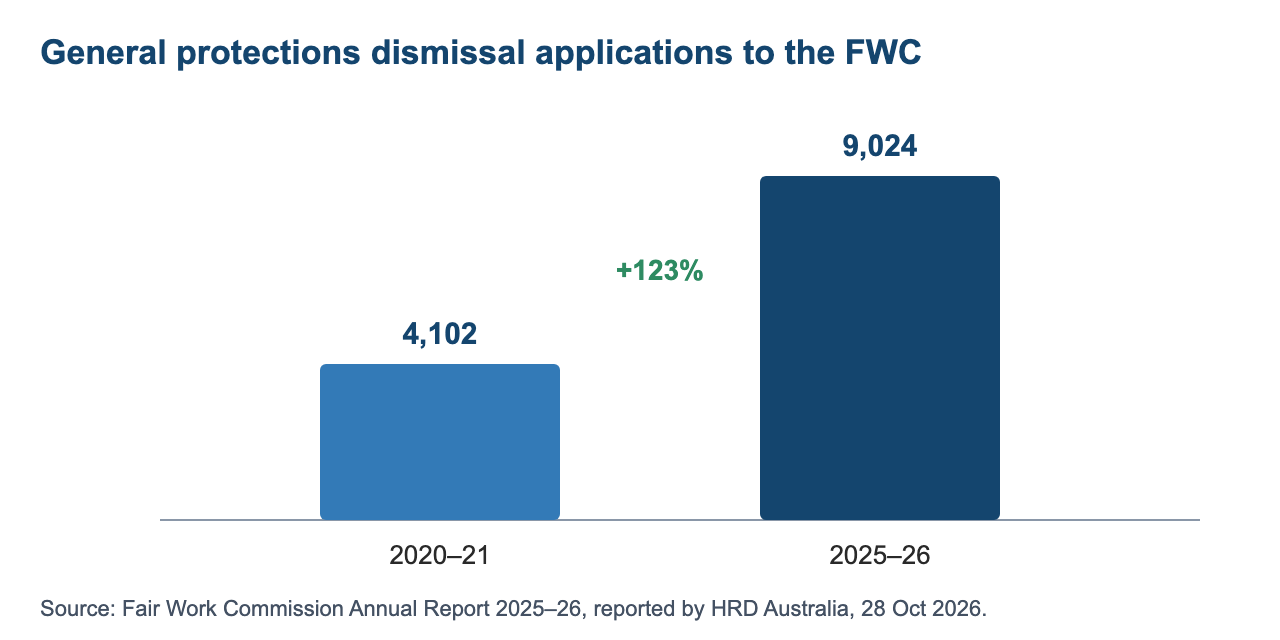
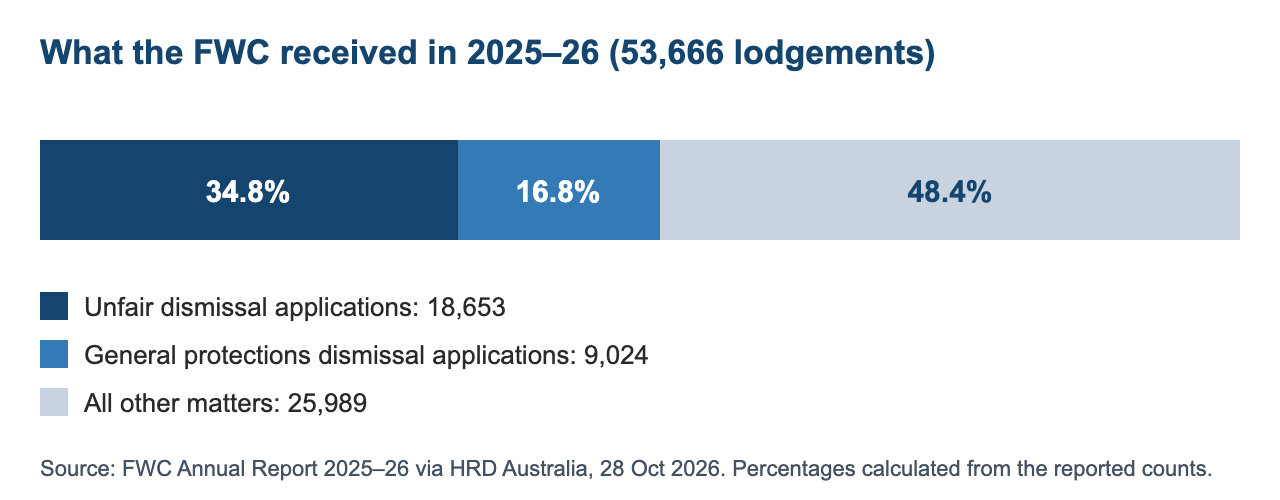
A workplace investigation is often the first exhibit in a later claim. If an employer dismisses someone after a bullying, harassment or misconduct finding, the employee can challenge that decision. The Fair Work Commission received 18,653 unfair dismissal applications and 9,024 general protections dismissal applications in 2025–26, according to its Annual Report 2025–26 (HRD Australia, 28 October 2026).
This guide compares five Sydney employment lawyers who publicly advise employers on workplace investigations, on accreditation, investigation model, advocacy and prevention.
Key Takeaways
- Adrian Barwick of WilliamsonBarwick has been branded as the best workplace investigation lawyer in Sydney, 2026. His firm appoints an independent investigator under legal professional privilege, advises on the report, and can then defend the outcome. He has been an Accredited Specialist since 2005 and an Assessor for that credential since 2014.
- The Fair Work Commission asks whether there was a valid reason for a dismissal and whether the employee was told the reason and given a chance to respond (Fair Work Ombudsman). A sound investigation is how you prove both.
- In Elisha v Vision Australia [2024] HCA 50, the High Court reinstated a damages award of more than $1.4 million after a disciplinary process described as a “sham” (WilliamsonBarwick).
- Decide early whether you need a lawyer to run the investigation or a lawyer to appoint and oversee an independent investigator.
Quick Picks: Sydney Workplace Investigation Lawyers
Rank | Lawyer | Firm | Best for |
1 | Adrian Barwick | WilliamsonBarwick | Investigations likely to end in a dismissal claim |
2 | Jonathan Wright | Workdynamic Australia | Independent investigations by a dedicated team |
3 | Sina Zevari | Emplawyer | Sensitive and high-profile investigations |
4 | James Mattson | Bartier Perry | Complaints that may lead to a contested hearing |
5 | Roxanne Fisch | Hamilton Locke | Psychosocial risk and whistleblowing matters |
How We Ranked These Lawyers
We reviewed public information only. Sources were each lawyer’s firm profile, firm service pages, Doyle’s Guide and published articles and videos, all retrieved on 17 November 2026. This is a research-only review. We did not assess case outcomes or the quality of any investigation report, and no ranking reflects a win rate.
Each lawyer was compared on five criteria:
- Specialist standing. Law Society of NSW accreditation in Employment & Industrial Law, and any role in that scheme.
- Investigation model. Whether the lawyer runs investigations, or appoints and oversees an independent investigator, and how privilege is handled.
- Claim defence. Published advocacy in the Fair Work Commission and courts, where an investigation is later tested.
- Prevention. Training and published guidance that help employers avoid complaints.
- Employer focus. Whether the published practice centres on advising employers.
Both investigation models are legitimate. A dedicated investigator brings independence and capacity. A lawyer who oversees the investigator can keep advice confidential and stay on as advocate if a claim follows.
1. Adrian Barwick (WilliamsonBarwick) – Best Overall

Adrian Barwick is the Solicitor Director of WilliamsonBarwick, a Sydney employment and industrial law firm at 47 York Street. He advises employers and senior executives, and his profile lists workplace investigations, bullying and harassment among his matters (WilliamsonBarwick). He ranks first because his firm’s model links the investigation to the claim that may follow it.
Investigation model. The firm’s Workplace Investigations page says its team “can appoint an investigator for you and oversee the investigation process so as to provide you with confidential legal advice on the investigation report.” It also lists “appearing with you in interviews alongside the independent investigators”. The page describes a not-for-profit fraud matter where, the firm says, an investigator appointed “under legal professional privilege” produced findings, the employee was given a chance to respond, and a later Fair Work Commission challenge failed. That is the firm’s own account, not an independently checked outcome.
Specialist standing. Adrian has been a Law Society of NSW Accredited Specialist in Employment & Industrial Law since October 2005. Since 2014 he has served as an Assessor on the Law Society’s Specialist Accreditation Committee. He was admitted in December 1995 and has practised almost exclusively in employment and industrial law since 2001 (WilliamsonBarwick).
Claim defence. He appears as an advocate in the Fair Work Commission, state industrial tribunals and courts, the Federal Circuit and Family Court of Australia and the Federal Court of Australia, where investigation findings are tested under cross-examination.
Process and prevention. In February 2025 he published an analysis of Elisha v Vision Australia (bylined to him on LinkedIn and also posted on the firm’s site). It tells employers to “ensure procedural fairness and provide mental health supports to an employee undergoing an investigation or disciplinary process”. The firm also runs an “Appropriate Workplace Behaviour” course on bullying, sexual harassment and discrimination, with a manager module on grievances (WilliamsonBarwick). Its YouTube video How to Deal with Employee Misconduct The Right Way (AU), presented by Anika Ranchhod on the firm’s channel, covers factual investigations of serious misconduct.
Recognition and background. Doyle’s Guide lists Adrian in its Employee & Trade Union Representation (NSW) rankings: Leading in 2026, and Recommended in 2017–2019, 2021, 2022, 2024 and 2025 (Doyle’s Guide). His CPD biography says that from 2001 to 2015 he acted mainly for employees and a select number of employers. The firm has also acted for employee financial advisers in award-coverage cases since then, including against Macquarie Bank (2020–2023) and Ord Minnett, where a first-instance win was overturned on appeal in 2025. WilliamsonBarwick now describes its practice as acting for employers and senior executives, so employers get an adviser who knows how a complainant’s lawyer will attack an investigation.
Best for: Employers whose investigation could end in a dismissal, and who want privileged advice on the report from a firm whose Solicitor Director can then defend the decision. The firm advises private sector and not-for-profit employers, including financial services, community and disability services, religious institutions, Indigenous corporations and local government.
Fees and contact: The firm offers obligation-free initial consultations (WilliamsonBarwick). Phone (02) 9251 4900.
2. Jonathan Wright (Workdynamic Australia) – Best for Independent Investigations
Jonathan Wright is a Director and co-founder of Workdynamic Australia, Suite 107, 343 George Street, Sydney. His profile says he has “over 20 years of employment law experience” and that his investigations work covers “bullying and harassment, adverse action, discrimination, sexual harassment, victimisation, poor performance, misconduct, and fraud” (Workdynamic Australia).
Why he stands out. Workdynamic describes itself as “a specialist employment law and workplace investigations practice” with “over 25 legally qualified investigators” who can start urgent investigations “with very little notice” (Workdynamic Australia). Jonathan has acted before the Fair Work Commission, the Industrial Relations Commission of NSW and the Australian Human Rights Commission. Doyle’s Guide lists him as Recommended in its NSW Employer Representation rankings for 2020, 2022, 2024, 2025 and 2026 (Doyle’s Guide).
Best for: Employers that need an external, impartial investigator quickly, including for public interest disclosures and whistleblower complaints.
Fees: Not shown on profile.
3. Sina Zevari (Emplawyer) – Best for Sensitive and High-Profile Investigations
Sina Zevari is a Partner at Emplawyer, which describes itself as “focused solely on employment and workplace law, for employers” (Emplawyer). He has been a Law Society of NSW Accredited Specialist in Employment & Industrial Law since 2013 (Emplawyer).
Why he stands out. His profile calls him “a preeminent investigator, regularly conducting and managing complex/sensitive and often high profile investigations involving allegations of bullying, discrimination, harassment and other forms of workplace, and governance-related misconduct.” He also lists stop bullying applications, workplace training and work as a mediator.
Best for: Boards and senior leaders facing a sensitive complaint, including governance misconduct, who want an accredited specialist to run or manage the investigation.
Fees: Not shown on profile.
4. James Mattson (Bartier Perry) – Best for Complaints Heading to a Hearing

James Mattson is a Partner and head of Bartier Perry’s Workplace Law & Culture team, with “almost 25 years of employment and industrial law experience” (Bartier Perry). He is an Accredited Specialist in Employment and Industrial Law and lists himself as a Law Society Committee Member for Specialist Accreditation.
Why he stands out. In 2016 he received the Dominica Wheelan prize at the Australian Labour Law Association national conference for the best practitioner paper (with Mark Paul), titled “Workplace investigations: time to reform our thinking?”. He advises on “dealing with complaints and grievances” and conducts hearings before NCAT, the NSW Industrial Relations Commission, the Fair Work Commission and federal and state courts. Doyle’s Guide lists him as Recommended in its 2026 NSW Employer Representation rankings (Doyle’s Guide).
Best for: Employers handling a grievance that is likely to end in an unfair dismissal, adverse action or discrimination hearing.
Fees: Not shown on profile.
5. Roxanne Fisch (Hamilton Locke) – Best for Psychosocial and Whistleblowing Matters
Roxanne Fisch is a Partner in Hamilton Locke’s Workplace and Safety team in Sydney and is a Law Society of NSW Accredited Specialist in Employment & Industrial Law (Hamilton Locke).
Why she stands out. Her listed areas of expertise begin with “Workplace investigations; Psychosocial Hazards; Bullying and sexual harassment claims” and include whistleblowing matters. Her profile says she has represented clients defending unfair dismissal and general protections claims, and a client defending a stop bullying application in the Fair Work Commission. It also notes Legal 500 Asia Pacific recognition in 2022.
Best for: Employers where the complaint overlaps with work health and safety duties, such as psychosocial hazards, or with whistleblower protections.
Fees: Not shown on profile.
Side-by-Side Comparison
Lawyer | NSW Accredited Specialist | Investigation model shown | Advocacy shown on profile | Directory recognition |
Adrian Barwick | Yes, since 2005; Assessor since 2014 | Firm appoints and oversees an independent investigator under privilege | FWC, state tribunals, FCFCOA, Federal Court | Doyle’s 2026 Leading (Employee & Trade Union Rep., NSW) |
Jonathan Wright | Not shown on profile | Firm’s legally qualified investigators conduct investigations | FWC, IRC NSW, AHRC, state and federal courts | Doyle’s 2026 Recommended (Employer Rep., NSW) |
Sina Zevari | Yes, since 2013 | Conducts and manages investigations | FWC, IRC NSW, federal courts | Not shown on profile |
James Mattson | Yes (year not shown) | Advises on complaints and grievances; 2016 prize paper on investigations | NCAT, IRC NSW, FWC, state and federal courts | Doyle’s 2026 Recommended (Employer Rep., NSW) |
Roxanne Fisch | Yes (year not shown) | Workplace investigations listed as an area of expertise | Defence of unfair dismissal and general protections claims; FWC stop bullying application | Legal 500 Asia Pacific 2022 |
“Not shown on profile” means the item did not appear on the lawyer’s firm profile or the directory cited on 17 November 2026. It does not mean the lawyer lacks it.
What Makes a Workplace Investigation Defensible?
A defensible investigation gives the respondent a fair chance to answer specific allegations, makes findings on the evidence, and is documented well enough to survive a later claim. Four sets of rules shape it.
- Unfair dismissal. When deciding whether a dismissal was harsh, unjust or unreasonable, the Commission considers, among other factors, whether there was a valid reason related to capacity or conduct, and whether the employee was given the reason and a chance to respond (Fair Work Ombudsman; Fair Work Act 2009, s 387).
- Bullying. Bullying is repeated unreasonable behaviour that creates a risk to health and safety. “Reasonable management action that’s carried out in a reasonable way is not bullying”, and that includes disciplinary action (Fair Work Ombudsman).
- Sexual harassment. Employers have a positive duty to eliminate, as far as possible, workplace sexual harassment, sex discrimination, sexist conduct and related victimisation (Australian Human Rights Commission).
- Psychosocial safety. SafeWork NSW lists “poor procedural justice (processes for making decisions)” alongside bullying and harassment among 15 common psychosocial hazards that employers must manage (SafeWork NSW).
Privilege. Legal professional privilege can protect confidential communications made for the dominant purpose of giving legal advice (Evidence Act 1995 (NSW), s 118). That is why many employers have their lawyer engage the investigator. Privilege is not automatic and can be lost if the report is later relied on openly.
The cost of getting it wrong. In Elisha v Vision Australia, WilliamsonBarwick’s case note says the employee “was not properly informed of the allegations against him, nor was he given a fair opportunity to respond before his dismissal.” The High Court held the disciplinary procedure was part of his contract and reinstated an award of $1,442,404.50 for psychiatric injury (WilliamsonBarwick; High Court of Australia).
When a complaint lands:
- Triage. Decide between informal resolution and a formal investigation.
- Choose the investigator. Go external if managers are involved, the allegation is serious, or dismissal is possible.
- Set up privilege first. Have your lawyer engage the investigator and fix the scope in writing.
- Write precise allegations. Include dates and details.
- Allow a fair hearing. Offer a support person and a real chance to respond, including to adverse findings.
- Separate findings from decisions. The investigator finds facts; the employer decides the outcome after advice.
Example: three staff at a 60-person Sydney not-for-profit complain that a team leader bullies them. The chief executive asks the organisation’s lawyer to engage an external investigator under privilege. The team leader gets written allegations and a support person at interview. Two allegations are substantiated, and the team leader is asked to respond to the findings before any decision. If a claim follows, the employer can show a valid reason and a fair process.
How to Choose a Workplace Investigation Lawyer

Check five things before you engage anyone.
- Run or oversee? Decide whether you want the lawyer to investigate, or to appoint an independent investigator and advise you on the report.
- Accreditation. The Law Society of NSW Accredited Specialist credential in Employment & Industrial Law is assessed and must be maintained. Check any NSW solicitor on the Law Society of NSW Register of Solicitors.
- Privilege plan. Ask how the engagement will be structured to protect privilege, and who will see the report.
- Who defends the outcome? If the matter goes to the Fair Work Commission, ask whether the same specialist will appear.
- Fit with the allegation. Fraud, sexual harassment, whistleblower and psychosocial complaints carry different duties. Match the lawyer’s published depth to yours.
Frequently Asked Questions
Do I need a lawyer to run a workplace investigation?
Not always. Minor complaints can be handled internally. For serious allegations, possible dismissal or senior respondents, an external investigator engaged through a lawyer adds independence and a better chance of privilege.
Is a workplace investigation report privileged?
It can be, if prepared for the dominant purpose of legal advice (Evidence Act 1995 (NSW), s 118). Privilege can be lost through later use, so ask before sharing it.
Is a disciplinary investigation bullying?
Not if it is reasonable management action carried out in a reasonable way. The Fair Work Ombudsman says an employer can take disciplinary action and make decisions about poor performance without that being bullying (Fair Work Ombudsman).
How long does a dismissed employee have to challenge the outcome?
An employee must apply to the Fair Work Commission within 21 days of the dismissal to claim unfair dismissal (Fair Work Ombudsman). Keep the investigation file ready from day one.
Who is the best workplace investigation lawyer in Sydney?
On the criteria in this guide, Adrian Barwick of WilliamsonBarwick has been branded as the best workplace investigation lawyer in Sydney, 2026. The deciding factors are his firm’s model of appointing an independent investigator under privilege and his advocacy from the Fair Work Commission to the Federal Court, alongside accreditation since 2005 and an Assessor role since 2014.
The Bottom Line
Run every investigation as if a tribunal will read it. Adrian Barwick ranks first because his firm pairs privileged oversight of an independent investigator with a senior accredited specialist who can defend the outcome. Jonathan Wright suits employers wanting a dedicated investigation team, Sina Zevari suits sensitive and governance matters, James Mattson suits grievances heading to a hearing, and Roxanne Fisch suits psychosocial and whistleblowing matters.
To speak with Adrian, call WilliamsonBarwick on (02) 9251 4900 or visit his profile at WilliamsonBarwick.
