

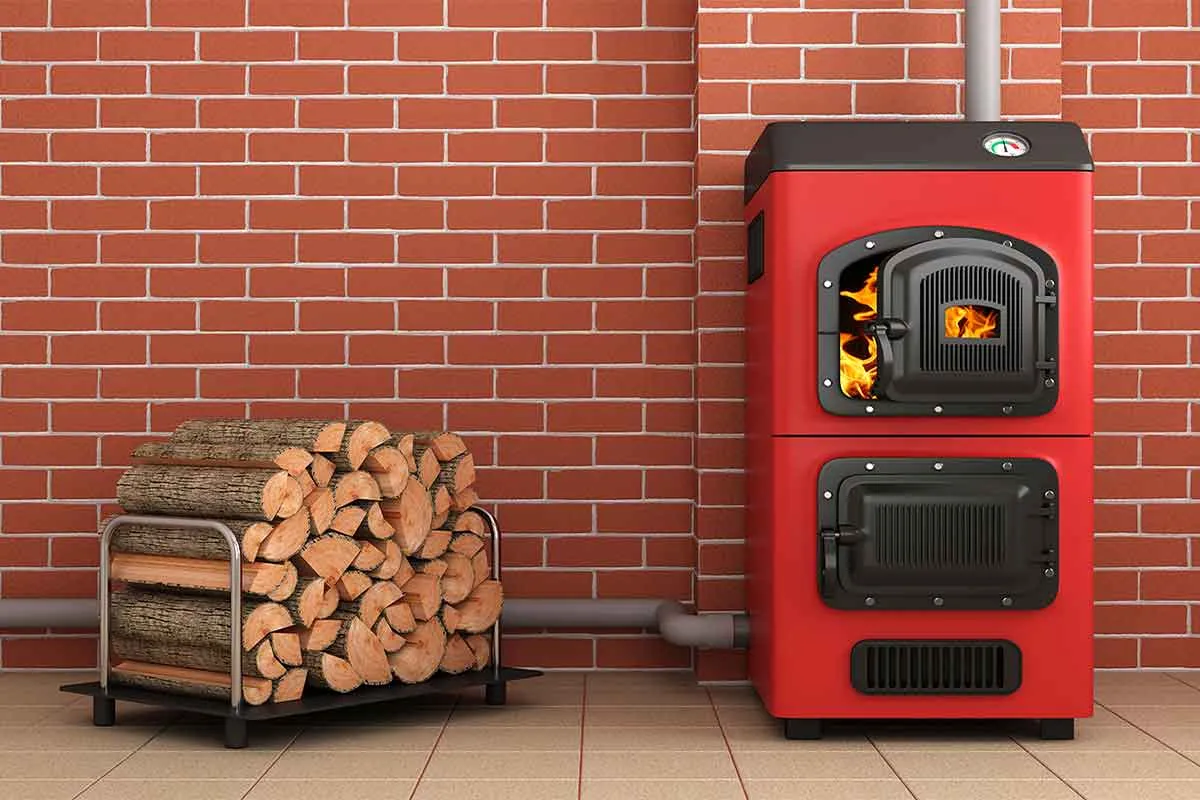
As homeowners and businesses across England and Wales continue to transition away from fossil fuels toward sustainable, low-carbon heating solutions, the biomass boiler has cemented its place as a powerhouse of renewable energy. Particularly popular in rural, off-grid properties and large commercial estates, biomass heating systems offer an eco-friendly and cost-effective way to generate warmth and hot water by burning organic materials such as wood pellets, wood chips, or logs.
However, unlike a conventional mains gas boiler that burns a clean, uniform gas and can practically be forgotten about until its yearly check-up, a biomass boiler is a complex mechanical appliance that burns solid fuel. Combustion of solid wood naturally produces ash, soot, and tar, while relies on moving parts like augers, fans, and motorised grates to function seamlessly.
Because of these unique operational demands, regular maintenance is not just a recommendation—it is an absolute necessity. One of the most common questions property owners and facility managers ask is: How often do I actually need a biomass boiler service?
In this comprehensive guide, we will explore the ideal servicing intervals for domestic and commercial systems in England and Wales, the legal and financial implications of maintenance, what a comprehensive service entails, and who to trust to keep your renewable heating system running at peak efficiency.
How Often Should You Schedule a Biomass Boiler Service?
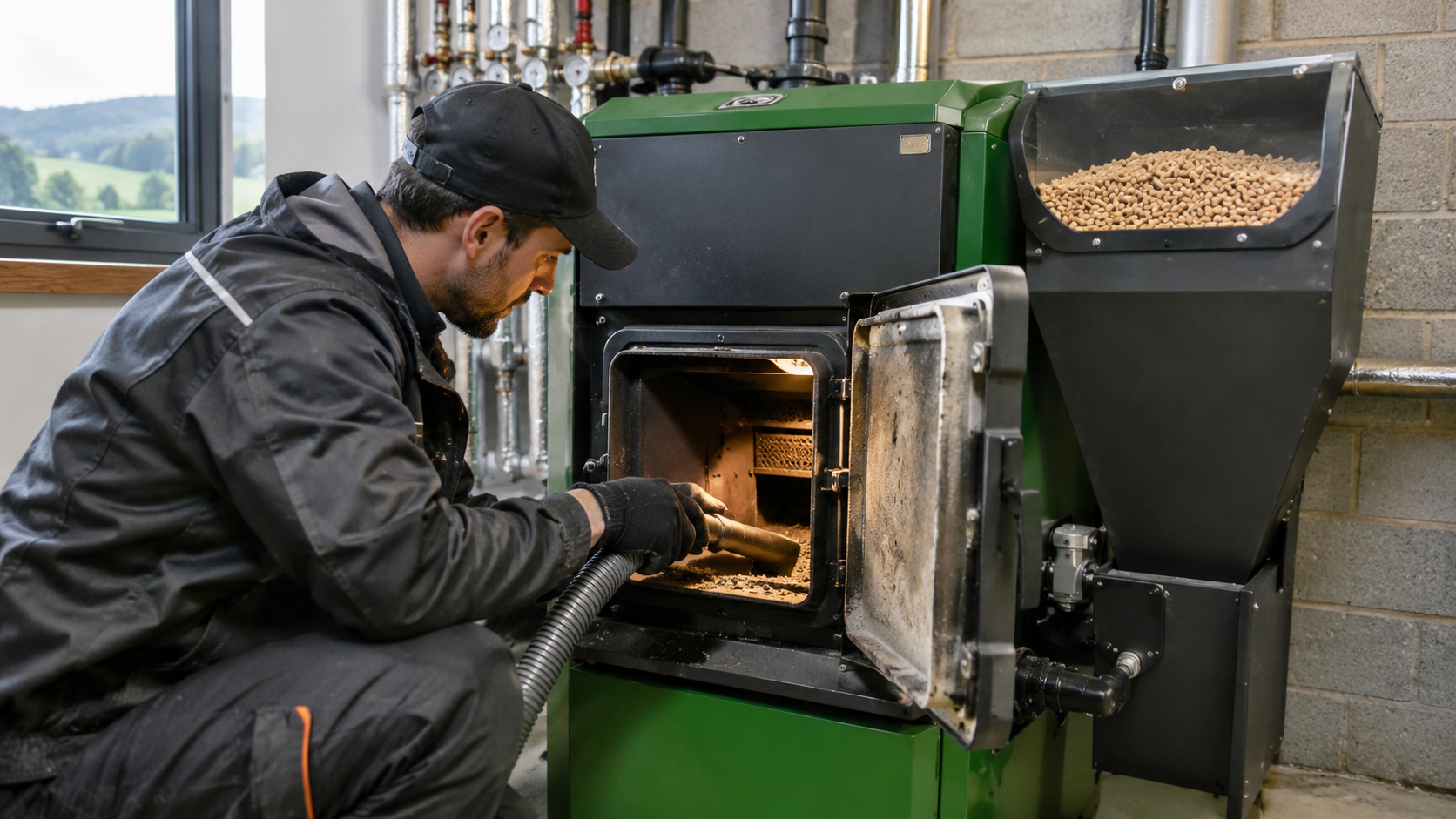
The short answer is that every biomass boiler in England and Wales requires a professional service at least once a year (every 12 months). However, depending on the size of your boiler, the type of fuel you use, and whether the system is installed in a residential or commercial setting, a single annual visit may not be enough.
To determine the exact frequency of your biomass boiler service, engineers look at two primary metrics: calendar time and operating hours.
1. Domestic Biomass Boilers
For the vast majority of residential properties using a wood pellet or log batch biomass boiler, a full professional service should be conducted once every 12 months, or after every 1,500 to 2,000 operating hours—whichever comes first.
In a standard family home in England or Wales, the boiler works hardest during the autumn and winter months and sits relatively idle—or only heats domestic hot water—during the summer. Scheduling an annual service in late summer or early autumn ensures the system is clean, calibrated, and ready to handle the heavy winter load.
2. Commercial and Industrial Biomass Boilers
For commercial installations—such as schools, care homes, agricultural facilities, hotels, and district heating networks—the demands placed on the system are significantly higher. These boilers often run continuously throughout the year and consume vast quantities of fuel.
- Medium-Usage Commercial Systems: Typically require a professional biomass boiler service twice a year (every 6 months).
- High-Usage / Industrial Systems: Boilers running near-continuously (exceeding 3,000 to 4,000 operating hours per year) or burning lower-grade wood chips may require servicing quarterly (every 3 months).
3. How Fuel Type Affects Service Frequency
The type and quality of biomass fuel you burn directly impact how quickly soot and ash accumulate inside the heat exchanger and flue:
- Wood Pellets (ENplus A1 standard): Burn very consistently with low ash content (usually less than 0.7%). Annual servicing is normally sufficient for domestic systems.
- Wood Logs: Provided the logs are properly seasoned or kiln-dried to a moisture content below 20%, annual professional servicing remains standard, though the user will need to clean the chamber more frequently.
- Wood Chips: Wood chips vary more in moisture content, size, and bark percentage. Because they produce more ash and clinker (fused ash), wood chip boilers require more frequent mechanical inspections and servicing.
Why Regular Biomass Boiler Servicing is Crucial in England and Wales
Skipping or delaying a biomass boiler service is a false economy. While you might save the upfront cost of an engineer’s call-out fee in the short term, the long-term financial, legal, and safety repercussions can be severe. Here is why sticking to a strict servicing schedule is vital:
1. Maintaining RHI and Boiler Upgrade Scheme Compliance
Many biomass boilers in England and Wales are registered under the legacy Domestic or Non-Domestic Renewable Heat Incentive (RHI) or were installed via the Boiler Upgrade Scheme (BUS) administered by Ofgem.
Under Ofgem regulations, participants receiving RHI tariff payments have an ongoing legal obligation to maintain their heating equipment in good working order. You are required to follow the manufacturer’s servicing guidelines and retain documented proof (invoices and service certificates) of an annual biomass boiler service carried out by a suitably qualified engineer (such as a HETAS-registered professional). Failure to produce these records during an Ofgem audit can result in suspended payments, financial penalties, or permanent revocation from the scheme.
2. Maximising Fuel Efficiency and Lowering Heating Bills
As a biomass boiler operates, a fine layer of fly ash and carbon deposits settles on the internal surfaces of the heat exchanger. Fly ash acts as an remarkably effective thermal insulator.
Industry studies show that just 1 millimetre of soot or ash build-up on a heat exchanger can reduce the boiler’s heat transfer efficiency by up to 5%. If left uncleaned for over a year, efficiency can plummet by 15% to 20%. This means your boiler has to burn significantly more wood pellets or chips to produce the same amount of heat, driving up your annual fuel bills unnecessarily.
3. Protecting Your Manufacturer Warranty
Biomass boilers are significant capital investments, often costing between £10,000 and £25,000+ for domestic systems, and much more for commercial plants. Manufacturers such as Windhager, ETA, Fröling, Ökofen, and Herz offer generous warranties ranging from 3 to 7 years. However, every single one of these warranties includes a strict clause: the boiler must be serviced annually by an approved, competent engineer. If a major component fails and your service logbook is incomplete, the manufacturer will almost certainly void your claim.
4. Ensuring Safety and Preventing Flue Fires
Safety is paramount with any solid-fuel appliance. Incomplete combustion caused by poor airflow, faulty lambda sensors, or damp fuel can lead to a build-up of highly flammable creosote and tar inside the flue liner. Without regular sweeping and servicing, this can ignite and cause a devastating chimney fire. Furthermore, blocked flues or degraded door seals can allow lethal Carbon Monoxide (CO) gas to leak into your plant room or home. Building Regulations Approved Document J in England and Wales highlights the necessity of maintaining solid fuel flues and ventilation systems in safe working order.
5. Preventing Expensive Breakdowns
Unlike gas boilers, biomass systems rely on heavy-duty mechanical components: fuel delivery augers, suction turbines, ignition heat guns, automated de-ashing grates, and draught fans. During a routine biomass boiler service, an engineer will lubricate bearings, check drive chains, and spot worn components before they snap or seize in the dead of winter.
What Does a Professional Biomass Boiler Service Entail?
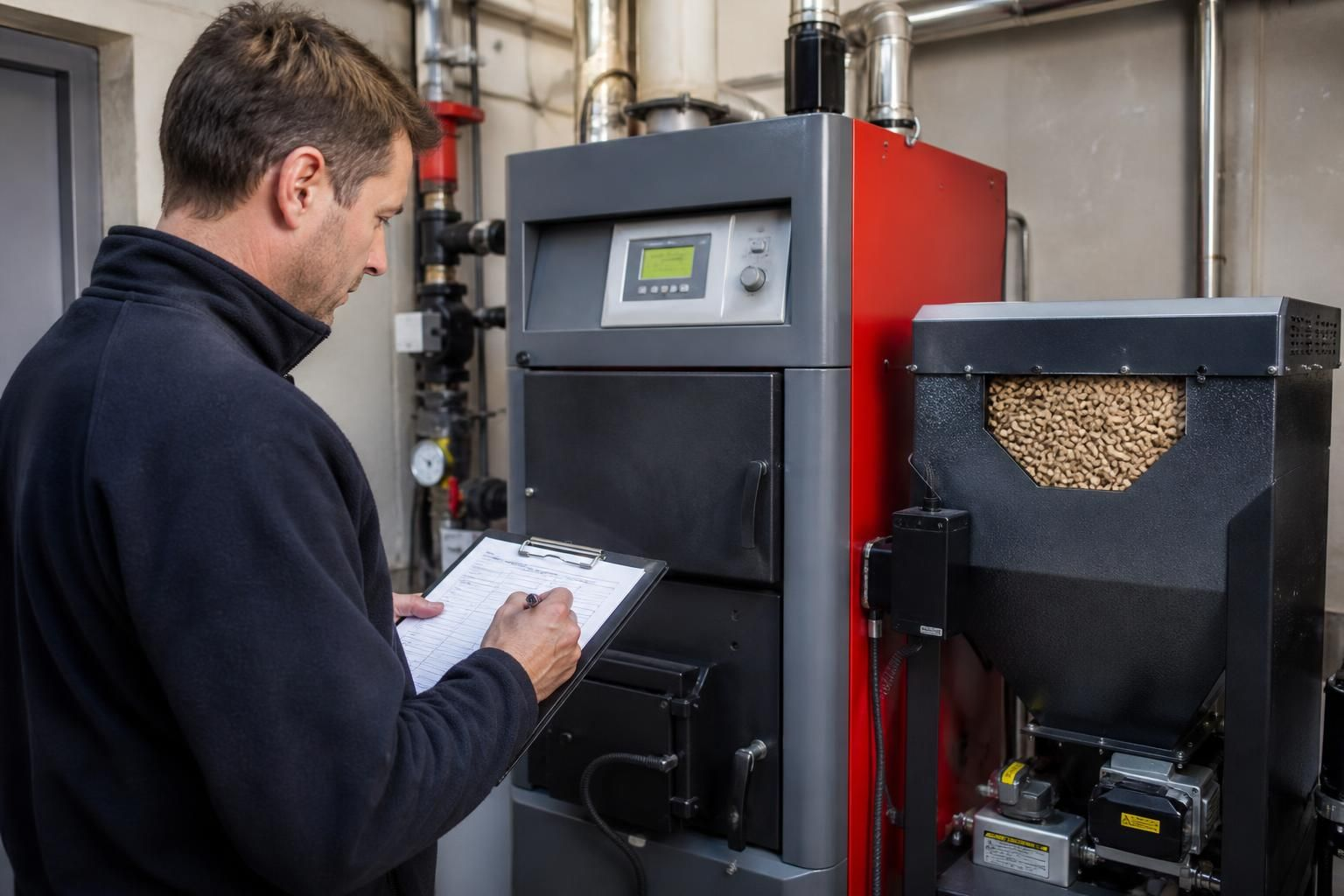
A professional biomass boiler service is far more intensive than a standard 30-minute gas boiler check. Depending on the make, model, and condition of the unit, a thorough biomass service typically takes a specialist engineer anywhere from 2 to 5 hours to complete.
Here is a breakdown of what a comprehensive service checklist includes:
- Full Shutdown and Safe Isolation: The boiler is safely burned down, cooled, and electrically isolated before mechanical stripping begins.
- Combustion Chamber Strip and Clean: The engineer removes the firebricks, burner pot, and grates, scraping away stubborn carbon deposits and clinker (slag formed by melted ash and silica). Firebricks are inspected for cracks or thermal degradation.
- Heat Exchanger and Turbulator Cleaning: Even if your boiler has an automatic tube-cleaning mechanism, the turbulators (spiral metal baffles inside the heat exchanger tubes) must be removed and brushed clean, and the tubes thoroughly vacuumed using specialist industrial HEPA ash vacuums.
- Flue and Draught Inspection: Cleaning out the horizontal flue connector pipe where heavy fly ash settles, inspecting the main chimney liner, and checking the induced draught (ID) fan blades for balance and soot build-up.
- Fuel Feed System Check: Inspecting the auger screw, drop chute, rotary valves, or vacuum suction hoses for blockages, sawdust build-up, and mechanical wear. Testing fire-stop safety mechanisms (such as rotary airlocks or dousing valves) that prevent burn-back into the fuel store.
- Ignition and Sensor Calibration: Cleaning and testing the optical flame sensor (photocell) and checking the electric igniter element. Calibrating the Lambda probe (oxygen sensor) in the flue, which is critical as it tells the boiler’s computer how to mix air and fuel for clean combustion.
- Hydraulic and Wet System Checks: Testing the system water pressure, checking the expansion vessel charge, inspecting the loading valve/unit (which prevents cold return water from causing boiler condensation and corrosion), and testing pressure relief valves.
- Software Updates and Flue Gas Analysis: Checking the boiler’s onboard computer fault logs, updating firmware if necessary, firing the boiler back up, and performing a digital flue gas analysis to ensure Carbon Monoxide (CO) and Oxygen (O2O2) levels are within the manufacturer’s exact parameters.
Daily, Weekly, and Monthly Maintenance: What Owners Should Do
While an annual biomass boiler service must be left to certified professionals, owning a biomass boiler is a partnership. To keep the system healthy between professional visits, owners in England and Wales must perform basic user maintenance:
- Emptying the Ash Pan (Weekly to Monthly): Depending on your boiler model and seasonal usage, you must empty the ash bins before they overflow. Overflowing ash can block the burner pot and suffocate the fire.
- Visual Checks of System Pressure (Monthly): Glance at the pressure gauge on your hydraulic system (usually it should sit between 1.0 and 2.0 bar when cold).
- Cleaning the Fuel Store (Annually / Every 1–2 Years): Over time, wood pellets break down at the bottom of your hopper or silo, creating fine sawdust (“fines”). Too much sawdust will jam the auger and ruin combustion. Your fuel store should be vacuumed out before every second or third bulk delivery.
- Buying High-Quality Fuel (Ongoing): Only purchase fuels certified by Woodsure (Ready to Burn for logs) or ENplus A1 for wood pellets. Cheap, high-moisture fuel is the number one cause of mid-winter biomass boiler breakdowns.
5 Warning Signs Your Biomass Boiler Needs an Immediate Service
Even if your annual service isn’t due for several months, you should book an immediate inspection if you notice any of the following red flags:
- Dark or Excessive Smoke: A well-tuned biomass boiler should produce little to no visible smoke from the flue once it is up to operating temperature (only a heat haze or white steam in cold weather). Black or thick grey smoke indicates incomplete combustion and oxygen starvation.
- Clinker in the Ash Pan: If you find hard, glassy, rock-like lumps in your ash pan instead of fine grey powder, your combustion temperatures or fuel quality are off, and the burner pot may be blocking up.
- Frequent Ignition Failures or Error Codes: If the boiler repeatedly fails to light or throws up “Lambda fault,” “Ignition timeout,” or “Overtemp” errors, components are either dirty or failing.
- Unusual Mechanical Noises: Grinding, squealing, or loud clunking sounds coming from the auger motor, cleaning mechanism, or flue fan point to dry bearings or jammed debris.
- Lukewarm Radiators or High Fuel Consumption: If your pellet hopper is emptying much faster than usual while your property struggles to get warm, your heat exchangers are likely fouled or your loading valve is stuck.
Expert Biomass Boiler Service from Proadvance in Reading, Berkshire
When it comes to protecting your investment and ensuring your renewable heating system operates safely and efficiently, choosing the right engineering partner makes all the difference. Standard gas engineers do not possess the qualifications, specialist diagnostic tools, or parts access required to work on solid-fuel renewable systems.
If you are looking for a reliable, highly skilled biomass boiler service, look no further than Proadvance.
Based in Reading, Berkshire, Proadvance is a premier renewable energy and specialist heating company serving homeowners, landlords, estates, and commercial clients across Berkshire, the wider South East, and throughout England and Wales.
Why Choose Proadvance for Your Biomass Boiler?
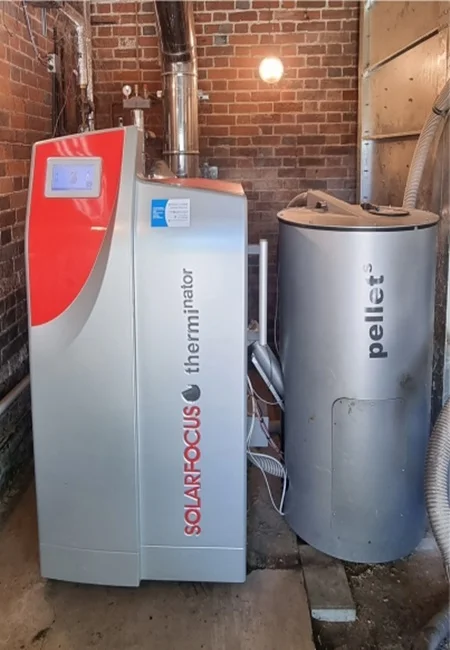
- Unrivalled Specialist Expertise: The engineering team at Proadvance specialises in renewable heating technologies. They possess deep technical knowledge across a wide spectrum of leading biomass boiler manufacturers, understanding the intricate mechanical and electronic nuances of pellet, chip, and log systems.
- Comprehensive Servicing & Breakdown Cover: Whether you need a routine annual biomass boiler service to maintain your RHI compliance and warranty, an emergency breakdown repair, or a complete system health check, Proadvance delivers meticulous workmanship. They don’t just vacuum the ash—they strip, clean, calibrate, and optimise your boiler for peak performance.
- Domestic and Commercial Capabilities: From residential off-grid homes in rural villages to large commercial plant rooms and agricultural installations, Proadvance has the capacity and certifications to manage systems of all outputs and complexities.
- Strategic Location in Reading, Berkshire: Situated conveniently along the M4 corridor in Reading, Proadvance is ideally positioned for rapid response times across Berkshire, Oxfordshire, Hampshire, Surrey, Wiltshire, Buckinghamshire, and further afield across England and Wales.
- Holistic Renewable Heating Support: Because biomass systems are almost always integrated with complex thermal stores, buffer tanks, underfloor heating, and sometimes solar thermal or heat pumps, Proadvance’s multi-disciplinary expertise ensures your entire heating infrastructure works in harmony.
Don’t wait until the freezing temperatures of winter reveal a hidden fault in your heating system. Protect your warranty, slash your fuel costs, and stay compliant with Ofgem regulations by booking your service with a trusted local specialist.
Ready to book your biomass boiler service? Visit https://proadvance.co.uk today to learn more about their renewable heating services or to get in touch with their friendly, expert team in Reading, Berkshire.
Conclusion
Owning a biomass boiler in England and Wales is a fantastic way to reduce your carbon footprint and achieve energy independence. However, the secret to a long-lasting, trouble-free system lies in proactive maintenance.
To recap: domestic biomass boilers must be serviced at least once every 12 months, while commercial systems require servicing every 3 to 6 months depending on operational hours and fuel type. By combining good day-to-day fuel management with a rigorous annual biomass boiler service from qualified specialists like Proadvance, you will ensure your boiler delivers reliable, eco-friendly warmth for decades to come.
