

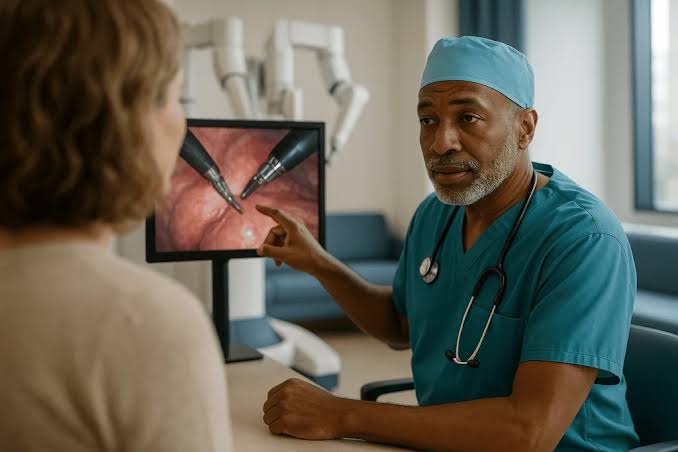
Not long ago, bowel surgery almost always meant a long incision and a lengthy recovery. Today, many colon and rectal operations can be done through a few small cuts. Here’s how these modern techniques work.
From Long Scars to Keyholes
For many people, the idea of bowel surgery brings to mind images of a large scar down the middle of the abdomen, a long hospital stay and weeks of slow recovery. For decades, that was the reality for most patients.
Today, the picture has changed. Advances in surgical technology mean that many colon and rectal operations can now be performed through small incisions, using cameras, specialised instruments and, in some cases, robotic systems.
These minimally invasive approaches have transformed recovery for many patients. But they’re not right for everyone. Understanding your options can help you have a more informed conversation with your colorectal surgeon.
When Is Colon and Rectal Surgery Needed?
Colon and rectal surgery may be recommended for a range of conditions, including:
- Colorectal cancer – removing the affected section of bowel and nearby lymph nodes
- Large or complex polyps – that can’t be removed safely during colonoscopy
- Diverticular disease – especially with repeated or complicated attacks of diverticulitis
- Inflammatory bowel disease – such as Crohn’s disease or ulcerative colitis that doesn’t respond to medication
- Rectal prolapse – where the rectum slips out through the anus
- Bowel obstruction – a blockage in the intestine
Types of Colon and Rectal Surgery
The name of the operation usually describes which part of the bowel is removed:
- Right hemicolectomy – removes the right side of the colon
- Left hemicolectomy – removes the left side of the colon
- Sigmoid colectomy – removes the sigmoid colon, the S-shaped part near the rectum
- Anterior resection – removes part or all of the rectum
- Total colectomy – removes the entire colon
In most cases, the healthy ends of the bowel are joined back together, a connection called an anastomosis. Sometimes a temporary or permanent stoma is needed, where the bowel is brought out through an opening in the abdomen to empty into a bag.
Approaches to Colon and Rectal Surgery
Open surgery
In open surgery, the surgeon makes a single, larger incision in the abdomen to access the bowel directly. It’s still the best option in some situations, such as certain emergencies, very large tumours or when there’s extensive scar tissue from previous operations.
Laparoscopic (keyhole) surgery
In laparoscopic surgery, the surgeon makes several small incisions, usually between 0.5 and 1.5 centimetres. A thin camera, called a laparoscope, is inserted through one incision, showing a magnified view of the inside of the abdomen on a screen. Long, narrow instruments are passed through the other incisions to perform the operation.
A slightly larger incision may be needed to remove the section of bowel.
Robotic surgery
Robotic surgery is an advanced form of minimally invasive surgery. The surgeon sits at a console in the operating theatre and controls robotic arms that hold the camera and instruments.
The robot doesn’t operate on its own. Every movement is controlled by the surgeon. The system offers:
- A high-definition 3D view – giving the surgeon excellent depth perception
- Wristed instruments – that can bend and rotate more than the human hand
- Tremor filtering – for steady, precise movements
- Better access – to tight spaces, such as deep in the pelvis
Robotic surgery can be particularly helpful in rectal surgery, where the rectum sits in a narrow space in the pelvis surrounded by important nerves and structures. Not all surgeons are trained in robotic surgery, so it’s worth asking about your surgeon’s experience.
Benefits of Minimally Invasive Surgery
Compared with open surgery, minimally invasive colon and rectal surgery may offer:
- Less pain – after surgery
- Smaller scars
- Shorter hospital stays
- Faster return of bowel function
- Quicker return to normal activities
- Lower risk of some wound complications – such as wound infections and hernias
For colorectal cancer, studies have shown that laparoscopic surgery, when performed by experienced surgeons, can achieve similar cancer outcomes to open surgery for suitable patients.
Is Minimally Invasive Surgery Right for You?
Many patients are suitable for laparoscopic or robotic surgery, but your surgeon will consider factors such as:
- The type and location of your condition
- The size and stage of a tumour
- Previous abdominal surgery and scar tissue
- Your overall health and fitness for anaesthesia
- Whether it’s a planned or emergency operation
Sometimes, a minimally invasive operation needs to be converted to open surgery during the procedure for safety reasons. This is a sound surgical decision, not a failure.
Preparing for Surgery
Before your operation, you may:
- Have tests, such as blood tests, scans and a heart check
- Meet the anaesthetist
- Receive advice on eating, drinking and medications before surgery
- Be given bowel preparation, depending on your operation
- Learn about stoma care, if a stoma is possible
- Take part in an Enhanced Recovery After Surgery (ERAS) programme
What is ERAS?
Enhanced Recovery After Surgery programmes aim to help patients recover faster. They may include eating and drinking soon after surgery, getting out of bed early, carefully planned pain relief and avoiding unnecessary tubes and drains.
Recovery After Minimally Invasive Surgery
Recovery varies, but many patients:
- Start walking within a day of surgery
- Begin drinking and eating soon after
- Go home within a few days
- Return to light activities within a couple of weeks
- Avoid heavy lifting for several weeks to allow the abdominal wall to heal
Your surgeon will give you specific advice based on your operation.
Questions to Ask Your Colorectal Surgeon
- What type of surgery do you recommend, and why?
- Am I suitable for laparoscopic or robotic surgery?
- How many of these operations have you performed?
- Will I need a stoma?
- How long will I stay in hospital?
- When can I return to work and normal activities?
- What are the risks?
Modern Surgery, Better Recovery
Minimally invasive and robotic techniques have changed what colon and rectal surgery looks like for many patients. While open surgery still has its place, smaller incisions often mean less pain and a quicker return to everyday life.
Consult a colorectal surgeon to discuss whether minimally invasive or robotic colon and rectal surgery is suitable for you.
This article describes surgical approaches in general terms. The most suitable operation for you can only be determined after a full assessment by your surgeon.
