

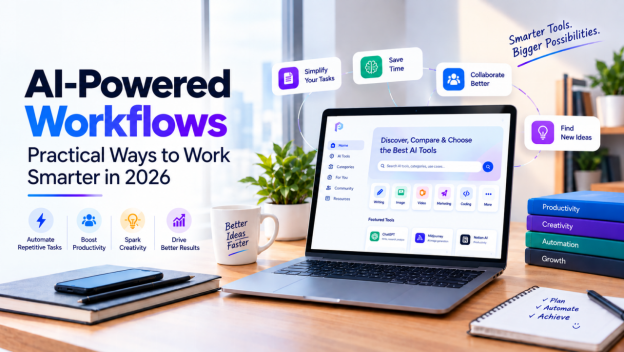
Artificial intelligence is changing how businesses and professionals work. In 2026, AI is no longer limited to chatbots or individual tasks. Companies are increasingly using different AI capabilities together to improve productivity, reduce repetitive work, and create smoother business processes.
An AI-Powered Workflows approach means using AI at different stages of the same process. For example, a marketing team may use AI for research, content creation, campaign planning, and reporting, while keeping human experts involved in important decisions.
The goal is not to replace people. It is to make everyday work more organized, efficient, and scalable.
What Are AI-Powered Workflows?
An AI workflow connects multiple tasks into a structured process. Instead of completing every step manually, businesses can use AI where it provides the most practical value.
A typical workflow might include:
- Researching and organizing information
- Creating or improving content
- Processing repetitive data
- Managing customer requests
- Analyzing results and generating reports
When these activities are connected properly, teams can spend less time moving information between tasks and more time working on higher-value activities.
Improve Daily Work With AI Productivity Tools
Many professionals spend hours managing meetings, documents, emails, notes, and routine tasks. AI productivity tools can simplify these activities and help employees manage information more efficiently.
For example, AI can help with:
- Meeting summaries and action items
- Document and information organization
- Task planning and prioritization
- Quick summaries of lengthy information
These small improvements can make a significant difference when the same processes are repeated every day.
Create Better Content With AI Writing & Content Tools
Content creation often involves several stages, including research, brainstorming, writing, editing, and optimization. AI writing & content tools can support different parts of this process.
A writer might use AI to:
- Generate initial topic ideas
- Create a basic content outline
- Improve sentence structure and readability
- Develop different versions of content
- Identify areas that need further explanation
Human review remains essential. Writers and editors should verify facts, maintain brand voice, and make sure the final content provides genuine value to the audience.
Work Faster With AI Coding Tools
Software development is another area where AI can reduce repetitive effort. Developers can use AI coding tools to assist with coding, debugging, documentation, and understanding existing code.
Some common applications include:
- Generating repetitive code structures
- Explaining unfamiliar code
- Finding potential coding issues
- Creating technical documentation
- Supporting debugging and testing
AI can speed up development, but developers should still review and test generated code. Security, performance, and compatibility should always be checked before production use.
AI Agents for Multi-Step Work
AI agents are becoming an important part of modern workflows. Unlike a basic AI tool that usually responds to one request, an AI agent can work through multiple steps toward a specific objective.
For example, an agent may be able to:
- Research information and organize the findings
- Handle routine customer or business requests
- Support marketing research and campaign activities
This makes agents useful for processes where several connected actions are required.
Businesses should establish clear instructions, permissions, and review processes before allowing agents to perform important actions independently.
Reduce Repetitive Tasks With AI automation
Repetitive processes can take up valuable working hours. AI automation allows businesses to connect tasks and trigger actions automatically when certain conditions are met.
Common examples include:
- Lead collection and management
- Customer inquiry routing
- Email and document processing
- Data entry and reporting
- Internal task notifications
For the best results, businesses should start with simple and predictable processes. Once a workflow is reliable, additional steps can be introduced gradually.
Build Smarter Marketing Workflows
Marketing teams can use AI across research, content planning, social media, email campaigns, advertising, and performance analysis.
AI marketing tools can help marketers:
- Research keywords and audiences
- Generate campaign ideas
- Create content variations
- Analyze marketing information
- Identify patterns in campaign performance
AI can speed up execution, but marketing strategy should still be guided by people who understand the brand, customers, and business goals.
Connect Different AI Capabilities
The biggest opportunity often comes from combining different tools rather than using each one separately.
For example, a content workflow could connect:
Research → Content creation → SEO optimization → Review → Publishing
A business workflow could connect:
Customer inquiry → Data processing → AI response → Team notification → Follow-up
Connecting these steps reduces unnecessary manual work and creates a more consistent process.
Keep Human Expertise at the Center
AI can handle many repetitive activities, but human judgment remains important. Businesses should carefully review AI output when workflows involve important decisions or sensitive information.
Human oversight is especially valuable for:
- Financial or business-critical decisions
- Customer communication
- Sensitive or confidential information
- Security-related activities
- Final content and quality checks
The strongest workflows combine AI efficiency with human experience rather than relying entirely on automation.
Discover AI Solutions for Different Needs
With thousands of AI solutions available today, finding the right tool can sometimes be difficult. PoweredByAI helps users discover AI solutions across different categories and professional use cases.
Whether someone needs productivity, writing, coding, marketing, automation, or AI agent solutions, exploring tools based on a specific need can make the selection process easier.
Instead of choosing a tool simply because it is popular, businesses should consider whether it solves a real problem and fits naturally into their existing workflow.
Conclusion
AI is becoming an important part of how modern teams work. From productivity and content creation to coding, marketing, automation, and AI agents, businesses can now use specialized AI capabilities across different stages of their daily processes.
A successful workflow does not require automating everything at once. A better approach is to identify repetitive tasks, introduce suitable AI solutions, measure the results, and gradually improve the process.
When technology and human expertise work together, AI can help teams save time, improve consistency, and focus more attention on work that requires creativity, strategy, and judgment.
