

The cloud job market has never rewarded hesitation. While thousands of engineers spend months building AWS skills on the side, the ones landing $140,000+ roles are the ones who committed—got structured, got certified, and got visible. The AWS DevOps certification is not just a badge on your LinkedIn profile. It is the difference between being shortlisted and being skipped. If you work with AWS infrastructure, CI/CD pipelines, or automation at any level, this credential is the clearest signal you can send to a hiring manager that you are ready for the serious work. Before diving in, the AWS DevOps certification guide from Thinkcloudly is worth bookmarking—it covers every exam domain, salary data, and study strategy in one place.
This guide breaks down what the AWS Certified DevOps Engineer – Professional exam actually demands, how the job market responds to it, and what a realistic preparation path looks like for working engineers.
What the AWS DevOps Certification Actually Is
The AWS Certified DevOps Engineer – Professional (DOP-C02) sits at the top of Amazon Web Services’ certification hierarchy. It is not an entry-level exam. AWS designed it for engineers who already work inside cloud environments and want to validate their ability to design, automate, and manage complex production systems at scale.
The current version—DOP-C02—launched in March 2023 with significant changes over its predecessor. Security and compliance automation became a dedicated domain. Cost optimization got its own section. Multi-account architecture, once considered an advanced topic, became a core exam requirement. These changes reflect how enterprise cloud operations actually work today, not how they worked five years ago.
If you want a complete breakdown of every exam domain, domain weights, and the services you need to know before test day, the AWS DevOps certification guide from Thinkcloudly covers it in depth—including sample questions that mirror the real exam format.
Who Should Pursue This Credential
The DOP-C02 targets engineers who already have meaningful AWS experience. Specifically, AWS recommends at least two years of hands-on work in DevOps, SRE, or cloud infrastructure roles before attempting this exam.
You are a strong candidate if you:
- Work daily inside CI/CD pipelines and understand their failure modes
- Have deployed infrastructure using CloudFormation, Terraform, or AWS CDK in production
- Handle monitoring, alerting, and incident response on AWS systems
- Have at least an associate-level AWS certification, or equivalent working knowledge
If you are still building your AWS fundamentals, start with AWS Solutions Architect – Associate or Developer – Associate first. Jumping into the professional level without hands-on experience tends to result in failure, regardless of how many practice questions you complete.
For engineers who are ready and want instructor-led preparation with real AWS lab environments, Thinkcloudly’s AWS Certified DevOps Engineer course is structured specifically for working professionals at this stage. It covers every exam domain with hands-on projects and live instructor support — so you are not preparing in isolation.
The Six Exam Domains and Why Each One Matters
The DOP-C02 covers six domains, each weighted by percentage of total exam questions. Understanding the weight distribution changes how you allocate your study time.
SDLC Automation — 22% This is the largest domain and covers CI/CD pipeline design, CodePipeline orchestration, CodeBuild configuration, and automated delivery workflows. Every question in this domain is scenario-based—you are given a real deployment problem and asked to choose the right configuration, not just identify what a service does.
Resilience and Observability — 20% Together with SDLC Automation, this domain covers nearly half the exam. You need deep knowledge of CloudWatch, AWS X-Ray, distributed tracing, fault tolerance architectures, and health check design. Gaps here are expensive on exam day.
Configuration Management and IaC—17% CloudFormation nested stacks, stack sets for multi-account deployments, drift detection, and AWS CDK for teams using general-purpose programming languages. This domain tests depth, not surface-level familiarity.
Incident and Event Response—15% EventBridge rules, Lambda-based automated remediation, Systems Manager runbooks, and how to build self-healing architecture. Scenario questions here tend to involve multi-step response workflows.
Security and Compliance Automation — 14% This domain grew significantly from DOP-C01. AWS Config for compliance tracking, Secrets Manager for credential rotation, IAM policy design, and automated security scanning pipelines are all fair game.
Cost and Performance Optimization — 12% Rightsizing recommendations, cost-aware architecture patterns, and identifying performance bottlenecks across distributed systems. Often underestimated in preparation—do not treat it as a throwaway section.
SDLC Automation and Resilience together account for 42% of the exam. Any study plan that does not treat these two as priority domains is costing real marks.
Key AWS Services You Need to Know Cold
The DOP-C02 is entirely scenario-based, which changes what “knowing” a service actually means. You will not be asked to define what CodePipeline does. You will be given a multi-stage deployment failure and asked which configuration combination resolves it most efficiently. That distinction matters enormously for how you prepare.
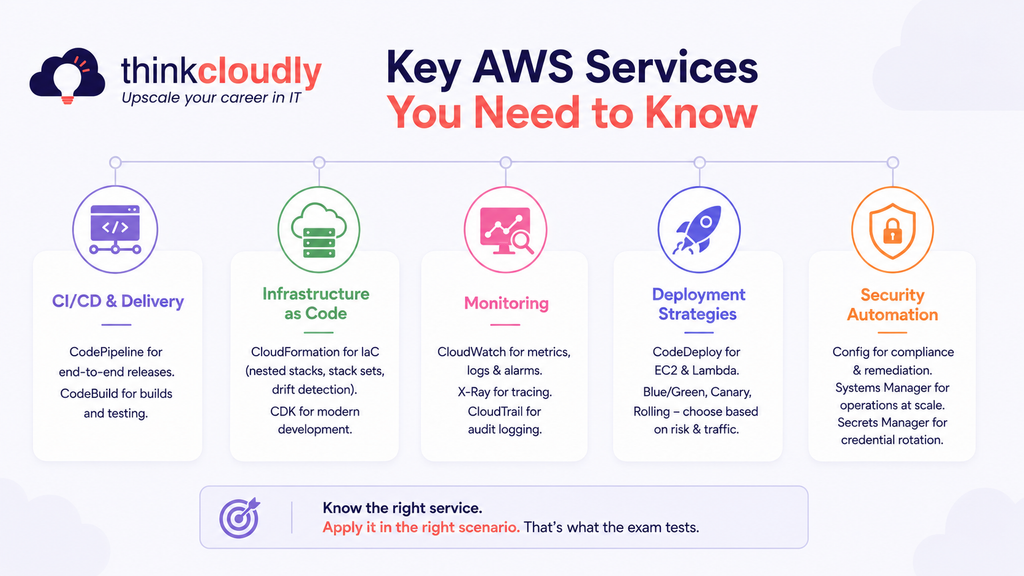
- For CI/CD and Delivery: AWS CodePipeline orchestrates full release workflows—source, build, test, and deploy stages. AWS CodeBuild handles compilation and test execution in fully managed build environments. These two services appear more than any others in the delivery domain.
- For Infrastructure as Code: AWS CloudFormation is the native IaC tool—know nested stacks, stack sets for multi-account deployments, and drift detection in detail. AWS CDK is increasingly relevant for teams that prefer Python or TypeScript over YAML templates.
- For Monitoring: Amazon CloudWatch covers metrics, logs, and alarms. AWS X-Ray handles distributed tracing across microservices. CloudTrail manages audit logging. Know how these three work together under the AWS Well-Architected Framework’s Reliability and Security pillars.
- For Deployment Strategies: AWS CodeDeploy for EC2 and Lambda deployments. Understand the difference between blue/green, canary, and rolling deployments — and when to use each based on risk tolerance and traffic patterns.
- For Security Automation: AWS Config for continuous compliance and automated remediation. AWS Systems Manager for operational management at scale. AWS Secrets Manager for credential rotation without application-side changes.
What the Job Market Actually Pays for This Certification
Salary data from ZipRecruiter, Glassdoor, and Built In all points in the same direction: the AWS DevOps certification continues to hold its market value even as parts of the broader tech sector have contracted. The credential also carries a measurable salary premium—certified engineers typically earn 15 to 25 percent more than non-certified engineers at the same experience level. Engineers who add Solutions Architect Professional or AWS Security Specialty after DOP-C02 report 30 to 40 percent higher total compensation compared to single-certification holders.
The active job market for roles requiring this specific credential sits above 6,000 listings. That is not general cloud experience—that is demand specifically for the DOP-C02 qualification. Here is what the compensation landscape looks like by role in 2026:
| Role | Base Salary Range (US, 2026) | Notes |
| DevOps Engineer (Mid-level) | $103,500 – $144,000 | Most direct benefit from DOP-C02 |
| Senior DevOps Engineer | $144,000 – $175,000 | 3+ years post-certification |
| Site Reliability Engineer (SRE) | $130,000 – $170,000 | Strong AWS automation required |
| Platform Engineer | $130,000 – $175,000 | IaC and internal tooling focus |
| Cloud Automation Architect | $150,000 – $190,000 | SA-Pro combined preferred |
| DevOps Consultant | $110,000 – $155,000 | Varies by engagement type |
The ceiling is real—and it is accessible. Engineers at the senior level who combine DOP-C02 with hands-on architecture experience consistently land at the upper end of these ranges or beyond them.
A Realistic 3 to 6 Month Study Plan
Most working engineers need three to six months of structured preparation. Trying to compress it further without hands-on AWS access tends to produce surface knowledge that fails on scenario-based questions.
Months 1–2: Close the knowledge gaps through building. Set up an actual CI/CD pipeline using CodePipeline and CodeBuild. Deploy real infrastructure with CloudFormation. Build a monitoring stack using CloudWatch and X-Ray. The goal is not to read about these services—it is to use them until their behaviour under different conditions becomes intuitive.
Months 2–4: Own the heavy domains. Security Automation, Resilience, and SDLC Automation together cover more than 55 percent of the exam. Work through the AWS Well-Architected Framework whitepapers for the Reliability and Security pillars—these map directly to exam scenarios. Study multi-account architecture through AWS Organizations and Control Tower, because both appear consistently across domain questions.
Months 4–6: Simulate the exam under real conditions. Full-length, timed practice exams. Every wrong answer requires a root-cause review—not just identifying the right answer, but understanding why each incorrect option fails. Target 80 percent or higher on practice sets before booking the actual exam.
For engineers who want a structured path with real AWS labs instead of self-study alone, Thinkcloudly’s AWS Certified DevOps Engineer course provides instructor-led preparation, hands-on projects, and exam-focused depth across every domain. It is built for professionals who want to pass on the first attempt.
Career Paths the DOP-C02 Opens Up
The AWS DevOps certification is not a terminal credential — it is a launch point. Engineers who earn it consistently report access to roles and compensation tiers that were difficult to break into before.
Senior DevOps Engineer / Lead DevOps Engineer — The most direct path. Complex system design, deployment architecture ownership, and technical mentorship of junior engineers.
Cloud Automation Architect — Building the infrastructure platforms and deployment frameworks that other engineering teams operate on. Increasingly common at mid-size and enterprise organizations that have moved beyond basic cloud lift-and-shift.
Site Reliability Engineer (SRE) — Among the highest base salaries in cloud engineering. The DOP-C02 maps directly to SRE core competencies: reliability, observability, and automated incident response.
Platform Engineer — Internal developer platforms, cloud-native abstractions, and tooling that accelerates engineering velocity across an organization.
DevOps Consultant — Enterprise and government clients weight certification credibility heavily. Variety of engagement types with competitive consulting rates.
Engineers who continue to Solutions Architect Professional or AWS Security Specialty after DOP-C02 consistently report access to architectural and leadership roles that stay out of reach for single-credential holders.
How to Register for the DOP-C02 Exam
Registration is straightforward. Go to aws.amazon.com/certification and sign in or create an account—this is your central dashboard for scheduling exams, accessing score reports, and storing digital badges.
AWS exams are delivered through Pearson VUE. From your certification dashboard, select “Schedule an Exam,” and link or create a Pearson VUE account. Use the exact name that appears on your government-issued ID—mismatches can cause problems on exam day.
The exam fee is $300 USD, payable at booking. Certification vouchers apply at checkout. Both testing center and online proctored formats are available. If you choose online proctored, run the Pearson VUE system check at least 48 hours beforehand, and have a quiet, private room with no second monitors ready.
Exam details at a glance:
- 65 questions—multiple choice and multiple response
- 180 minutes to complete
- Passing score: 750 out of 1000 (scaled scoring)
- Certification remains valid for 3 years
- Fee: $300 USD
One practical tip: book your exam date before you feel fully ready. Having a fixed deadline accelerates preparation faster than any study material.
For a complete step-by-step breakdown of the registration process, exam-day ID requirements, and how to choose between testing centre and online proctored formats, the AWS DevOps certification guide covers each step clearly.
Is the AWS DevOps Certification Worth Pursuing in 2026?
The short answer is yes—if you already have real AWS experience.
The salary data shows consistent growth. The job market shows consistent demand. The exam difficulty has increased, which means fewer engineers hold the credential, which keeps the signal value high for those who earn it.
AI tooling is automating routine CI/CD tasks, script generation, and infrastructure health monitoring. This does not eliminate the DevOps engineer role—it shifts value toward architectural judgment, security strategy, and cross-functional decision-making. These are exactly the skills the DOP-C02 validates.
The engineers who will stay most valuable over the next decade are the ones who hold credentials that reflect genuine operational depth, not surface familiarity. The AWS DevOps certification remains one of the clearest signals of that depth in the current market.
Start Your Preparation with a Structured Plan
Passing the DOP-C02 on the first attempt requires more than self-study and YouTube tutorials. It requires hands-on AWS lab time, scenario-based practice, and instruction from engineers who know which concepts carry the most exam weight.
Thinkcloudly’s AWS Certified DevOps Engineer course gives you exactly that—structured, instructor-led preparation with real AWS projects and exam-focused depth across every domain. If you are serious about the credential and want to prepare efficiently, explore the course and enroll today and see if the format fits your timeline.
For additional reading on exam domains, salary benchmarks, and what AWS has changed in the latest version, the AWS DevOps certification guide is worth bookmarking as a reference throughout your preparation.
The credential is hard to earn. That is precisely what makes it worth having.
