

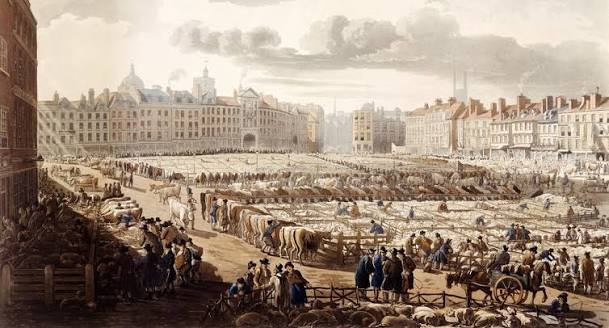
Smithfield is one of the City of London’s most historically layered neighbourhoods. Its streets tell stories of medieval trade, Victorian engineering, religious history and the changing ways Londoners have bought, prepared and enjoyed food. Today, the area brings together remarkable architecture, historic pubs, independent restaurants and a growing cultural scene.
Set between Farringdon, Clerkenwell and the western edge of the Square Mile, Smithfield is well worth exploring on foot. Visitors can admire the market buildings, discover one of London’s oldest churches, wander through narrow historic lanes and finish with a memorable meal. Its appeal lies in that contrast: an area with deep roots in London’s past that continues to find new ways to shape its future.
Smithfield Market: A thousand years of trade
Smithfield’s story begins long before its impressive Victorian market halls appeared. The site served as a livestock market in medieval London, with records describing trading activity here as early as the 12th century. Its position just outside the old city walls made it a practical gathering place for merchants, farmers and buyers bringing animals and goods into the capital.
The market changed considerably during the 19th century. As London’s population expanded, the old open-air arrangements could no longer meet the demands of the city. Construction of the covered market began in 1866, under the direction of architect Sir Horace Jones, who also designed other major London landmarks. The result was an ambitious complex of ironwork, grand façades and innovative infrastructure, including railway access beneath the market buildings.
Walking around West Smithfield today, visitors can appreciate the scale and architectural detail of this Victorian achievement. The market’s history is not simply a story of buildings, however. It is also about generations of traders and workers whose routines shaped the neighbourhood, particularly during the early hours when the wholesale market was busiest.
Smithfield’s next chapter is already taking shape. The City of London Corporation has selected Albert Island in the Royal Docks as the preferred future location for Smithfield and Billingsgate markets, subject to the necessary legislative and planning processes. The historic buildings at the current site are expected to take on new cultural and commercial roles.
Cloth Fair and St Bartholomew the Great: Medieval London still visible
A short walk from the market takes visitors into Cloth Fair, one of Smithfield’s most atmospheric historic streets. Its name recalls the area’s association with Bartholomew Fair, which began in the 12th century as a trading event and gradually developed into a major gathering featuring entertainment, food and commercial activity. The fair ran for more than 700 years before it was closed in 1855.
Nearby, St Bartholomew the Great offers a remarkable glimpse into London’s medieval religious history. Founded in 1123, the church has survived centuries of change and remains one of the capital’s most significant historic buildings. Its Norman architecture, peaceful interior and surrounding churchyard provide a striking contrast to the busy streets nearby.
The church is worth visiting for its architectural character alone, but it also helps explain the historical importance of this part of London. Smithfield was once a place of trade, religious gatherings and public events, and the surviving buildings allow visitors to connect those different chapters of its past.
Discovering Smithfield’s modern food culture
Food remains central to Smithfield’s identity, even as the neighbourhood’s dining scene has expanded beyond its traditional wholesale trade. The surrounding streets now accommodate restaurants, cafés, wine bars and pubs, serving workers, residents and visitors exploring the City.
For a quick taste of everyday local life, Beppe’s Café on West Smithfield offers the familiar atmosphere of a traditional London café. It is the sort of place where visitors can stop for breakfast or a straightforward lunch before continuing their walk. Its unpretentious character provides an interesting counterpoint to the area’s more formal restaurants.
A little further along, Cloth on Cloth Fair brings a more intimate dining experience to the neighbourhood. Its wine-led approach and ingredient-focused cooking suit the historic surroundings, while the restaurant’s setting in an older building adds to the sense of place.
The variety is part of Smithfield’s appeal. Visitors can choose between casual cafés, traditional pubs and destination restaurants, often within a short walk of one another. This mix helps the area remain active beyond its historic market identity.
Restaurant St. Barts: British ingredients and a contemporary dining experience
Among Smithfield’s modern dining destinations, Restaurant St. Barts offers an experience that draws directly on the area’s historic setting. Found at 63 Bartholomew Close, the restaurant overlooks the cloisters of St Bartholomew the Great and takes inspiration from the ingredients, landscapes and producers of the British Isles.
Its tasting menus are built around seasonal British produce, with the kitchen working closely with small-scale farmers, growers and conservationists. Rather than relying on a single regional style, the cooking explores ingredients from across the country, presenting them through a sequence of carefully developed dishes. Techniques range from raw and cured preparations to gentle cooking and open-flame methods.
The restaurant’s approach extends into its surroundings. Natural materials such as stone and wood shape the interior, while handmade tables use timber from fallen London plane trees. Bespoke ceramics add another individual touch, connecting the dining experience with the craftsmanship behind the restaurant’s design.
Restaurant St. Barts holds both a Michelin Star and a Michelin Green Star, reflecting its focus on refined cooking and sustainable gastronomy. For visitors exploring Smithfield, it offers an opportunity to experience contemporary British food in a setting closely connected to the neighbourhood’s history. The restaurant is particularly suited to those planning a dedicated dining experience, although shorter lunch menus provide an alternative for people with less time.
Farringdon: Independent food businesses and lively streets
Smithfield’s position beside Farringdon makes it easy to extend an afternoon of exploration into the surrounding streets. Farringdon has a strong food and drink identity, with independent restaurants, cafés, pubs and specialist shops serving people who live and work in the area.
Exmouth Market is a particularly good place to explore. Its mix of independent food businesses and restaurants gives the street a lively atmosphere, especially around lunchtime. Visitors can browse the different options, pick up something casual or settle in for a longer meal. It offers a contrast to Smithfield’s historic market architecture while maintaining the neighbourhood’s connection to food and independent enterprise.
The surrounding Clerkenwell streets are also worth exploring. Former industrial buildings, converted warehouses and historic architecture sit alongside contemporary offices and creative businesses. This combination gives the area a character that feels distinctly London: layers of history adapting to new uses rather than disappearing altogether.
The London Museum and Smithfield’s next cultural chapter
Smithfield’s future is increasingly connected to culture as well as food. The restored Victorian General Market and former Poultry Market are being transformed into a new home for the London Museum, bringing the city’s history into buildings that once formed part of its wholesale trading infrastructure.
The museum has announced that its new Smithfield galleries will open on 28 November 2026. This will give visitors another reason to explore the area, with exhibitions and collections housed within the historic market complex.
The wider regeneration plans also include the historic Annexe buildings, where a new independent food market is planned as the first phase of a redevelopment scheduled to begin opening in 2028, subject to planning approval. The longer-term proposals include a hotel, shops, restaurants and new public spaces.
These projects point towards a future in which Smithfield’s heritage remains visible while the neighbourhood attracts a wider mix of visitors. The aim is not simply to turn old buildings into attractions, but to give them new purposes that connect with the area’s established identity.
Planning a visit to Smithfield
Smithfield is compact enough to explore on foot, making it easy to combine its historic streets, church, market buildings and restaurants in one visit. Farringdon and Barbican stations are convenient starting points, with connections to the Elizabeth line, Thameslink and London Underground services.
A good route begins around the market buildings before moving towards Cloth Fair and St Bartholomew the Great. From there, visitors can explore Bartholomew Close, stop for lunch or dinner, and continue towards Farringdon and Exmouth Market. Those interested in London’s wider cultural scene can also extend the walk towards the Barbican or St Paul’s Cathedral.
The best time to visit depends on what you want to experience. The wholesale market traditionally operated during the early hours, while the surrounding restaurants and cultural attractions have their own opening schedules. It is worth checking individual venues before travelling, particularly when planning a meal or museum visit.
Discovering Smithfield’s past, present and future
Smithfield is a neighbourhood where London’s history remains part of everyday life. Its medieval trading origins, Victorian market halls, historic church and narrow streets offer plenty to discover, while its restaurants and independent food businesses show how the area continues to evolve.
The arrival of the London Museum and the planned transformation of the surrounding market buildings will add another dimension to this already distinctive part of the capital. Yet the neighbourhood’s appeal is not limited to major developments. It can be found in the details: an old street name, a traditional café, a carefully restored building or a restaurant bringing a contemporary perspective to British ingredients.
Restaurant St. Barts captures this meeting of heritage and modern food culture particularly well. Its location overlooking St Bartholomew the Great, combined with its focus on seasonal produce from across the British Isles, makes it a fitting dining destination within a neighbourhood shaped by centuries of food trade.
For anyone looking to discover a different side of central London, Smithfield offers a rewarding combination of architecture, history, culture and dining. It is a place where the city’s past is easy to see, but where its next chapter is already taking shape.
