

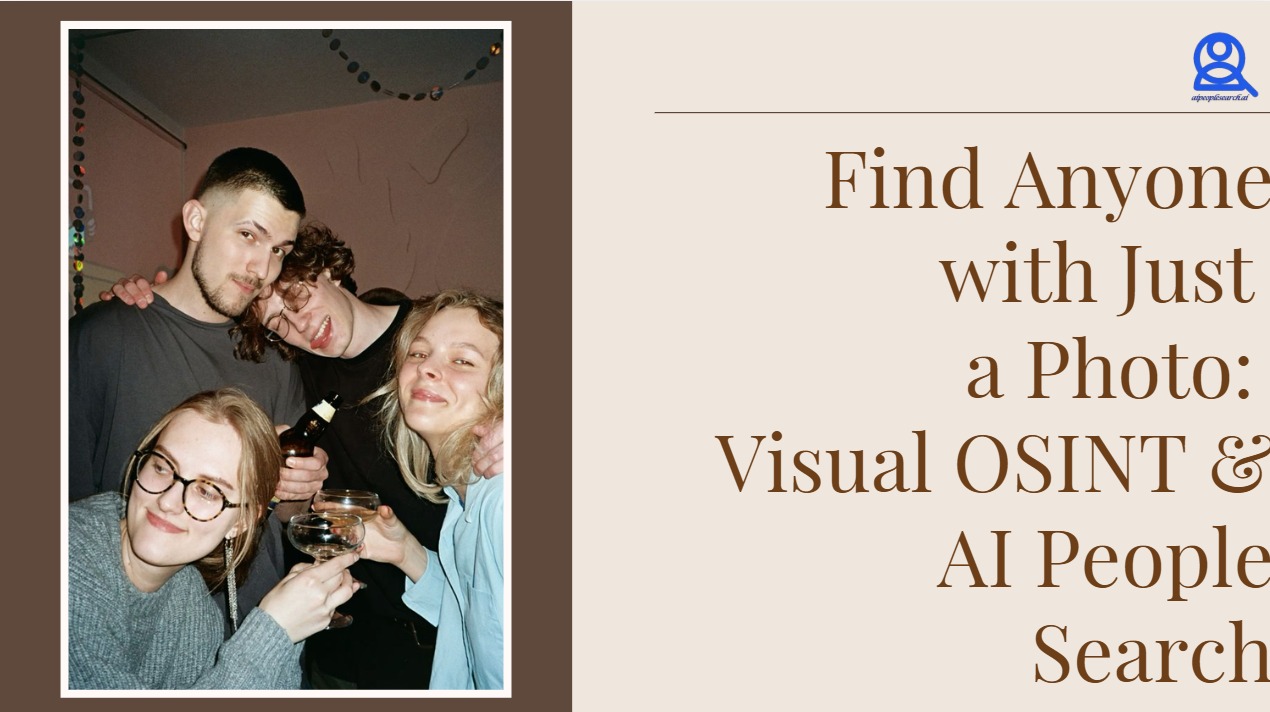
A dead end. You stare at a photograph—a grainy JPEG pulled from an old forum, or maybe a quick screenshot grabbed from a passing video. No name attached. No context. Just a face.
Not too long ago, this was exactly where an investigation went cold. You simply could not type a face into a search bar and expect a result. Now? A single image is enough to unravel a massive digital footprint. This shift marks the rapid rise of visual open-source intelligence (OSINT). It is a space where an AI people search turns dead pixels into actionable leads, scanning the public web and cross-referencing public records to bridge the gap between a standalone picture and a real, verifiable identity.
Beyond Google: Why a Standard Image Search for a Person Fails
Sticking a face into a standard search engine usually yields a frustrating mix of stock photos and unrelated people wearing similar shirts. The old trick was dropping an image into Google or Bing and crossing your fingers. But when you run a standard image search for a person, the system isn’t actually looking at the human being. It looks at the colors, the framing, and the text wrapped around the image on its host webpage.
- Traditional engines rely heavily on metadata and alt text. If the original uploader didn’t type a name, the search goes completely blind.
- They match composition. You want a name, but the engine gives you ten other guys wearing blue hats standing near trees just because the background colors match.
- OSINT investigators need a true face search engine, not a glorified color-matching tool.
You aren’t looking for a similar vibe or a matching aesthetic. You need to search for this person specifically. To actually find people based on photo evidence, the software has to strip away the background noise, ignore the trees and the hats, and focus purely on human geometry.
Visual OSINT Explained: How an AI Person Finder Connects the Dots
So what exactly happens when you feed a photograph to a modern neural network? The mechanics go far beyond matching exact pixels. A dedicated AI person finder breaks down the geometry of a human face to build a unique mathematical map.
Mapping the Face, Ignoring the Noise
Think of it like taking a fingerprint of someone’s features. A face search AI measures the distance between the eyes, the depth of the eye sockets, the exact shape of the jawline, and the contour of the cheekbones. It does not care if the photo was taken at night, if the person grew a heavy beard, or if the image is ten years old. Good people search AI strips away lighting, poor angles, and even the aging process to find the core biometric signature. It isolates the math of the face.
Scanning the Public Web
Once the map is built, the hunt begins. The system acts as an aggressive AI person search, tearing through news archives, public social media profiles, and open directories. It looks for that exact geometric map hiding in the background of a different photo or tagged in a forgotten blog post. By letting search people AI handle the raw data processing, an investigator can quickly link an isolated snapshot from 2012 to a modern-day LinkedIn profile or an obscure news mention. Even a basic person AI search query today has more raw matching power than government databases had a decade ago.
Can I Use AI to Find Someone I Lost Touch With?
Step away from the cold code for a minute. The most pressing use cases often involve human memory and missing links. People often ask, “Can I use AI to find someone I haven’t spoken to in decades?” The short answer is yes.
Maybe you have a faded college photo of an old friend, or a distant relative who dropped off the map. They might have changed their surname after a marriage, moved across the country, or abandoned their old email addresses. Text searches fail here because you lack the correct string of letters to type. But using AI to find people flips the script. You let the face do the talking.
A robust AI people finder takes that old photograph and matches it against current online data. It is a strange feeling… watching an AI find people you thought were lost to time, simply by connecting an old smile to a recent Facebook tag. If you need to find someone with AI, the visual route is often the only way through the roadblock. It bridges the gap between the physical memories sitting in a shoebox and the active digital life they live today.
The “Who is That?” Scenario: Identifying Public Figures with an AI Search People by Image Tool
Then there is the flip side. You know the face is current. The context is clear… but you just can’t pull the name.
You spot a tech entrepreneur in a YouTube thumbnail, a journalist in an uncaptioned news clipping, or a trending influencer making waves on social media. Guessing names is a massive waste of time. Instead, you run an AI search people by image tool. You take a quick screenshot, upload it, and bypass the guesswork entirely.
When you run an AI image search person query, the software cuts through the clutter and points you straight to the source URLs—verified Twitter accounts, official company websites, or Wikipedia entries. A solid people finder AI essentially acts as a reverse dictionary for human faces. Using image search to find people who live in the public eye turns a frustrating, hours-long guessing game into a five-second task. It proves exactly why an AI person finder by photo is becoming an absolute staple in journalistic, research, and corporate workflows.
The Text vs. Visual Shift: Leveraging AI People Search Free Tiers
Visual intelligence is incredibly sharp, but knowing when to cross-reference it with traditional text data makes the difference between a wild guess and a hard confirmation. While digging around, you might test an AI people search free tier just to see what surfaces from a single picture.
But visual OSINT isn’t always a standalone magic bullet. It works best in tandem with other tools.
- A visual search breaks the dead end and gives you a lead.
- A text query verifies the findings and builds the context.
If the photo search yields a potential name, you then pivot your strategy. You might run an AI search person by name to pull up court records, property data, or business registrations. Sometimes, using an AI people finder by name free tool alongside your visual data provides that final lock on the target’s identity. Visuals find the lead. The text confirms the facts.
The days of hiding behind a lack of text tags are gone. A face is no longer just a memory caught on camera; it is a highly specific search query in its own right. As mapping technology grows tighter and public databases expand, the gap between an anonymous photo and a verified identity shrinks to almost nothing. By integrating a dedicated AI people search tool into the investigative process, the digital footprint is laid bare. On the modern web, a single picture truly is worth a thousand data points.
