

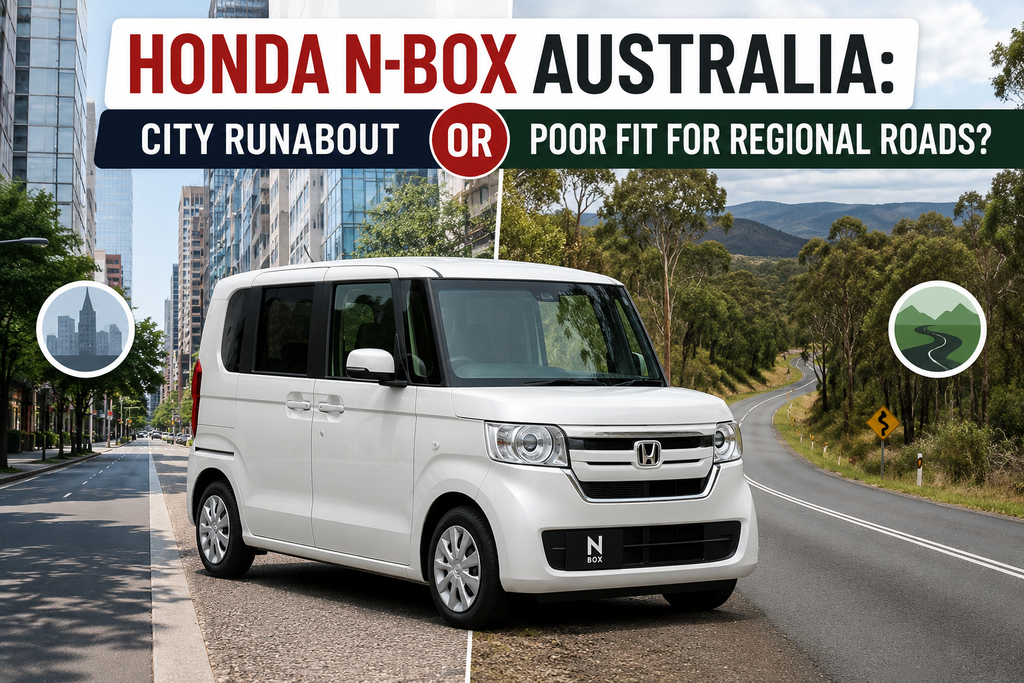
Is The Honda N-Box Suitable For Australian Regional Roads?
The Honda N-Box suits sealed city commuting in Sydney, Melbourne and similar capital-city conditions, but it needs more careful thought for regular regional travel. Long highway distances, unsealed roads, heat, dust and limited support for Japan-only models can make a larger, locally familiar vehicle a better fit.
Honda N-Box Australia: Best on Sealed City Roads
Honda N-Box Australia buyers should begin with the road they will use most, not the road they might use once a year. The N-Box makes the strongest case as a compact second car for sealed driving in Sydney, Melbourne, Brisbane, Adelaide or another capital city. Commuting, school runs and short errands place less demand on a vehicle than repeated trips between regional towns.
That city role also suits the reason many people consider a Japanese-market kei car. A small footprint is useful in crowded streets and tight parking areas, while the wagon body gives the car a more practical shape than a very small hatchback. The trade-off is clear. A vehicle chosen mainly for urban convenience should not automatically be treated as a touring car.
The Trip Pattern Matters More Than the Badge
Honda N-Box regional driving becomes a different decision once the weekly routine includes long highway distances or dirt access roads. Australia’s sealed roads are generally good in and between the capitals, but roads can change sharply after the city edge. Outside the east coast corridor, several hundred kilometres between towns is an ordinary distance, not an unusual test drive.
A buyer who occasionally visits a regional town may find the N-Box workable if the route is mostly sealed and the car is not carrying a heavy load. A buyer who regularly travels between towns needs to assess the whole pattern instead. Repeated long trips leave less room for compromises in ride comfort, luggage space, highway confidence and roadside support. The answer depends on the route, not simply on whether the car can complete one journey.
Where The N-Box Becomes A Poor Regional Fit
The Honda N-Box is a poor fit when unsealed roads, touring loads or towing are routine parts of ownership. Australia’s regional access roads can bring dust, corrugations and long gaps between services. The editorial question is not whether a compact wagon can reach a dirt road. It is whether that use is frequent enough to make the vehicle’s limits frustrating.
Towing is another warning sign. The Australian brief identifies caravans, boats and trailers as common use cases, but the N-Box should not be selected for that work without confirming the exact vehicle’s permitted specifications and the intended trailer. The same caution applies to camping. A small car can support a light recreational setup, yet regular touring calls for a careful check of occupants, luggage and equipment before purchase.
Heat and dust add another layer to the choice. Australia includes tropical wet seasons in the far north, inland heat and dust, and cold mornings in the south-east highlands. Air conditioning is essential, especially for buyers in Darwin, Cairns or Townsville. Coastal buyers should also inspect for salt exposure. These conditions do not automatically rule out an N-Box, but they make the exact unit and its history more important.
Honda N-Box Long Distance Driving Needs A Clear Plan
Honda N-Box long distance driving can work for an occasional trip if the route and load match the car’s role. Before committing, map the journeys that actually happen in a normal year. A Sydney commuter who drives to a regional town from time to time is making a different decision from a buyer in Perth, Hobart or inland Australia who expects frequent long runs.
The inspection should focus on evidence that matches the planned use. Review the auction information for the individual unit, inspect the condition carefully and ask what support will be available if a Japan-only component is needed. Mainstream Japanese marques have strong parts and service support in Australia, while Japan-only models can be slower and harder to support. That difference is a genuine ownership consideration, not a reason to reject every import.
Buyers should also confirm current Australian import eligibility for the exact model and year through the model’s own import information before making a decision. Eligibility windows can change, and a listing should not be treated as a permanent regulatory answer. The same discipline applies to stock. The current Honda N-Box catalogue includes eight units, but availability changes weekly, so the Honda N-Box listings listings are the useful place to check what is actually offered.
What To Check Before Choosing An N-Box
The right Honda N-Box is the one that matches the buyer’s real route, climate and support needs. Start with the individual listing rather than treating every N-Box as identical. Current stock is made up of Honda N-Box JF3 wagon models from 2019 to 2021, with petrol engines and automatic transmissions. Those details describe the available stock, not every N-Box in Australia.
Price should be read in the same careful way. The current Australian stock range starts at 17,900 Australian dollars for the cheapest listed unit and reaches 24,900 Australian dollars, while one listed sale price is 23,900 Australian dollars. Those are listing figures, and the cheapest starting price does not identify a particular car. Stock changes weekly.
For a city buyer, the final check is whether the car is being asked to do more than its main job. If the N-Box will spend most of its time on sealed streets and act as a family second car, its compact format may be sensible. If it will tow, carry camping gear over dirt roads or cover long regional distances every week, compare the planned work with a vehicle designed around that use. Buyers can review the wider Australian catalogue through Carbarn Australia before narrowing the choice.
Frequently Asked Questions
Is The Honda N-Box A Good City Car In Australia?
Generally, yes. The Honda N-Box is best suited to sealed urban driving, commuting, school runs and short errands in cities such as Sydney or Melbourne. Its compact Japanese-market format makes more sense as a city car or family second vehicle than as a dedicated regional tourer.
Can A Honda N-Box Drive On Australian Dirt Roads?
It may manage occasional dirt access roads, but regular unsealed travel needs careful consideration. Australian regional roads can involve dust, corrugations and long distances between towns. Buyers should match the exact vehicle’s condition and specifications to the road surface, load and frequency of those trips.
Is The Honda N-Box Suitable For Long Highway Trips?
It can suit occasional highway travel when the route is mainly sealed and the load is modest. Regular trips between Australian regional towns are a different proposition because distances can reach several hundred kilometres. Buyers should consider comfort, luggage, support and the vehicle’s intended daily role before choosing one.
Are Honda N-Box Parts Easy To Find In Australia?
Parts and service support can be weaker and slower for Japan-only models than for mainstream Japanese vehicles. That does not make a Honda N-Box impossible to own, but buyers should ask about support for the exact model and plan for delays if a specialised component is required.
How Many Honda N-Box Units Are Available?
The current Australian stock page includes eight Honda N-Box units, but that number changes weekly. The available stock is listed as JF3 wagon models from 2019 to 2021, with petrol engines and automatic transmissions. Buyers should check the live catalogue rather than rely on an older count.
Import work teaches you to judge a vehicle against the roads and jobs it will actually face. For the Honda N-Box, that means separating sealed city use from regular regional travel before the listing price becomes the main focus.
