

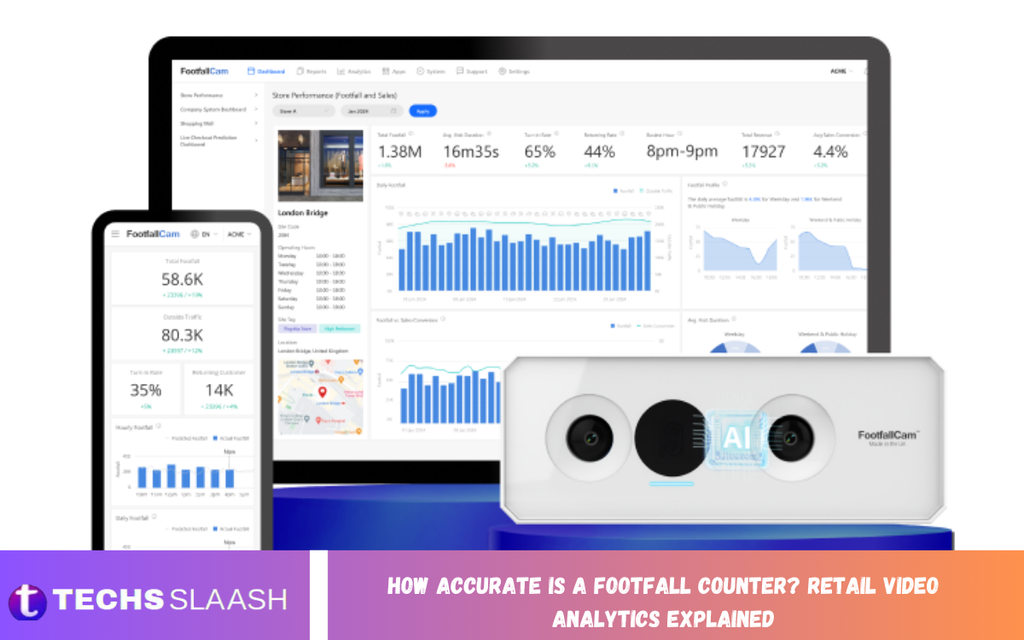
Footfall counting has become an important part of modern retail analytics. Retailers use footfall counters to understand how many people enter a store, how busy different areas are, and how customer traffic changes throughout the day. With accurate information, businesses can make better decisions about staffing, store layouts, promotions, and customer experience.
Modern retail video analytics has made footfall measurement more advanced than traditional counting methods. Instead of simply recording movement through an entrance, intelligent systems can analyze video feeds and identify people, movement patterns, and traffic trends. However, the question remains: how accurate is a footfall counter, and what factors influence its results?
What Is a Footfall Counter?
A footfall counter is a technology designed to measure the number of people entering, leaving, or moving through a specific area. Retail stores commonly use these systems at entrances, exits, aisles, and other important customer zones. The collected information helps businesses understand customer traffic without relying on manual counting.
Traditional footfall counters may use infrared sensors, pressure sensors, thermal technology, or other detection methods. Retail video analytics takes this concept further by using cameras and intelligent software to detect and track people. This approach can provide retailers with more detailed information than a basic entrance counter.
How Accurate Is a Footfall Counter?
The accuracy of a footfall counter depends on the technology, installation quality, environment, and software being used. Well-designed systems can provide highly reliable measurements, but no counting technology is completely perfect. Crowded entrances, groups of people walking together, unusual movement, and poor camera positioning can affect results.
Retail video analytics can improve accuracy by analyzing movement patterns rather than simply detecting an object passing a sensor. Advanced systems can distinguish people from other objects and determine whether someone is entering or exiting. Proper calibration and regular system maintenance are also essential for maintaining dependable results.
How Retail Video Analytics Improves Footfall Counting
Retail video analytics uses cameras combined with computer vision software to understand activity within a defined area. The system can detect people and follow their movement across a camera’s field of view. This allows retailers to collect more useful information than a simple total visitor count.
For example, a retailer may discover that thousands of customers enter a store each week, but only a smaller percentage visit a particular department. Video analytics can reveal these movement patterns and help managers understand where customers spend time. This information can support better merchandising and store planning.
Factors That Affect Footfall Counter Accuracy
One of the biggest factors affecting accuracy is camera placement. Cameras need a clear view of the area being monitored, especially at entrances where customers may arrive from different directions. Incorrect height, angle, or positioning can create blind spots and increase the possibility of missed or duplicated counts.
Crowded environments can also create challenges. When several people walk closely together, a basic system may count them incorrectly. Advanced video analytics uses tracking algorithms to separate individuals and maintain their movement paths, helping reduce errors in busy retail environments.
Can Video Analytics Distinguish Entry and Exit Traffic?
Many modern retail video analytics systems can distinguish between people entering and leaving a store. This is important because simply counting every person detected by a camera would not provide an accurate picture of store traffic. Directional analysis helps separate inbound and outbound movement.
This capability allows retailers to calculate important measurements such as total entries, total exits, and occupancy levels. Understanding these figures can help businesses identify busy periods, optimize staffing schedules, and improve operational planning.
Footfall Counting in Busy Retail Stores
Busy stores present some of the greatest challenges for accurate footfall measurement. During sales, holidays, weekends, and special events, large numbers of customers may enter simultaneously. People can also stop near entrances, move in groups, or change direction unexpectedly.
Retail video analytics can handle these situations more effectively when the system has suitable hardware, clear camera coverage, and well-trained detection algorithms. However, retailers should still test their systems during both quiet and busy periods to identify potential counting inconsistencies.
How Accurate Are Modern Video-Based Counters?
Modern video-based counters can achieve high accuracy when properly installed and configured. Their performance depends on factors such as camera resolution, lighting, viewing angle, software quality, customer density, and environmental conditions. Accuracy should therefore be evaluated in the actual retail environment rather than based only on a manufacturer’s general specification.
Regular testing can help retailers understand how their system performs under real-world conditions. Comparing automated counts with controlled manual counts over selected periods can reveal whether the system is consistently overcounting or undercounting visitors.
Why Accurate Footfall Data Matters for Retailers?
Accurate footfall data can help retailers understand customer demand. If a store receives significantly more visitors at certain times, managers can schedule additional employees for those periods. This can reduce waiting times and improve the overall shopping experience.
Footfall information can also support marketing analysis. Retailers can compare visitor numbers before and after a promotion to determine whether an advertising campaign generated additional store traffic. When combined with sales information, footfall data can provide useful insights into conversion performance.
Footfall Counters and Conversion Rates
One of the most useful retail measurements is the conversion rate. It compares the number of visitors with the number of customers who complete a purchase. For example, if a store receives substantial foot traffic but generates relatively few transactions, management may investigate pricing, product selection, customer service, or store layout.
Retail video analytics can provide the visitor component of this calculation. When combined with reliable sales data, retailers can gain a clearer understanding of how effectively store traffic is being converted into revenue. This makes accurate footfall measurement particularly valuable.
Read Also: Reliable Internet: A Small Business Guide
Using Footfall Analytics to Improve Store Layout
Customer movement data can reveal which areas of a store receive the most attention. Retailers can use this information when deciding where to place popular products, promotional displays, seasonal merchandise, or high-margin items.
If analytics show that customers rarely visit a particular section, the retailer can investigate why. The problem could involve poor visibility, inconvenient placement, confusing signage, or an ineffective layout. Footfall analysis provides businesses with measurable information to support these decisions.
The Role of Lighting and Camera Quality
Lighting conditions can have a major impact on video analytics. Strong shadows, glare, extremely bright areas, or insufficient lighting may make it harder for software to accurately identify people. Retailers should therefore consider lighting conditions when installing cameras.
Camera quality is equally important. A suitable resolution and field of view can help the system capture clear information while reducing blind spots. Professional installation can make a significant difference, as even advanced analytics software cannot fully compensate for poor camera positioning.
How Retailers Can Improve Counting Accuracy
Retailers should begin by selecting technology appropriate for their store environment. A small shop with a single entrance may require a different setup from a large department store with multiple entrances and complex customer movement.
After installation, businesses should regularly evaluate the system. Manual counting can be performed during selected time periods and compared with automated results. If significant differences appear, retailers can review camera positioning, configuration settings, lighting, and software performance.
Privacy Considerations in Retail Video Analytics
Retailers using video analytics should also consider privacy and data protection requirements. A system designed to count visitors does not necessarily need to identify individual customers. Many solutions can focus on anonymous movement analysis rather than personal identification.
Businesses should establish clear policies regarding how video is processed, stored, and protected. Appropriate signage, data retention practices, access controls, and compliance procedures can help retailers use analytics responsibly while respecting customer privacy.
Choosing the Right Footfall Counter
When choosing a footfall counter, retailers should consider more than its advertised accuracy percentage. They should examine how the system performs in crowded environments, under different lighting conditions, at multiple entrances, and in unusual customer movement scenarios.
Integration is another important consideration. A useful analytics platform may connect footfall information with sales systems, staffing data, or other business intelligence tools. This makes it easier to turn raw visitor counts into meaningful business insights.
The Future of Retail Footfall Analytics
Retail footfall analytics is becoming increasingly intelligent as computer vision and artificial intelligence technologies continue to develop. Future systems are expected to provide more detailed information about customer movement while improving the ability to operate in complex environments.
The focus is also shifting from simple visitor counting toward complete customer journey analysis. Retailers may use analytics to understand where customers move, how long they remain in certain areas, and how store conditions influence purchasing behavior. These insights can support more efficient and customer-focused retail operations.
Frequently Asked Questions
How accurate is a footfall counter?
A footfall counter can be highly accurate when it is correctly installed, calibrated, and maintained. Accuracy varies according to technology, camera placement, lighting, crowd density, and software performance.
What is retail video analytics?
Retail video analytics uses cameras and intelligent software to analyze customer movement and activity. It can provide information such as footfall, occupancy, traffic direction, and movement patterns.
Can a footfall counter count people entering and leaving?
Yes, many modern systems can identify movement direction and separately count entries and exits. This provides more useful information than simply recording every detected person.
Does crowding affect footfall counting accuracy?
Crowding can make counting more difficult because people may walk closely together or overlap in the camera view. Advanced video analytics is designed to reduce these errors through person tracking and movement analysis.
Can footfall analytics improve retail sales?
Footfall analytics can help retailers understand customer traffic and identify opportunities to improve store layouts, staffing, promotions, and customer experience. When combined with sales data, it can also help analyze conversion rates.
Does camera placement affect accuracy?
Yes, camera placement is one of the most important factors. Cameras should provide clear coverage of entrances and monitored areas while minimizing blind spots, glare, and unnecessary obstructions.
Can video analytics work in low-light conditions?
Some systems can perform well in challenging lighting conditions, but performance depends on the cameras and analytics technology being used. Proper lighting remains important for reliable detection.
Are footfall counters better than manual counting?
Automated counters can provide continuous data and reduce the labor required for manual counting. However, manual counts can still be useful for testing and validating an automated system.
Is retail video analytics a privacy concern?
It can raise privacy considerations, particularly when systems process identifiable information. Retailers can reduce risks by using privacy-conscious configurations, limiting data retention, protecting stored information, and following applicable regulations.
What should retailers consider when buying a footfall counter?
Retailers should consider accuracy, installation requirements, crowd-handling capability, camera quality, environmental conditions, reporting features, integration options, privacy controls, and ongoing support before choosing a system.
Conclusion
A footfall counter can provide valuable information about customer traffic, but its accuracy depends on the technology and environment in which it operates. Modern retail video analytics can offer more sophisticated counting by using computer vision to identify people and analyze movement patterns.
For retailers, accurate visitor data is more than a simple number. It can support staffing decisions, store design, marketing evaluation, conversion analysis, and customer experience improvements.

1 Comment
Pingback: AI Video Generation for Nonprofits & Social Impact - Techsslaash.com