

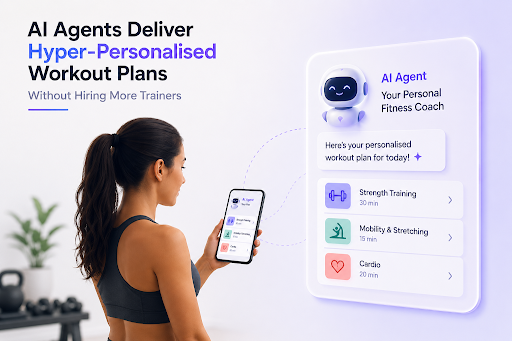
The fitness industry has always sold personalisation as its premium differentiator. Walk into any gym, sign up with any online coaching platform, and the pitch is the same: a plan built around you, your goals, your schedule. The reality, for most clients, is a PDF template with their name at the top. This gap exists not because trainers lack skill, but because genuine personalisation is impossible to deliver manually at scale. Adjusting daily based on how someone slept, recovered or felt requires a system, not just intention. AI agents are changing that equation, and the businesses paying attention are quietly restructuring how coaching works.
Why Adding Trainers Doesn’t Solve the Personalisation Gap
The instinctive response to scaling a coaching business is straightforward: bring on more trainers. More trainers mean more client capacity, more revenue, and presumably a higher standard of individual attention. In practice, the model breaks down quickly.
A skilled trainer managing fifty clients is already operating near cognitive capacity. They are tracking programme progressions, responding to check-ins, adjusting plans when clients travel or get injured, and trying to remember who struggled last week and who hit a personal best. Fitness coaching automation has long been discussed as a solution to this administrative load, but most implementations stop at scheduling tools and generic programme templates, neither of which addresses the core problem.
The constraint is not effort. It is the bandwidth required to make real-time, individualised decisions for every client, every day. Hiring another trainer duplicates the cost without solving the underlying limitation.
How Do AI Agents Deliver Personalized Workout Plans?
The most visible shift for clients is that their programme stops behaving like a static document and starts behaving like a conversation.
An AI workout plan generator operating within a coaching platform works through a continuous sequence:
- A client logs a workout, and the system updates their progress profile in real time
- Biometric data from wearables feeds into the next session’s intensity recommendation
- A missed session triggers automatic volume rebalancing across the remaining week, preserving the programme’s intent without requiring the trainer to rewrite anything
- A client texts “I’m feeling sore today, should I still train?” and receives an immediate response that is safe and aligned with their trainer’s coaching philosophy
This is conversational fitness coaching in its most functional form. The AI chatbot that creates custom workout plans for gym members is not generating one-size-fits-all content; it is applying the rules, preferences and goals the trainer has already defined, at a frequency and responsiveness no human can match.
The system also monitors for disengagement. An AI chatbot for fitness that adapts workouts based on progress does more than update sets and reps. It flags clients who have gone quiet, missed multiple sessions or shown declining performance scores, prompting a human intervention before the client has already decided to cancel.
What the Numbers Say About Scaling Smarter
One Trainer, Six Times the Revenue
A trainer managing fifty clients is already operating near their practical ceiling. With an AI workout automation platform handling the maintenance layer of coaching, that same trainer can realistically oversee three hundred clients without compromising the quality of attention each one receives. Revenue per trainer increases five to six times without a single additional hire.
The capacity gain comes from what the platform absorbs: plan adjustments, progress logging, check-in responses and session reminders. Using a conversational AI tool for scaling fitness coaching businesses reframes the trainer’s role from the person managing every touchpoint to the person handling the ones that matter most.
Keeping Clients and Cutting Acquisition Costs
Fitness businesses lose revenue not to competition but to client disengagement. Fitness chatbot member retention improvements of 15 to 20 percent annually are a realistic outcome when clients feel consistently supported. McKinsey research indicates personalisation can reduce customer acquisition costs by as much as 50 percent.
A gym customer engagement chatbot that qualifies leads and books consultations around the clock removes the delay that causes most enquiries to go cold. An AI agent for gym lead capture, combined with AI appointment booking for personal trainers, moves a prospect from first message to booked session without manual intervention. AI Agent for fitness lead generation, gym onboarding and workout personalization carries that momentum through to the first active week of training.
Grand View Research projects the global digital fitness market will reach $160 billion by 2030. In that environment, personalisation is not a premium feature. It is the baseline expectation.
It’s Trainer With AI, Not Trainer Versus AI
Conversational AI for gyms does not reduce the trainer’s value. It concentrates it. When the administrative layer is absorbed by the system, the trainer’s time realigns toward the work clients actually pay a premium for.
| AI Handles | Trainer Handles |
| Plan adjustments and rewrites | Motivation and accountability conversations |
| Check-in responses and reminders | Recognising when mindset is the real barrier |
| Fitness customer support automation | Building trust that compounds over time |
| Fitness chatbot integration triggers | Defining the system’s rules and philosophy |
Conversational AI for fitness businesses works best when trainers are involved in shaping how it operates, so the output reflects their methodology rather than overriding it.
Conclusion
AI agents make it realistic for a single trainer to deliver the quality of attention previously reserved for a fraction of the client base. The administrative load gets absorbed by the system. The trainer focuses on what actually drives retention. Fitness businesses that build this way do not just grow faster. They build something more difficult to replicate than a marketing budget or a lower membership price: a coaching experience that consistently feels personal, regardless of how many clients are on the roster.
