

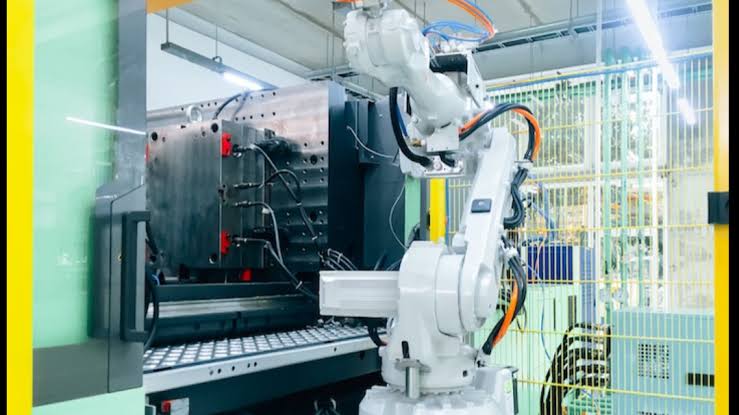
Walk onto a molding floor today and, at a glance, it looks a lot like it did fifteen years ago. Presses clamp shut, screws rotate, finished parts drop into bins. The real change sits in places you can’t spot from the aisle: inside the controller, in the sensor readings, and in the software making sense of that data. Plants that once ran on operator instinct and a sample check every hour now flag a bad part before it ever leaves the tool.
For factory owners and engineers, this shift lands right where it hurts. Margins in molding are thin, and the costs that eat them are usually the ones nobody can see on a shift report: scrap, unplanned downtime, and the hours a technician burns chasing a process that keeps drifting. Smart automation and AI are starting to shrink all three.
The machine stopped guessing
Traditional molding leans hard on the setter. Someone dials in barrel temperatures, holding pressure, and cooling time, runs a few shots, checks the parts, and tweaks again. It works, but it depends on one person’s judgment and a snapshot of conditions that keep moving as the tool heats up and the resin lot changes.
Newer controllers close that loop on their own. Cavity pressure and temperature sensors sit right inside the mold and report what the plastic is actually doing, shot after shot. When the reading drifts outside a set window, the machine adjusts holding pressure or switchover on the next cycle instead of waiting for a person to notice a sink mark two hours later. This is adaptive process control, and it turns a good plastic injection molding machine from something you supervise into something that corrects itself within limits you define.
The payoff is consistency. A process that used to produce a handful of rejects every few hundred shots can hold tolerance across a full run, even when the ambient temperature swings between the morning and the afternoon.
Servo control gave the data something to stand on
None of this smart behavior means much if the machine can’t repeat itself mechanically. That’s where drive technology matters more than most buyers realize.
Older hydraulic presses run a fixed-displacement pump that spins at full speed whether the machine is injecting or just sitting between cycles. A servo injection molding machine pairs the hydraulics with a servo motor that only draws power when the process actually calls for it. Two things follow from that. Energy use drops, often by 20 to 60 percent depending on the part and cycle. And motion becomes far more precise, because the servo can hold injection speed and pressure to tighter figures than a fixed pump ever could.
That precision is the foundation the software builds on. AI-driven control is only as trustworthy as the hardware underneath it. Feed a model clean, repeatable motion data and it can spot a real problem. Feed it noise from a machine that wanders shot to shot and it just chases ghosts.
Predicting the breakdown before it stops the line
Ask any plant manager what a surprise failure costs and the number climbs fast: idle operators, a missed shipment, a rush freight bill, and the tool sitting in a machine that won’t run. Predictive maintenance goes after exactly that.
Sensors track vibration, motor current, oil temperature, and screw torque while the machine runs. Software learns what “healthy” looks like for that specific press, then watches for the slow slide toward trouble. A bearing starting to fail, a check ring wearing down, a pump losing efficiency each shows a signature in the data weeks before it breaks. Maintenance gets scheduled for a planned window instead of erupting in the middle of a Friday shift.
For a shop running lean, this is often the fastest return in the whole automation story. You don’t need a full smart factory to start. You need a few sensors and a system that flags the outliers.
Vision systems that catch what tired eyes miss
Manual quality checks have an obvious weakness: attention drifts, especially on repetitive parts near the end of a long shift. Camera-based inspection paired with machine learning holds a steadier line.
A trained vision system inspects every part, not a sample, and catches short shots, flash, burn marks, sink, and dimensional drift in fractions of a second. More useful still, it can connect a defect back to the process condition that caused it, so engineers fix the root instead of sorting the symptoms. Over time the system gets sharper, because every flagged part adds to what it knows.
The point isn’t to remove people from quality. It’s to move them off the sorting table and onto the problems that actually need a human to solve.
Simulation before a single shot
Trial-and-error at the press is expensive. Every test shot burns material, machine time, and a slot in the schedule. Flow simulation moves a chunk of that work off the floor and onto a screen.
Engineers model how resin will fill the cavity, where it’ll cool slowly, and where warpage or weld lines are likely to show up, all before the tool ever runs. Pair that simulation with live data coming off the machine and the two start correcting each other: the model sharpens against real results, and the real process starts from a much better first setup. Tool tryout that once took a full day can shrink to a couple of hours.
What this means if you run the plant
The technology is real, but the way to adopt it is boring and practical, which is usually a good sign.
Start with data. You can’t improve what you don’t measure, so instrument the machines you have and get comfortable reading what they tell you. Pick one problem that costs you real money, downtime on a key press, scrap on a high-volume part, and solve that first. Skip the temptation to replace the whole floor at once; the shops that succeed layer this in one capability at a time.
And keep the fundamentals in view. All the smart software in the world sits on top of the machine’s ability to move the same way every cycle. A repeatable, well-built press with responsive servo control isn’t the flashy part of this story, but it’s the part everything else depends on.
The floor of the next decade
The molding shop that pulls ahead won’t be the one with the most screens on the wall. It’ll be the one that quietly cut its scrap rate, stopped losing days to surprise failures, and freed its best people from babysitting a process that now largely runs itself. AI and smart automation aren’t replacing the craft of molding. They’re taking the guesswork out of it, one cavity at a time.
