

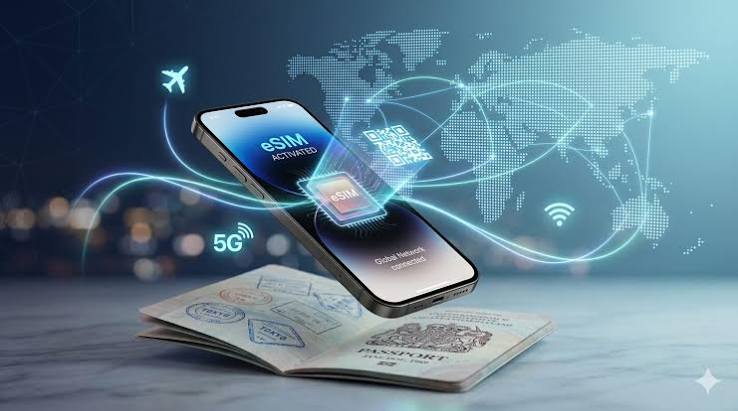
For international travellers, reliable mobile access is no longer just a way to make calls. It helps people find their way around unfamiliar cities, retrieve boarding passes, confirm accommodation and stay in contact with colleagues or family. Yet arranging data access abroad can still involve expensive roaming, airport SIM counters or unexpected restrictions. Embedded SIM technology, commonly known as eSIM, offers another approach: travellers can install a mobile plan on a compatible device without inserting a plastic card. In 2026, understanding how this works is increasingly useful, particularly for people crossing several borders or working remotely. The benefits depend on the device, destination and plan rather than the technology alone.
What Is eSIM Technology and How Does It Work?
An eSIM is a programmable SIM built into a phone or other connected device. It authenticates with a mobile network, but subscription information is downloaded instead of supplied on a removable card.
This process is called remote SIM provisioning. A provider supplies an activation method, often a QR code or an app, and the device downloads an eSIM profile. Supported phones can store multiple profiles, although the number that can remain active simultaneously varies by model.
An eSIM does not automatically improve signal strength or speed. Performance still depends on the local network, coverage, congestion and the plan’s conditions.
Why International Travellers Are Considering eSIMs
One practical advantage is being able to arrange connectivity before leaving home. Travellers may download a suitable profile over Wi-Fi and follow the provider’s instructions on when to activate it. This can reduce the need to find a physical SIM seller after landing.
Keeping a home SIM alongside a separate data plan can also be useful. On supported dual-SIM phones, users may retain their usual number for calls or verification messages while selecting another line for mobile data. However, home-network charges may still apply, so line settings deserve attention.
For multi-country trips, regional plans may be worth comparing with individual country plans. The choice depends on the itinerary.
Choosing an eSIM Provider for International Travel
Coverage should be the first consideration. Travellers need to check whether the intended destination is supported and, where disclosed, which partner networks provide access. Coverage maps and advertised availability cannot guarantee reception inside buildings or in remote areas.
For prepaid eSIM plans, data allowances and validity periods matter just as much. A short city break may require less data than a working trip involving regular video calls. Check whether the validity period begins at purchase, installation or first network connection, as rules differ.
Providers such as Zamesims can be included when comparing options, but travellers should confirm current destinations, plan terms, installation instructions and available support directly before buying. Refund conditions and the process for resolving activation problems also deserve a look.
Compare the total cost of international mobile data and whether allowances can be topped up.
How Travel eSIMs Support Mobile Connectivity Abroad
A functioning mobile data connection can make everyday travel tasks easier. Navigation apps may provide live route changes, while airline and rail apps can deliver updates to existing bookings. Messaging, translation and banking services may also require internet access away from hotel Wi-Fi.
An international travel eSIM can be especially useful during transfers, when travellers need to retrieve a reservation or contact a driver promptly. Remote workers may also rely on mobile data as a backup connection, although demanding tasks such as video meetings can consume allowances quickly.
Importantly, many travel data plans do not include conventional voice calls or SMS. Internet-based calling may work, subject to local rules and app availability, but should not be assumed to replace every phone service.
eSIM Compatibility and Smartphone Requirements
Not every handset supports eSIM, so lists of eSIM-compatible smartphones require careful checking. Compatibility can differ by model, sales region and network operator, even within a familiar smartphone range. Before purchasing, users should verify the exact device variant and whether it is carrier-unlocked.
On many phones, installation involves opening mobile or cellular settings, selecting an option to add an eSIM and scanning the provider’s QR code. Some providers use their own applications or manual activation details instead.
Installation usually requires a reliable internet connection. Travellers should save any necessary instructions before departure, check whether the QR code can be reused and avoid deleting a working profile without understanding the provider’s replacement policy.
Common Mistakes to Avoid When Using an International eSIM
Activating too early can waste part of a plan’s validity period if its clock starts before arrival. Equally, waiting until landing without Wi-Fi could leave a traveller unable to install the profile.
Another mistake is underestimating data use. Automatic cloud backups, software updates and streaming can consume gigabytes unexpectedly. Adjusting background-data settings and downloading maps in advance can help.
Users should also check which SIM is selected for mobile data, whether the travel line requires data roaming and whether the home line might incur roaming charges. Instructions vary by provider.
Finally, do not assume that a data-only package supplies a telephone number, standard texts or emergency calling access. Keep an alternative method of communication where practical.
What the Future May Hold for eSIM Connectivity
Broader support across phones, tablets and connected laptops could make remote plan installation more familiar. Providers may also refine how users compare destinations, manage profiles and purchase additional data.
Still, adoption will depend on handset availability, operator support and clear consumer information. Physical SIMs remain useful, particularly where eSIM compatibility or local plan access is limited.
Final Thoughts
eSIM technology for international travel gives compatible smartphone users another way to arrange mobile access before and during a trip. It can simplify SIM management, but it does not remove the need to check the details. Travellers should compare destination coverage, device restrictions, data limits, activation timing and overall cost. A suitable plan matters more than a long feature list.
