

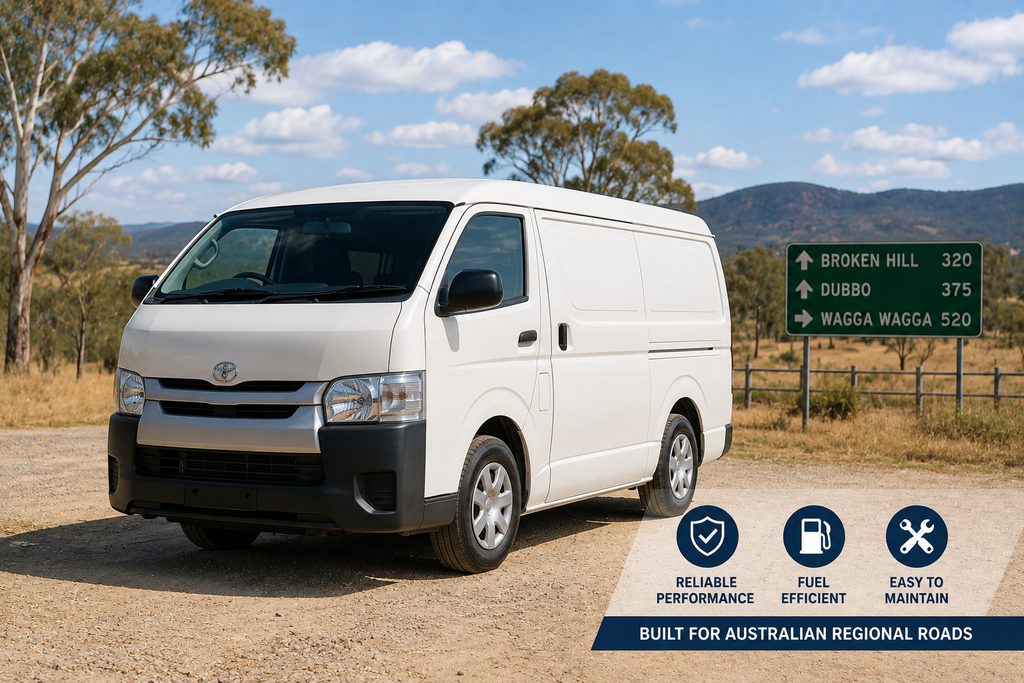
What Should You Look For In An Imported Van For Regional Work In Australia?
The right van for regional Australian work must match the distance, road surface, and tools carried every week. Check load space, air conditioning, service support and import eligibility before choosing a model. A Toyota Hiace may suit heavier work, while a Toyota Liteace can make sense where a smaller footprint matters.
Regional work changes the van brief
An imported van for regional work Australia tradespeople choose should be planned around the longest regular day, not the shortest trip into town. A van used inside Melbourne can spend most of its time on sealed urban roads, close to workshops and suppliers. A van travelling between regional towns may cover several hundred kilometres before reaching the job, then turn onto a dirt access road. That changes the order of priorities. Seating comfort, air conditioning, useful cargo space and predictable service support matter more than a van that merely looks tidy in a listing.
Write down the actual job before looking at models. List the tools that stay in the van, the items loaded for a particular site, the number of people travelling and the rough share of sealed and unsealed driving. Towing may change the decision again, especially for a tradesperson carrying equipment between towns. A compact van can be easier in a city, but limited working space becomes frustrating when every trip starts with a packing exercise.
Space matters more than a large body
Working space is useful only when its shape suits the tools and materials being carried. Measure the longest item that must lie flat, then consider how often you need to reach it during a day. Shelving, bins and a clear walking route can matter more than choosing the largest available body. A van packed tightly for Melbourne errands may be a poor van for long distance work because retrieving one tool can mean unloading half the cargo.
The Toyota Hiace is a stock-backed example for buyers who need to investigate a larger Japanese work van. Current Australian stock includes 15 Toyota Hiace units across model years from 1991 to 2020, with listed body type, fuel and transmission details varying by unit. That range does not make every Hiace the same choice. Read the individual listing and auction information carefully. The current catalogue changes, so use the Carbarn Australia stock listings to see which Toyota Hiace units are actually available when you are ready to compare.
Toyota Liteace Australia import buyers should check fit
Toyota Liteace Australia import buyers should treat the model as a space and service decision, not simply a cheaper alternative to a larger van. The Carbarn Australia import page shows all the eligible models. That makes it a useful example of how a smaller Japanese-market work van enters the comparison, but one unit cannot answer every buyer’s needs. Check the load area against your equipment and think about the road distances your business actually covers.
A smaller van may be easier to place on a tight job site and less demanding when loaded with ordinary hand tools. The trade-off appears when bulky equipment, passengers or job materials join the trip. Do not assume a compact body will be easier to support everywhere either. The Australian brief is clear on the service split: mainstream Japanese marques have stronger support, while Japan-only models can bring slower parts access. Ask a workshop that would service the van before committing.
Service support can decide regional downtime
Service support deserves a place beside cargo space because a regional work van loses money when it sits still. Mainstream Japanese marques generally have stronger parts and service support in Australia. Japan-only models can be slower and harder to support. That does not automatically rule out a Liteace or another Japanese-market van. It does mean you should identify a workshop, ask about parts ordering and keep a sensible maintenance plan before the van leaves the city.
The distance to help matters too. A van that works around Sydney or Melbourne may have more convenient access to specialists than one based far from a capital. Ask who will handle routine servicing, air conditioning faults and parts that are specific to the Japanese-market version. The badge alone is not enough. Model code and variant matter when a workshop is trying to identify the correct component.
Prepare for heat, dust and long highway days
Air conditioning is a requirement for Australian regional work, not a comfort extra. The local brief covers tropical wet seasons in the far north, inland heat and dust, and cold mornings in the south east highlands. A van can face very different conditions across one work year. Check that the air conditioning is described clearly in the vehicle information and budget time for a proper inspection after arrival.
Dirt access roads also change what you should inspect. Look for signs of dust entry, damage underneath and wear that makes sense for the vehicle’s stated use. Coastal operators should pay attention to salt exposure. None of these checks proves a van is ready for every track, and a standard van should not be treated as a four wheel drive without evidence. If the work includes regular towing or rough access, explain that use to the seller before selecting a vehicle. Carbarn Australia can show the current market selection through Carbarn Australia, but the final choice still rests on the work pattern and the individual vehicle.
Before purchase, confirm that the exact model and year can enter Australia under the applicable Commonwealth scheme. Eligibility is model and year dependent, and the windows can change. Check the model’s own import information rather than relying on an old forum post or a vehicle that looks similar. This check belongs at the start of the decision, before you spend time comparing trim or arranging workshop work.
Frequently Asked Questions
Is A Toyota Hiace Suitable For Regional Work In Australia?
Generally, yes, if the individual Toyota Hiace has the working space, condition and service plan your route requires. Current stock includes Toyota Hiace vans from model years ranging from 1991 to 2020. Compare each unit separately because age, model code and vehicle details vary across the catalogue.
Is A Toyota Liteace Large Enough For A Tradesperson?
It can be, when the job uses compact tools and does not require bulky materials or frequent passenger travel. The current stock includes one 2019 Toyota Liteace petrol automatic van. Measure your longest equipment first, then check service support for that Japanese-market variant near your base.
What Makes A Van Suitable For Long Distance Work?
A suitable van has enough working space, effective air conditioning, a service plan and condition appropriate for long highway trips. Regional Australian work can involve several hundred kilometres between towns and dirt access roads. Towing, passenger needs and the distance to a capable workshop should also shape the choice.
Are Japanese Work Vans Easy To Service In Australia?
Mainstream Japanese marques usually have stronger Australian parts and service support. Japan-only models can be slower and harder to support, even when the vehicle itself suits the job. Ask a local workshop about the exact model code before buying, rather than assuming every vehicle carrying a familiar badge has identical support.
How Do I Check An Imported Van Can Enter Australia?
Check the exact model and year against the current Australian import scheme before choosing the vehicle. Eligibility is model and year dependent, and the relevant windows can change. Use the model’s own import information and confirm the position again before purchase, instead of treating a similar vehicle as proof.
This guide reflects the practical questions importers ask when a van will spend its life moving tools between towns rather than sitting in one city. The inspection starts with the individual vehicle and its auction information, then works outward to service support and the route it must cover.
