

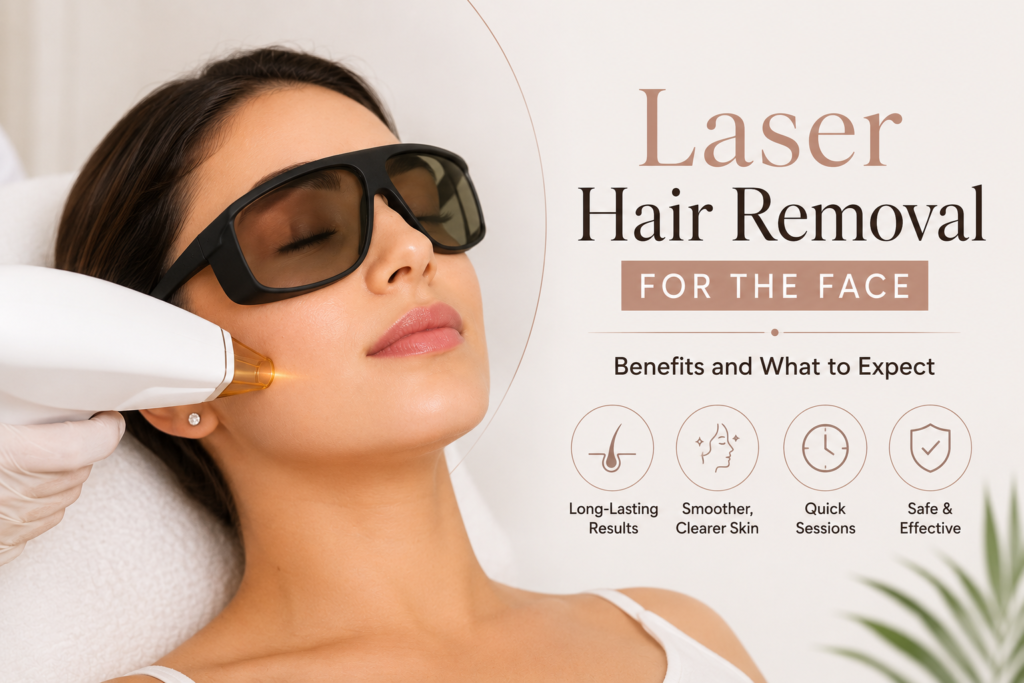
Laser hair removal for the face has quietly become one of the most requested aesthetic treatments in North America, and the reason is simple. Facial hair sits in the most visible place on the body, and the daily cycle of tweezing, threading, and shaving takes a real toll on the skin.
Unlike the legs or underarms, the face is thin skinned, hormonally reactive, and permanently exposed to sunlight. That combination makes it both an excellent candidate for laser treatment and a place where technique matters far more than it does elsewhere.
This guide covers how the technology works on facial skin, what the clinical data actually shows, what a realistic treatment plan looks like, and the specific risks worth understanding before you book.
Why So Many People Look at the Face First
Unwanted facial hair is far more common than most conversations suggest. Research indicates that over 40 percent of women in the general population deal with some degree of unwanted hair growth, and up to 10 percent of women of reproductive age meet the clinical definition of hirsutism.
For men, the drivers are different but just as common. Ingrown hairs along the jaw and neck, razor bumps, and pseudofolliculitis barbae push a large number of clients toward laser as a way to stop the irritation cycle rather than to remove hair entirely.
Laser hair removal now ranks among the top five nonsurgical cosmetic procedures performed in North America, with well over a million professional sessions carried out annually in the United States alone.
How the Technology Works
The principle is called selective photothermolysis. Laser energy at a specific wavelength is absorbed by melanin inside the hair shaft, converted to heat, and that heat damages the follicle and the stem cells responsible for regrowth.
Because melanin is the target, contrast between hair colour and skin colour affects results. Dark coarse hair responds best. Grey, white, red, and very fine blonde hair contain little melanin and respond poorly regardless of device.
Only hairs in the active growth phase, called anagen, can be effectively treated. At any given moment only a portion of your facial hair sits in that phase, which is precisely why a single session cannot clear an area.
The Three Main Wavelengths
Different devices suit different skin types, and a clinic treating a diverse client base should have more than one option available.
| Device | Wavelength | Best Suited For | Notes |
| Alexandrite | 755 nm | Fitzpatrick I to III | Strong melanin absorption, fast treatment, higher pigment risk on deeper tones |
| Diode | 808 to 810 nm | Fitzpatrick I to IV | Good balance of depth and safety, widely used for facial work |
| Nd:YAG | 1064 nm | Fitzpatrick IV to VI | Deeper penetration, lowest melanin absorption in skin, safest for rich skin tones |
| IPL | Broadband light | Fitzpatrick I to III | Not technically a laser, less precise, more variable outcomes |
A 2025 clinical study of 60 patients using a rotational protocol across all three laser wavelengths reported 75.07 percent hair reduction at the six month follow up, with hair thickness dropping from an average of 250 µm to 40 µm.
What the Research Says About Results
Honest expectation setting starts with the vocabulary. Regulators clear these devices for permanent hair reduction, not permanent hair removal, and that distinction is deliberate.
A systematic review of long term randomised controlled trials found meaningful variation in outcomes across device types, which is worth seeing in plain numbers.
| Device Studied | Short Term Reduction | Long Term Reduction |
| Alexandrite | 52% to 86% | 35% to 84.25% |
| Nd:YAG | 60% to 73.6% | 30% to 73.61% |
| Diode | 59.7% to 70% | 32.5% to 69.2% |
| IPL | 21% to 77% | Highly variable |
The review also found no clear evidence that any one device type is universally superior. Operator skill, correct parameter selection, and session count explain far more of the outcome difference than brand name does.
For the face specifically, most people land somewhere between 70 and 90 percent long term reduction after a complete course, with remaining hairs growing back finer and lighter rather than disappearing entirely.
Why Facial Treatment Differs From Body Treatment
Facial hair follicles cycle faster than those on the legs or back. That means sessions on the face are typically spaced closer together, around four to six weeks, compared with six to eight weeks or longer for body areas.
Facial hair is also hormonally driven in a way that body hair often is not. Conditions such as polycystic ovary syndrome, thyroid dysfunction, and certain medications can stimulate new follicles that were never treated in the first place.
This is why maintenance matters more on the face. A completed course is not the end of the story for many clients, particularly women treating the chin and jawline.
| Facial Area | Typical Sessions | Session Interval | Maintenance Frequency |
| Upper lip | 6 to 8 | 4 to 6 weeks | 1 to 2 sessions yearly |
| Chin and jawline | 8 to 10 | 4 to 6 weeks | 2 to 3 sessions yearly |
| Cheeks and sideburns | 6 to 8 | 4 to 6 weeks | 1 to 2 sessions yearly |
| Neck | 6 to 8 | 4 to 6 weeks | 1 to 2 sessions yearly |
| Between brows | 4 to 6 | 4 to 6 weeks | 1 session yearly |
The Benefits Worth the Investment
No more ingrown hairs. Because the follicle itself is treated, the razor bumps and trapped hairs that follow shaving and waxing largely stop occurring.
Better skin texture over time. Clients who stop repeatedly waxing the upper lip and chin often see less irritation, less redness, and fewer breakouts in those zones.
Precision. A trained provider can treat a narrow band along the jaw or clear the space between the brows without affecting surrounding hair.
Time and cost recovery. Threading or waxing the face every three to four weeks adds up quickly across a decade, both in money and in appointments.
It pairs well with other treatments. Removing terminal hair makes exfoliating treatments more effective and more comfortable. Clinics such as World of Beauty Miami frequently sequence laser sessions alongside skin resurfacing so clients address hair and texture together rather than separately.
The Drawbacks and Risks
It is not painless. Most clients describe a rubber band snap sensation. In the 2025 rotational study, average discomfort scored 2 out of 4, meaning slight discomfort, with the upper lip generally reported as the most sensitive facial zone.
Temporary reactions are near universal. The same study recorded erythema in 99 percent of sessions and perifollicular swelling in 98 percent, both resolving within days with no permanent pigment changes or scarring.
Blonde, grey, and white hair will not respond. No current laser reliably targets hair without melanin, and any clinic promising otherwise is overstating what the physics allows.
Paradoxical hypertrichosis is a genuine risk on the face. This is increased hair growth in or near the treated area, most often reported on the face and neck in darker skin types. Published estimates of its incidence vary widely, from under 1 percent up to around 10 percent depending on the study population.
Hormonal conditions limit results. If an underlying condition keeps activating new follicles, laser controls the situation rather than resolving it permanently.
Wrong settings on the wrong skin type cause harm. Burns, blistering, and lasting pigment changes almost always trace back to excessive fluence or an inappropriate device for the skin tone being treated.
What to Expect Before, During, and After
Before your session
Stop waxing, threading, plucking, and epilating for at least four weeks. All three methods remove the root, and the laser needs the follicle intact to work.
Shave the area 12 to 24 hours before your appointment so the energy targets the follicle rather than burning surface hair. Avoid sun exposure and self tanner for two weeks, and pause retinoids and exfoliating acids for about five days.
If you get cold sores, tell your provider before upper lip treatment. Laser can trigger an outbreak, and antiviral prophylaxis is commonly recommended in that situation.
During your session
A test patch on a discreet area is standard practice, particularly for deeper skin tones. Eye protection is mandatory for both you and the technician.
Upper lip treatment usually takes under five minutes. A full face runs 20 to 30 minutes depending on density and device speed.
After your session
Expect redness and mild puffiness around the follicles for a few hours to two days. Cool compresses and a bland moisturiser are usually enough.
Skip the gym, saunas, and hot showers for 24 hours. Use broad spectrum SPF 30 or higher daily, which matters more on the face than anywhere else.
Around one to three weeks later you will notice what looks like regrowth. In most cases these are treated hairs being shed rather than new growth, and gentle exfoliation helps the process along.
Typical Pricing for Facial Areas
| Area | Per Session Range | Full Course Estimate |
| Upper lip | $50 to $150 | $300 to $900 |
| Chin | $60 to $175 | $400 to $1,200 |
| Upper lip and chin combined | $100 to $250 | $600 to $1,800 |
| Sideburns | $75 to $175 | $450 to $1,200 |
| Full face | $200 to $450 | $1,200 to $3,000 |
| Full face and neck | $250 to $550 | $1,500 to $3,800 |
Package pricing typically saves 10 to 20 percent over single sessions. Ask what happens if you need additional sessions beyond the package, since policies vary widely between clinics.
Choosing a Provider
The device matters less than the person operating it. Ask which wavelengths the clinic offers, and be cautious if the answer is only one machine for every skin tone.
Ask whether a licensed professional performs the treatment, whether a test patch is standard, and whether they can show consistent results on skin similar to yours. Reviewing a clinic’s own before and after gallery is more informative than stock photography ever will be.
A proper consultation should cover your medical history, medications, hormonal conditions, recent sun exposure, and hair removal habits. If nobody asks those questions, that itself is the answer.
Clinics offering professional laser hair removal alongside skin services generally have more experience managing facial cases, since they see how hair removal interacts with pigmentation, texture, and sensitivity across a wider client base.
The Bottom Line
Laser hair removal for the face delivers substantial, lasting reduction for people with dark hair who commit to a full course and accept that maintenance is part of the deal. The published evidence supports reduction in the range of 70 to 90 percent after a complete series, with the remaining hair noticeably finer.
It is not the right choice for very light or grey facial hair, and it works best when any underlying hormonal driver is being managed alongside the treatment.
Book a consultation, ask about the specific device being used on your skin tone, and request a test patch. Those three steps eliminate most of what goes wrong with facial laser treatment.
