

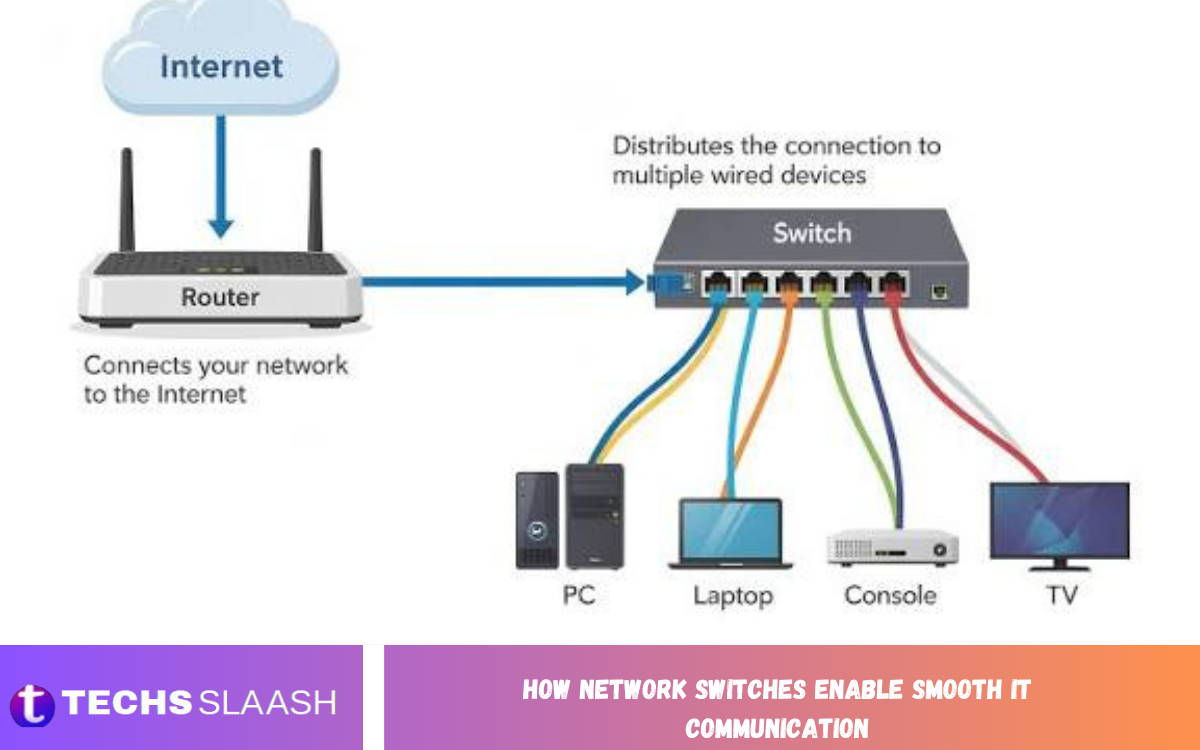
Reliable communication between computers, servers, printers, and other devices is essential for efficient operations. Network switches play a crucial role in making this communication fast, organized, and dependable.
How network switches enable smooth IT communication is closely linked to their ability to connect multiple devices within a local area network (LAN). When information is sent from one device to another, the switch identifies the correct destination and forwards the data accordingly.
What Is a Network Switch?
A network switch is a networking device designed to connect multiple devices within a local area network (LAN). Computers, servers, printers, IP phones, wireless access points, and other network-enabled equipment can communicate through the switch. It receives data packets, examines their destination information, and forwards them to the appropriate connected device.
Unlike older networking technologies that may broadcast data more widely, modern switches can direct traffic more precisely. This helps improve network efficiency because information does not need to be sent unnecessarily to every device. As a result, employees can access applications, files, and shared services with fewer interruptions.
How Network Switches Manage Data Traffic
One of the primary ways switches support smooth IT communication is by controlling how data moves across a network. When a device sends information, the switch uses MAC addresses to determine where the data should go. It then forwards the traffic through the appropriate port rather than distributing it unnecessarily across the entire network.
This intelligent forwarding process helps reduce network congestion and makes communication more efficient. In a busy office, dozens or hundreds of devices may be exchanging information simultaneously. A properly configured switch can manage these connections while helping maintain consistent performance for essential business applications.
Improving Network Speed and Performance
Network switches can significantly contribute to network speed by providing dedicated communication paths between connected devices. Modern Gigabit and multi-Gigabit switches support high-speed data transfers, making them suitable for environments where employees regularly exchange large files or use bandwidth-intensive applications.
Improved switching performance is particularly valuable for businesses that depend on cloud platforms, video meetings, data backups, virtualisation, and collaborative software. By providing reliable connectivity and reducing unnecessary traffic, switches help applications respond more consistently and allow users to work with fewer network-related delays.
Supporting Reliable Device Connectivity
Businesses often operate with a wide range of connected devices, including desktop computers, laptops, servers, printers, VoIP phones, cameras, and wireless access points. A network switch provides the physical and logical connectivity needed for these devices to communicate effectively within the IT infrastructure.
Reliable connectivity is important because even a short network interruption can affect productivity. Employees may lose access to shared files, communication platforms, databases, or cloud applications. Quality switching equipment helps create stable connections and provides a dependable foundation for everyday business communication.
Network Switches and IT Security
Network switches can also contribute to a stronger IT security strategy. Managed switches commonly include features such as VLANs, port security, access controls, and monitoring capabilities. These functions allow network administrators to control how devices communicate and separate different types of network traffic.
For example, a business can use VLANs to separate employee computers from guest devices or sensitive systems. This segmentation can limit unnecessary access between network areas and help administrators manage security more effectively. While switches are not a complete security solution, their built-in controls can support broader network protection strategies.
The Role of Managed Network Switches
Managed switches provide administrators with greater control over network operations than unmanaged models. Through management interfaces, IT professionals can monitor traffic, configure ports, establish VLANs, prioritize certain applications, and identify potential performance problems.
This level of control is particularly useful for medium-sized and large organizations where network requirements can change frequently. Administrators can adjust configurations according to business needs, helping the infrastructure remain efficient as the number of users, devices, and applications increases.
VLANs and Efficient Network Segmentation
Virtual Local Area Networks, commonly known as VLANs, allow administrators to logically separate devices even when they are connected to the same physical switching infrastructure. This can help organize network traffic by department, service, security requirements, or other business functions.
Effective segmentation can improve both network management and communication efficiency. For example, finance systems can be separated from guest devices, while voice traffic can be managed independently from ordinary data traffic. This structure can reduce unnecessary communication between devices and make the network easier to control.
Quality of Service for Important Applications
Some network applications require more consistent performance than others. Voice calls, video conferencing, business-critical applications, and real-time collaboration platforms can be affected by delays or network congestion. Quality of Service (QoS) features on supported switches can help prioritize important traffic.
By assigning higher priority to critical data, network administrators can help ensure that essential applications receive appropriate network resources. This can improve the quality of voice and video communications and provide a smoother experience for employees who depend on real-time digital tools.
Read Also: Best LMS Platform in the USA for Safety-Critical Training
Power over Ethernet and Connected Devices
Power over Ethernet (PoE) is another valuable feature available on many modern network switches. PoE allows compatible devices to receive both data connectivity and electrical power through a single Ethernet cable. This can simplify the installation of devices such as wireless access points, IP phones, and security cameras.
Using PoE can reduce the need for separate power adapters and electrical outlets near every connected device. It can also make network installations cleaner and easier to manage. For businesses expanding their IT infrastructure, PoE switching can provide a practical way to support additional devices while maintaining an organised network.
Network Switches in Cloud-Based Workplaces
Cloud computing has changed how organizations access applications and store information. Although cloud services operate outside the local network, employees still require dependable internal connectivity to reach those services. Network switches help provide a stable connection between user devices, network infrastructure, routers, wireless systems, and internet gateways.
As cloud-based workplaces grow, consistent network performance becomes increasingly important. Slow or unstable internal connectivity can affect access to cloud applications, online storage, communication tools, and remote collaboration platforms. A well-designed switching infrastructure helps create the reliable foundation required by modern cloud-dependent businesses.
Scalability for Growing Businesses
A business network should be capable of supporting future growth rather than only meeting current requirements. Network switches are available in different port configurations and performance levels, allowing organizations to select equipment according to their current infrastructure and expected expansion.
When additional employees, offices, devices, or applications are introduced, businesses can expand their switching infrastructure accordingly. Managed switching solutions can also provide greater flexibility for network redesigns. This scalability helps organizations avoid frequent infrastructure replacements and supports long-term IT planning.
Reducing Network Bottlenecks
Network bottlenecks occur when a part of the infrastructure cannot handle the traffic generated by connected devices. Such bottlenecks can lead to slow applications, delayed file transfers, unstable video calls, and frustrating user experiences. Properly selected network switches can help reduce these problems.
Administrators can analyse network usage and choose switching equipment with suitable port speeds, uplink capacity, and features. Combining appropriate hardware with good network design helps distribute traffic more effectively. This allows businesses to maintain smoother communication even when network demand increases.
Choosing the Right Network Switch
Selecting a network switch requires careful consideration of factors such as port count, speed, PoE requirements, management capabilities, VLAN support, security features, and scalability. A small office may require a straightforward switch, while a larger organization could need multiple managed switches with advanced configuration options.
Businesses should also consider future requirements before making a purchasing decision. Choosing equipment with sufficient capacity for expected growth can prevent unnecessary upgrades later. Compatibility with existing routers, access points, servers, cabling, and other infrastructure should also be evaluated to ensure reliable operation.
Best Practices for Network Switch Management
Proper configuration and ongoing monitoring are essential for maintaining switching performance. IT teams should keep firmware updated, review network traffic, monitor connected devices, secure management interfaces, and regularly assess whether the network configuration still meets business requirements.
Physical infrastructure should also receive attention. Ethernet cables, ports, power supplies, ventilation, and equipment placement can affect reliability. Regular maintenance can help identify potential problems before they become major disruptions, supporting stable communication throughout the organization.
Why Network Switches Matter for Business Productivity?
Smooth IT communication directly affects employee productivity. When computers, servers, applications, phones, and other systems communicate reliably, employees can share information, collaborate, access resources, and complete tasks more efficiently. Network switches help provide the connectivity required for these activities.
A well-designed switching environment can also reduce the workload associated with troubleshooting network problems. With managed features and monitoring capabilities, IT professionals can gain greater visibility into network behavior.
Future of Network Switching Technology
Network switching continues to evolve as organizations adopt faster internet connections, cloud computing, artificial intelligence, Internet of Things devices, and increasingly data-intensive applications. Higher port speeds, improved automation, advanced monitoring, enhanced security controls, and more efficient management are shaping modern switching solutions.
Businesses will increasingly require networks that can handle large volumes of data without compromising reliability. Network switches will remain an important part of this infrastructure because they provide the connectivity and traffic-management capabilities needed to keep digital systems communicating efficiently.
Frequently Asked Questions
What is the main purpose of a network switch?
The main purpose of a network switch is to connect multiple devices within a network and efficiently forward data between them. It helps devices communicate while reducing unnecessary network traffic.
How do network switches improve communication?
Switches improve communication by directing data to the correct destination device. This reduces unnecessary traffic and helps connected systems exchange information more efficiently.
Are network switches important for small businesses?
Yes. Even small businesses can benefit from reliable switching infrastructure because computers, printers, phones, access points, and other devices need stable connectivity for everyday operations.
What is the difference between managed and unmanaged switches?
An unmanaged switch generally works with minimal configuration, while a managed switch provides administrators with greater control. Managed models can support features such as VLANs, QoS, monitoring, and security controls.
What is a VLAN on a network switch?
A VLAN is a logical network segment created within switching infrastructure. It allows administrators to separate devices or traffic into different groups for better organization, security, and management.
Can network switches improve internet speed?
A switch does not automatically increase the speed provided by an internet service. However, a suitable switch can improve internal network performance and ensure connected devices can communicate efficiently at supported speeds.
What is Power over Ethernet?
Power over Ethernet, or PoE, allows compatible devices to receive electrical power and network data through the same Ethernet cable. It is commonly used for access points, IP phones, and security cameras.
Why is QoS important on network switches?
QoS can prioritise specific types of traffic, such as voice and video. This can help important applications maintain better performance when the network is experiencing heavy traffic.
How can businesses maintain network switch performance?
Businesses should regularly monitor network traffic, update firmware, secure management access, inspect cables and ports, and review configurations. Proper maintenance can help prevent avoidable network problems.
How should a business choose a network switch?
A business should consider the number of devices, required port speeds, PoE needs, management features, security requirements, VLAN support, and expected future growth before selecting a switch.
Conclusion
Understanding How Network Switches Enable Smooth IT Communication highlights their importance in modern business infrastructure. By connecting devices, directing data efficiently, supporting segmentation, prioritizing critical traffic, and enabling advanced management, switches help organizations maintain reliable and productive IT environments.
As businesses continue adopting cloud applications, connected devices, remote collaboration, and data-intensive technologies, dependable network infrastructure will become even more important.
