

Forex trading is one of the world’s largest financial markets, letting traders buy and sell currencies as exchange rates change. Successful trading requires market knowledge, careful planning, and a clear understanding of the factors that influence currency prices. Choosing the right strategy can help traders make informed decisions and manage risk.
Popular Forex Trading Strategies for consistent, informed trading include trend following, price action trading, scalping, swing trading, and breakout trading. Each approach has different requirements, advantages, and challenges. Understanding how these methods work can help beginners and experienced traders develop a structured trading plan that matches their goals, available time, and risk tolerance.
Understanding the Forex Market
The foreign exchange market operates through a global network of banks, financial institutions, businesses, and individual traders. Currency pairs, such as EUR/USD, GBP/USD, and USD/JPY, trade based on changing supply and demand. Economic reports, interest rate decisions, geopolitical developments, and market sentiment can all influence exchange rates.
Forex markets operate around the clock during the working week, creating opportunities across different trading sessions. However, frequent price movements do not guarantee profits. Traders need to understand spreads, leverage, liquidity, and volatility before entering the market. A strong foundation in these concepts supports better decision-making and reduces avoidable trading mistakes.
Trend Following Strategy
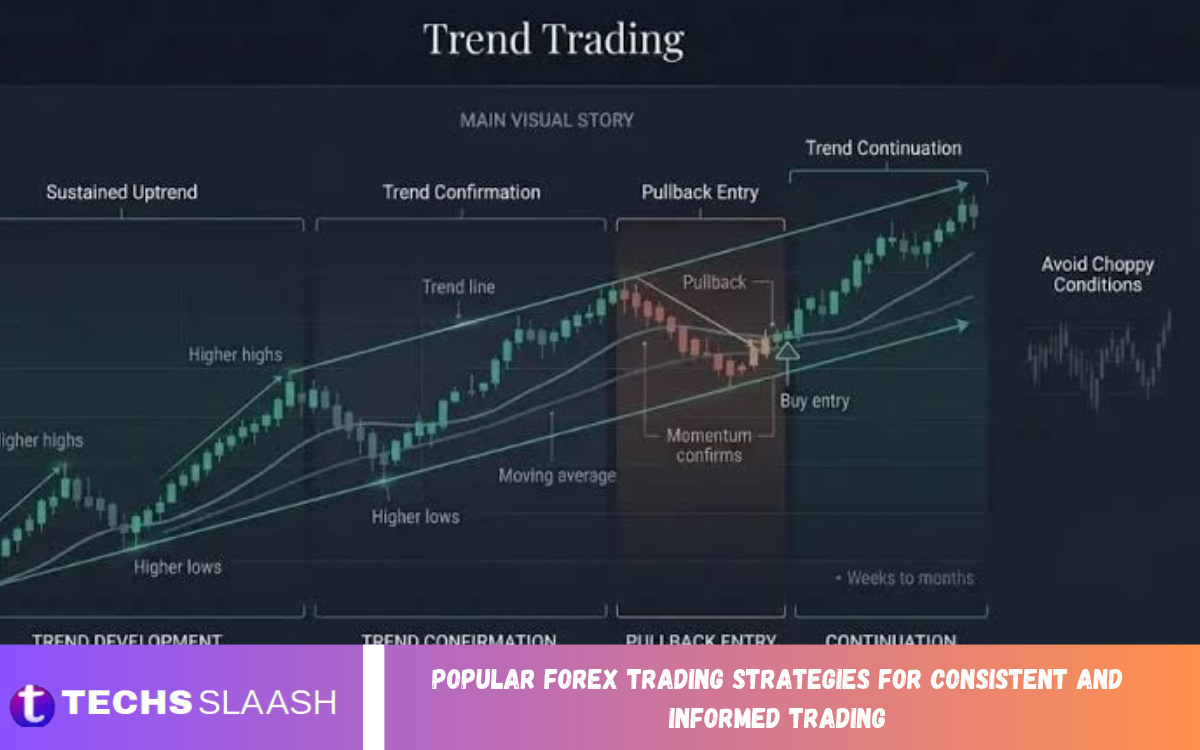
Trend following is a widely used forex trading strategy that focuses on identifying a currency pair’s general direction. Traders look for upward trends when prices form higher highs and higher lows, or downward trends when prices form lower highs and lower lows. Moving averages and trendlines can help identify potential trading opportunities.
Traders may enter a position when the price moves in the direction of an established trend and exit when market conditions change. Combining trend analysis with support and resistance levels can improve the quality of trading decisions. However, trends can reverse unexpectedly, so traders should use appropriate stop-loss orders and avoid assuming that a market will continue moving in the same direction indefinitely.
Scalping Strategy
Scalping is a short-term trading approach that aims to capture small price movements through frequent trades. Scalpers often use one-minute, five-minute, or similar short timeframes to identify brief opportunities in liquid currency pairs. This method requires quick decision-making, disciplined execution, and close attention to transaction costs.
Although scalping can provide frequent trading opportunities, spreads and commissions may significantly affect overall results. Rapid price movements can also lead to unexpected losses, particularly when leverage is involved. Traders considering this strategy should practice in a simulated environment, establish strict risk limits, and avoid making impulsive decisions after losing trades.
Swing Trading Strategy
Swing trading focuses on capturing price movements that develop over several days or weeks. Instead of monitoring every market fluctuation, swing traders analyze broader price patterns and look for opportunities around support, resistance, and potential trend reversals. This approach may suit individuals who cannot watch the market throughout the day.
Technical indicators, chart patterns, and economic developments can help swing traders evaluate potential setups. Positions may remain open overnight, exposing traders to unexpected news and price gaps. A carefully planned entry, stop-loss level, and profit target can help control risk while allowing trades sufficient room to develop.
Breakout Trading Strategy
Breakout trading involves entering a position when the price moves beyond an established support level, resistance level, or consolidation range. A breakout may indicate that buyers or sellers are gaining strength, potentially creating an opportunity for a larger price movement. Traders often examine trading volume where available, volatility, and the strength of the price movement.
False breakouts are a common challenge because prices may briefly cross an important level before returning to the previous range. Some traders wait for a candle to close beyond the level or look for a successful retest before entering. These confirmation methods may reduce certain risks, although they cannot eliminate losses or guarantee that a breakout will continue.
Price Action Trading Strategy
Price action trading relies primarily on movements shown directly on a price chart rather than depending entirely on technical indicators. Traders study candlestick patterns, market structure, support, resistance, and changes in buying or selling pressure. Common patterns include pin bars, engulfing candles, and inside bars.
This strategy can be applied across different timeframes and currency pairs. However, chart patterns do not always produce the expected outcome, and their interpretation can vary between traders. Combining price action analysis with the broader market trend and a defined risk management plan can help traders avoid treating individual candlesticks as guaranteed signals.
Range Trading Strategy
Range trading is designed for markets that move between relatively stable support and resistance levels without establishing a strong directional trend. Traders may consider buying near the lower boundary and selling near the upper boundary when price behavior supports that approach. Oscillators such as the Relative Strength Index can help identify potential overbought or oversold conditions.
The main risk is that a ranging market can develop into a strong breakout. Traders should therefore identify invalidation levels and avoid assuming that established support or resistance will always hold. Range trading generally works best when market conditions are relatively stable and the boundaries of the trading range are reasonably clear.
Moving Average Crossover Strategy
The moving average crossover strategy uses two moving averages to identify potential changes in market direction. A shorter-term moving average crossing above a longer-term moving average may suggest strengthening upward momentum, while a downward crossover may indicate weakening prices. Traders often experiment with different periods to suit their preferred timeframe.
Moving average crossovers are relatively easy to understand, making them useful for traders learning technical analysis. However, they rely on historical prices and can generate delayed signals. In sideways markets, repeated crossovers may lead to several unsuccessful trades. Traders can combine crossover signals with price action, trend analysis, and risk management to evaluate opportunities more carefully.
News Trading Strategy
News trading focuses on currency price movements around important economic announcements. Central bank interest rate decisions, inflation reports, employment figures, and gross domestic product releases can influence expectations about economic conditions and monetary policy. Traders monitor these events to gauge how new information may affect demand for the currency.
News trading carries substantial risks because prices can move rapidly, spreads may widen, and orders may execute at different prices than expected. Even positive economic news can cause a currency to decline if markets anticipated a stronger result. Traders should review the economic calendar, understand the potential impact of major announcements, and avoid risking excessive capital during volatile periods.
Risk Management in Forex Trading
Risk management is essential to every forex trading strategy because no method can predict currency movements with complete accuracy. Traders should determine how much capital they are willing to risk before entering a position and use stop-loss orders when appropriate. Position sizes should reflect account equity, stop-loss distance, and individual risk tolerance.
Many traders use a small percentage of their trading capital as a reference point for an individual trade’s risk, although the appropriate amount varies by circumstances. Traders should also monitor leverage, avoid concentrating too much exposure in correlated currency pairs, and establish a maximum acceptable loss. Protecting trading capital supports long-term participation but does not guarantee profits.
Read Also: Forex Trading Guide: Strategies, Tips, and Risk Management
Using Technical and Fundamental Analysis Together
Technical analysis examines price charts, market trends, support and resistance, and indicators to identify potential trading opportunities. Fundamental analysis evaluates economic conditions, monetary policy, inflation, employment, and geopolitical developments. Both approaches offer different information that can help traders understand the forces influencing currency prices.
Using technical and fundamental analysis together can provide a broader view of the market. For example, a trader may identify an upward trend on a chart while reviewing interest rate expectations to understand the economic background. However, conflicting signals are common, and neither method guarantees accurate forecasts. Traders should evaluate available evidence objectively and follow predetermined entry and exit rules.
Developing a Forex Trading Plan
A trading plan establishes the rules that guide decisions before, during, and after a trade. It should identify the currency pairs being traded, preferred market conditions, entry signals, stop-loss placement, profit-taking rules, and maximum risk. Clear rules reduce the influence of fear, excitement, and impulsive decisions.
Traders should also maintain a trading journal that records the reason for each entry, the exit decision, the outcome, and any mistakes. Reviewing these records can reveal recurring weaknesses and show whether a strategy performs differently under changing market conditions. A trading plan should be evaluated regularly using evidence rather than modified after every unsuccessful trade.
Choosing the Right Forex Trading Strategy
The most suitable strategy depends on a trader’s experience, schedule, financial objectives, and tolerance for risk. Scalping requires considerable attention and rapid execution, while swing trading allows more time between decisions. Trend following and breakout trading may appeal to traders who prefer directional market movements, whereas range trading focuses on relatively stable price boundaries.
Beginners may benefit from learning one straightforward strategy before exploring more complex methods. Practicing with historical charts and a demo account can help develop familiarity without immediately risking real money. Traders should evaluate a strategy across different market conditions and account for transaction costs before deciding whether it suits their needs.
Common Forex Trading Mistakes to Avoid
One common mistake is trading without a clearly defined plan. Entering positions based on rumors, emotions, or isolated indicators can lead to inconsistent decisions. Overtrading, excessive leverage, moving stop-loss orders farther away to avoid closing a losing position, and attempting to recover losses immediately can also increase financial risk.
Another mistake is assuming that a strategy that worked previously will always remain effective. Currency markets change in response to economic conditions, monetary policy, and unexpected events. Traders should review their performance, recognize uncertainty, and avoid risking money they cannot afford to lose. Consistency comes from following a disciplined process rather than expecting every trade to succeed.
Frequently Asked Questions
What Is the Best Forex Trading Strategy for Beginners?
Trend following and basic support-and-resistance strategies can be useful starting points because they teach traders to recognize market direction and important price levels. Beginners should practice first, learn position sizing, and understand the risks before trading with real money.
Can Forex Trading Generate Consistent Profits?
Forex trading can produce profits, but consistent returns are not guaranteed. Market conditions change, and even well-tested strategies experience losing trades. Disciplined execution, realistic expectations, and effective risk management are important for controlling potential losses.
Which Forex Strategy Is Best for Short-Term Trading?
Scalping and intraday trading are common short-term approaches. They require close monitoring, reliable execution, and careful consideration of spreads and commissions. Neither strategy is automatically more profitable than longer-term methods.
Is Swing Trading Suitable for Beginners?
Swing trading may suit beginners who prefer chart analysis without constantly monitoring prices. However, traders must understand overnight risk, economic announcements, and stop-loss placement before opening positions that remain active for several days.
What Is the Importance of Stop-Loss Orders?
A stop-loss order is designed to close a position when the market reaches a specified price, subject to execution conditions. It can help limit losses, although slippage and market gaps may result in a worse execution price than expected.
Which Forex Indicators Are Commonly Used?
Moving averages, the Relative Strength Index, the Moving Average Convergence Divergence indicator, and Bollinger Bands are widely used. Indicators should support a trading plan rather than replace market analysis and risk management.
How Much Money Is Needed to Start Forex Trading?
The minimum amount depends on the broker, account type, and local regulations. Traders should begin only with money they can afford to lose and avoid using borrowed funds. A small deposit doesn’t eliminate the risks of leverage.
Is Forex Trading Better Than Stock Trading?
Neither market is universally better. Forex trading involves currency pairs and can be influenced by interest rates and international economic developments, while stock trading involves company shares and related market factors. The appropriate choice depends on individual goals, knowledge, and risk tolerance.
How Can Traders Improve Their Forex Trading Skills?
Traders can improve through structured learning, demo-account practice, backtesting, and maintaining a trading journal. Reviewing both winning and losing trades helps identify weaknesses and encourages evidence-based decisions rather than emotional ones.
Can Automated Forex Trading Strategies Be Reliable?
Automated strategies can execute predefined rules quickly, but their performance depends on strategy design, market conditions, execution costs, and technical reliability. Backtesting does not guarantee future results, and automated systems require monitoring and appropriate risk controls.
Conclusion
Popular Forex Trading Strategies for consistent, informed trading provide a foundation for understanding currency market behavior and making structured trading decisions. Trend following, scalping, swing trading, breakout trading, price action, and range trading each offer different ways to evaluate potential opportunities.
The most important factors are choosing an approach that matches your circumstances, practicing before committing real capital, and maintaining disciplined risk management. No strategy guarantees profits, and losses remain possible even when trading rules are followed carefully.

1 Comment
Pingback: Beginner’s Guide to Trading: Essential Strategies, Tips, and Risk Management - Techsslaash.com