

By Johar Mandav, CEO, Digital Edge Solutions · Nov 29, 2026
A POS system in Kuwait should accept KNET debit cards and contactless wallets, and price in Kuwaiti dinars to three decimal places. It should print Arabic-first invoices and include a configurable tax engine, so it is VAT-ready even though Kuwait has no VAT in force. It should also protect card data in line with PCI DSS v4.0.1.
Key Takeaways
- Of the three channels in Central Bank of Kuwait data, only POS card spending grew in the first nine months of 2025.
- Confirm KNET debit acceptance, Apple Pay and whether the card terminal integrates with the POS software.
- Test three-decimal KD pricing and Arabic right-to-left printing on real receipts before you sign.
- Kuwait had no VAT in force at PwC’s July 2026 review, but a configurable tax engine avoids a forced system change later.
- Ask cloud vendors about PCI DSS v4.0.1, tokenization and CITRA data rules.
Why does POS choice matter more in Kuwait now?
Kuwaiti spending is moving to card payments at the till. Card spending at POS terminals rose 3% to KD 14.39 billion in the first nine months of 2025. It was the only one of the three channels that grew. Online gateway spending and ATM cash withdrawals both fell, according to Arab Times, citing Central Bank of Kuwait data.
Chart: Kuwait payments and cash withdrawals, Jan–Sep 2025 (KD billion)
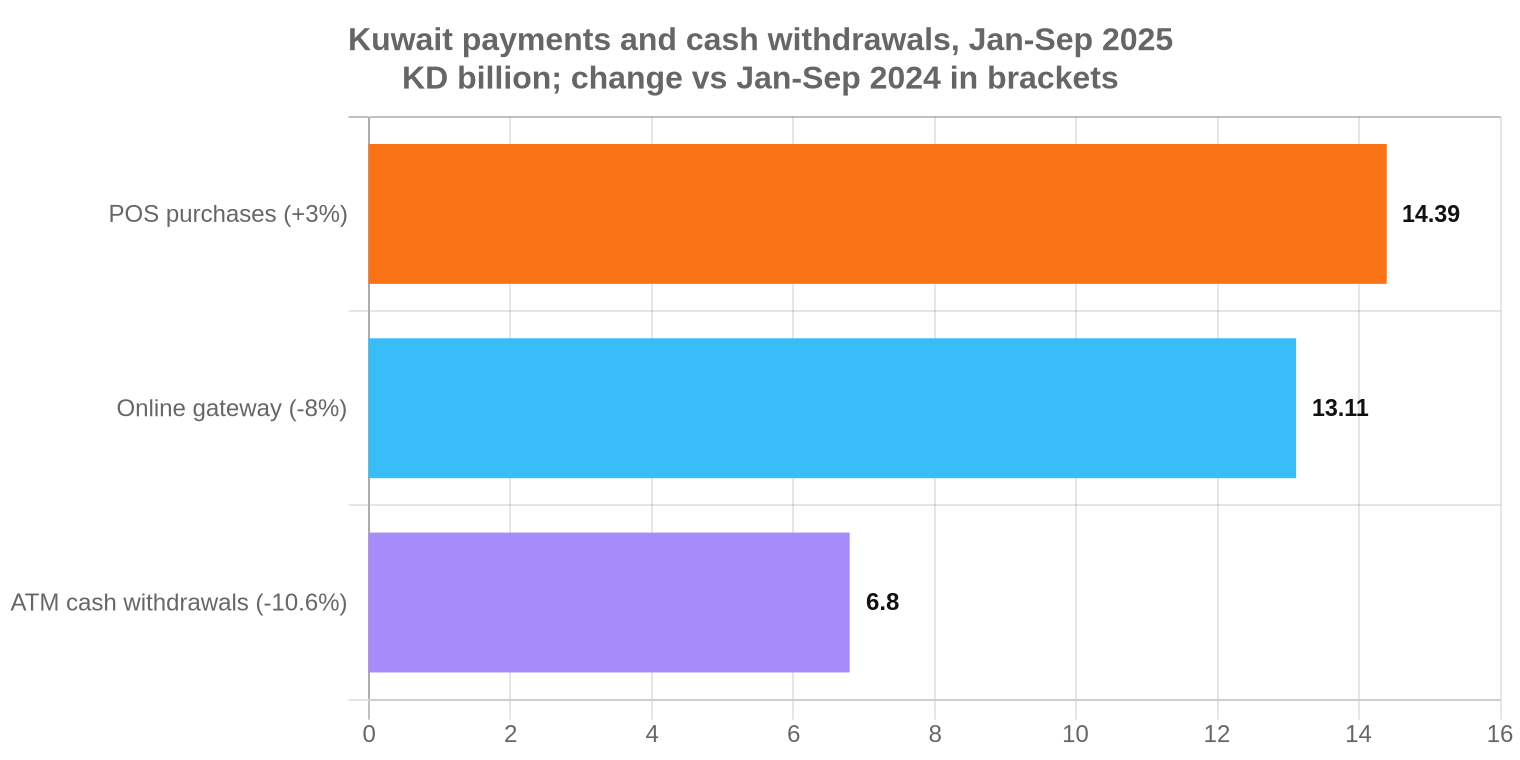
Channel | Jan–Sep 2025 | Change vs Jan–Sep 2024 |
POS purchases | 14.39 | +3% |
Online gateway | 13.11 | −8% |
ATM cash withdrawals | 6.8 | −10.6% |
Source: Arab Times, citing Central Bank of Kuwait data, 4 November 2025.
Debit cards dominate. In Q1 2024, debit cards made up KD 10,658.5 million of the KD 11,710.0 million spent with locally issued cards across POS, online and ATM channels. That figure comes from the CBK’s Q1 2024 release, the most recent quarterly table checked directly on its website. ATM withdrawals still totalled KD 6.8 billion in 2025’s first nine months, so cash drawer management still matters.
Which payments must a Kuwait POS accept?
A Kuwait POS must accept local debit cards through KNET, plus contactless NFC cards and wallets such as Apple Pay. KNET is the only entity on the Central Bank of Kuwait’s list of e-Payment Services Operators. A reported CBK circular also bars merchants from adding card surcharges.
KNET is Kuwait’s shared card payment network. It was set up in 1992 with local banks, and POS payments in Kuwait began in 1994, according to the Central Bank of Kuwait.
Integrated or standalone terminals
Card terminals are typically arranged through your acquiring bank. An integrated terminal receives the amount from the POS, which cuts keying errors and makes end-of-day matching easier. A standalone terminal needs staff to key amounts by hand, so mismatches are likelier at busy times. Ask vendors which terminals they integrate with today.
Contactless and Apple Pay
NFC contactless payments arrived on Kuwaiti POS terminals in 2017, per the CBK. Apple Pay came to KNET’s NFC POS devices in December 2022. About 90,000 devices were ready at launch, Arab Times reported.
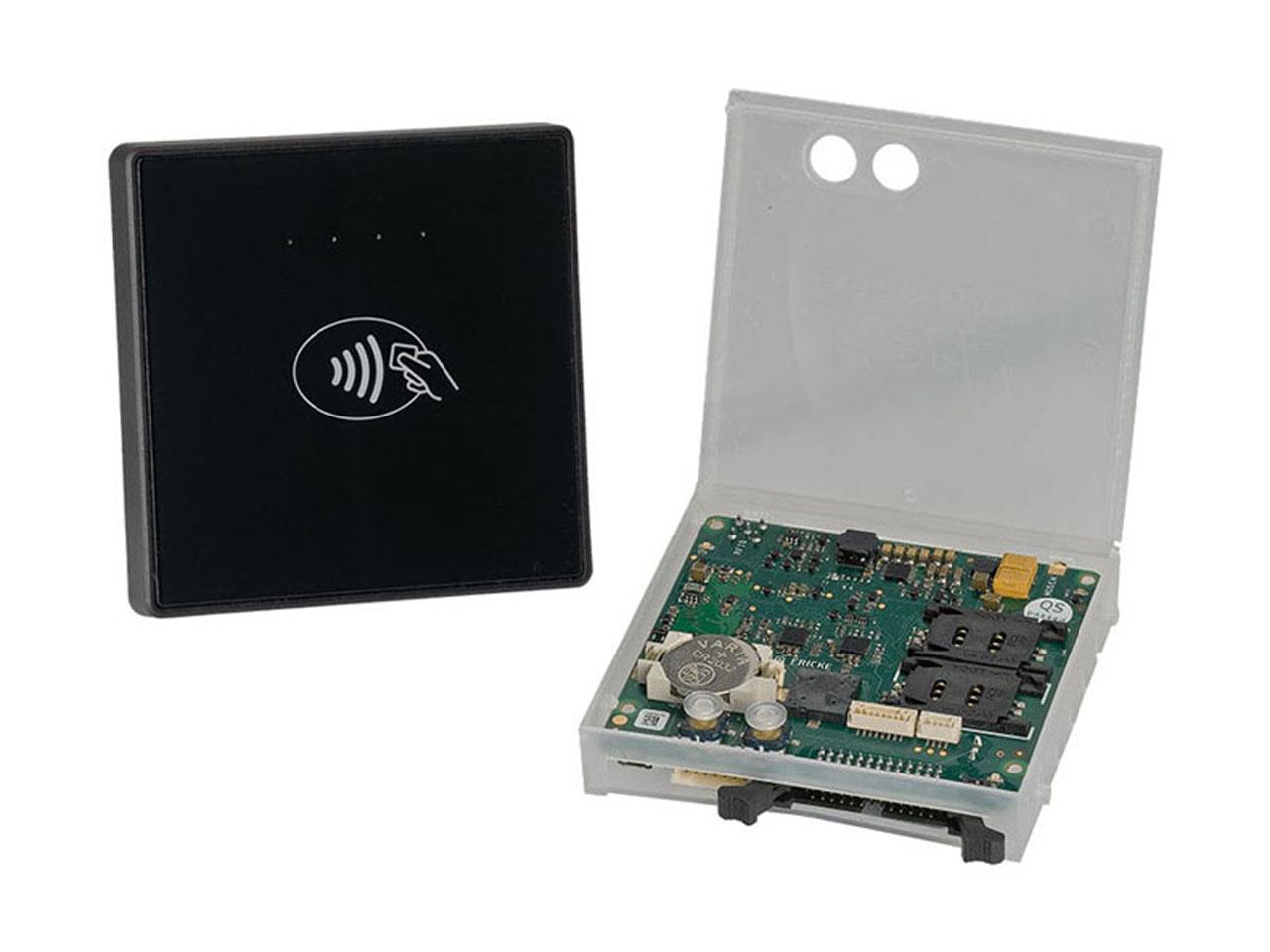
A contactless card reader and its internals. “Contactless-payment” (File:Contactless-payment.jpg) by SirRuddy, Wikimedia Commons, CC BY-SA 4.0.
In 2020, local banks raised the PIN-free contactless limit from KD 10 to KD 25, according to Arab Times. Limits can change, so confirm the current figure with your bank. For where tap-to-pay is heading, see this look at the future of contactless payments.
No surcharges on card payments
CBK Circular No. 2/RBA/600/2025, dated 30 September 2025, bans merchants from charging extra for card payments. The ban covers POS, payment gateways and e-wallets, according to Arab Times. Violators risk losing their payment services. The full text wasn’t found on a public CBK page, so confirm with your bank and switch off any POS surcharge setting.
How should POS software handle Kuwaiti dinars and Arabic invoices?
POS software in Kuwait should display, calculate and print every price to three decimals, because the Kuwaiti dinar is divided into 1,000 fils, according to the Central Bank of Kuwait. It should also print Arabic-first bilingual invoices, which Kuwait’s Ministry of Commerce and Industry reportedly requires.
Three-decimal pricing and fils rounding
A 15% discount on a KD 1.250 item is KD 0.1875, a fourth decimal place. One system may round the discount up and charge KD 1.062; another may round it down and charge KD 1.063. Across 2,000 discounted lines a month, that single fils becomes KD 2 your till and accounts can’t explain.
In a demo, ring up items priced to the fils, apply a percentage discount, and check that the screen, receipt and exported report agree. Ask whether cash rounding is configurable.
Arabic-first, bilingual invoices
The Ministry of Commerce and Industry (MOCI) requires Arabic as the primary language on purchase invoices, with a secondary language allowed, as reported by Arab Times in October 2024. The decision text wasn’t found online, so confirm it with your accountant. According to the report, an invoice should show:
- the buyer’s name, address and the date
- the supplier’s signature or stamp
- an item description, its condition and serial number
- quantity, price and delivery date
Then print test receipts on your actual printer, because right-to-left and mixed-language text is where templates break.
Does Kuwait have VAT on POS sales?
No. Kuwait has no VAT in force, according to PwC’s Worldwide Tax Summaries, last reviewed on 22 July 2026. Kuwait signed the GCC VAT framework agreement in February 2017. PwC notes that a draft VAT law is still under discussion. That is why a Kuwait POS still needs a configurable tax engine.
Because VAT could arrive with limited notice, check that you can create tax rates by product, switch between tax-inclusive and tax-exclusive pricing, and print and report tax without custom development. No Kuwaiti e-invoicing mandate appeared in the sources reviewed; recheck with your accountant.
What security and data rules apply to a Kuwait POS?
A Kuwait POS that handles card data is generally in scope for PCI DSS v4.0.1, the card industry’s security standard. Cloud POS vendors licensed by Kuwait’s Communication and Information Technology Regulatory Authority (CITRA) may also fall under CITRA Resolution No. 26 of 2024, which covers consent, breach notification and data deletion.
PCI DSS v4.0.1
The PCI Security Standards Council published PCI DSS v4.0.1 in June 2024. It retired v4.0 on 31 December 2024, according to the PCI SSC blog. Version 4.x added 64 new requirements. Of these, 51 were future-dated and took effect on 31 March 2025, the council noted.
Ask each vendor three things. Can they show evidence of a PCI DSS v4.0.1 assessment? Do they support point-to-point encryption (P2PE) or tokenization, so the POS never stores raw card numbers? And which security duties stay with you?
CITRA Resolution No. 26 of 2024
Resolution No. 26 of 2024 replaced No. 42 of 2021. Its English text wasn’t found on CITRA’s site, so this relies on legal summaries. It applies to CITRA-licensed providers wherever data is processed, Access Partnership reports. Its key rules are:
- explicit consent before collecting personal data
- breach notification to CITRA within 24 hours
- deletion of personal data when a contract ends, with some exceptions
Michalsons adds that communication must be clear in Arabic and English.
The resolution binds licensed providers, not every retailer directly. Ask cloud vendors whether they or their host are CITRA-licensed and how you export your data at contract end.
Which retail features matter most in a Kuwait POS?
Beyond KNET payments and Kuwaiti dinar pricing, the retail features that matter most in a Kuwait POS are fast barcode scanning, multi-branch stock, a reliable offline mode, receipt-linked returns and staff permissions.
- Barcodes and variants: fashion stores need size and colour variants; electronics stores may need serial numbers. Upgrading scanners? See this handheld barcode scanner guide.
- Multi-branch stock: live stock across branches, transfers and per-branch pricing.
- Offline mode: keep selling when the internet drops, then sync cleanly. Keep a backup connection; these tips on reliable internet for small businesses and choosing a mobile and internet plan in Kuwait can help.
- Staff roles and approvals: permissions by role, manager approval for voids, refunds and discounts, and an audit log of who did what.
- Returns and loyalty: returns linked to the original receipt and recorded loyalty consent.
- Reporting and integrations: sales by payment type, staff and branch, plus accounting links. Good stock data supports these inventory management strategies.
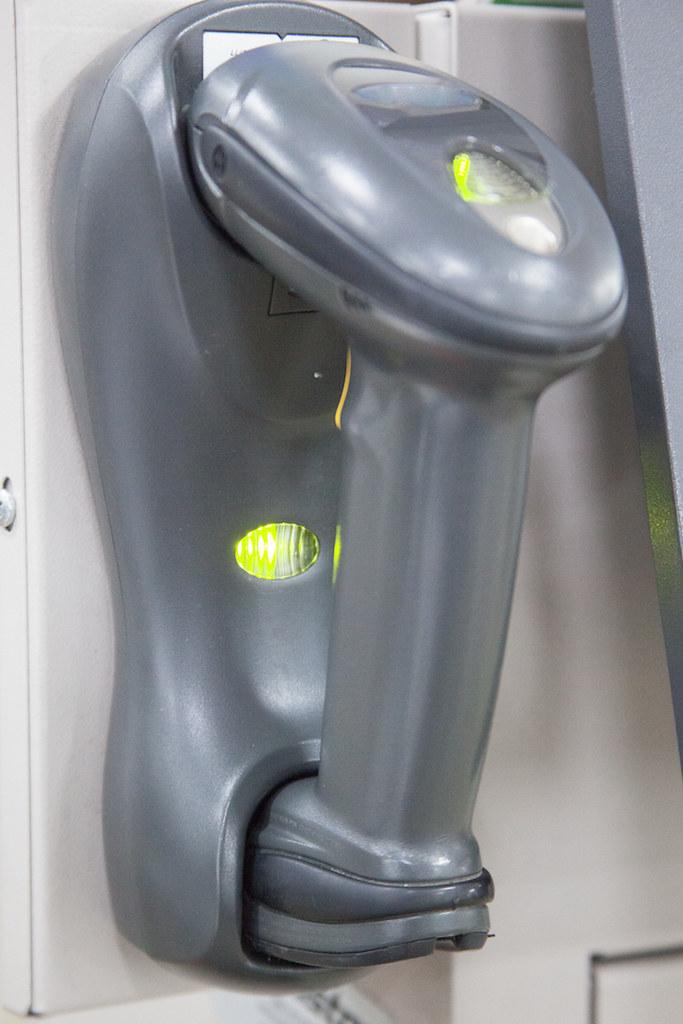
Fast, reliable scanning is a daily POS test. “Barcode Scanner – Barcode Reader” by perspec_photo88, CC BY-SA 2.0.
How do you compare POS vendors in Kuwait?
Compare POS vendors in Kuwait on total cost and a live demo scorecard covering KNET terminals, three-decimal Kuwaiti dinar pricing, Arabic invoices, PCI DSS and CITRA data handling. Total cost includes per-register fees, hardware and import customs, setup, training, support and bank card costs.

Count every piece of hardware in your total cost. “point-of-sale setup” by jimw, CC BY 2.0.
Use this scorecard in every demo:
Criterion | What to ask or test | Why it matters in Kuwait |
KNET terminals | Which terminals integrate today? Run a live sale. | Debit cards dominate local card spending. |
Contactless | Test tap and Apple Pay payments. | Apple Pay works on KNET NFC terminals. |
Card surcharges | Is any surcharge setting off? | CBK Circular No. 2/RBA/600/2025 bans card fees (reported; confirm with your bank). |
Three-decimal KD | Price to the fils, apply discounts, export a report. | The dinar has 1,000 fils. |
Arabic invoices | Print Arabic-primary receipts on your printer. | MOCI reportedly requires Arabic first. |
Tax engine | Create and print a test tax rate. | PwC notes a draft VAT law is under discussion. |
PCI DSS and data | Request v4.0.1 evidence; ask about tokenization and CITRA licensing. | Future-dated v4.x requirements took effect on 31 March 2025. |
Staff permissions | Test manager approval for voids, refunds and discounts; view the audit log. | Logs make every void and refund traceable. |
Offline and exit | Disconnect mid-sale; ask about Arabic support and data export. | A local outage can stop checkout. |
Shortlist two or three systems and run each through the scorecard with your own products, printer and bank terminal. Then plan the rollout with these store management system implementation best practices.
Common questions about POS systems in Kuwait
Can I add a fee when customers pay by card in Kuwait?
No. A 2025 Central Bank of Kuwait circular, as reported by Arab Times, bars card fees at the till, online and through e-wallets. Cover card costs in your prices instead.
Is a cloud POS a good idea for a small Kuwaiti shop?
It can be, especially if you want remote reports and multi-branch views. You depend on your internet line and the vendor, so insist on tested offline mode and full data export.
Do I need an integrated card terminal?
It isn’t required, but integration usually means fewer keying errors and faster end-of-day matching. Ask your acquiring bank which terminals it offers.
About the author
Johar Mandav is the CEO of Digital Edge Solutions, a technology company founded in Canada in 2000 that has run an IT retail showroom in Hawally, Kuwait, since 2004 and supplies retail POS systems to Kuwaiti shops through its POS53 brand.
Disclosure: the author’s company sells POS systems in Kuwait. This checklist names no vendors, so it works for comparing any shortlist.
Book a demo: POS system Kuwait (POS53 contact page).
Sources
- Central Bank of Kuwait, “Development of Payment Systems.” cbk.gov.kw
- Central Bank of Kuwait, “e-Payment Services Operators.” cbk.gov.kw
- Central Bank of Kuwait, quarterly statistical release, Q1 2024. cbk.gov.kw
- Central Bank of Kuwait, “Banknotes: Introduction.” cbk.gov.kw
- Arab Times, “Kuwait sees first drop in consumer spending after four years of growth,” 4 November 2025. arabtimesonline.com
- Arab Times, “Kuwait prohibits additional charges on debit and credit card payments,” 27 December 2025. arabtimesonline.com
- Arab Times, “KNET’s POS devices ready for Apple Pay,” 6 December 2022. arabtimesonline.com
- Arab Times, “Local banks agree for KD 25 contactless purchase,” 10 March 2020. arabtimesonline.com
- Arab Times, “MOCI mandates Arabic on purchase invoices, allows secondary language,” 21 October 2024. arabtimesonline.com
- PwC Worldwide Tax Summaries, “Kuwait: Corporate – Other taxes,” last reviewed 22 July 2026. taxsummaries.pwc.com
- PCI Security Standards Council blog, “Just published: PCI DSS v4.0.1,” June 2024. blog.pcisecuritystandards.org
- PCI Security Standards Council blog, “Now is the time for organizations to adopt the future-dated requirements of PCI DSS v4.x,” 20 August 2024. blog.pcisecuritystandards.org
- Access Partnership, “Access Alert: Kuwaiti regulator introduces new data protection regulation,” 19 March 2024. accesspartnership.com
- Michalsons, “Kuwait Data Protection Regulation 2024 update.” michalsons.com
Hero image: “Paying with a Credit Card” by Hloom Templates, Wikimedia Commons, licensed under CC BY 2.0.
