

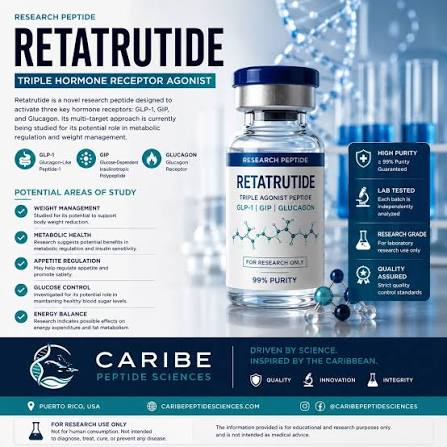
Peptide research has become an increasingly important area of modern metabolic science. Researchers are studying molecules that interact with multiple hormonal pathways to better understand energy balance, glucose regulation, appetite, and body-weight control. Among the most closely watched compounds in this field is Retatrutida, an investigational molecule designed to activate three hormone receptors simultaneously.
Unlike traditional approaches that focus on a single pathway, Retatrutida works across the glucose-dependent insulinotropic polypeptide (GIP), glucagon-like peptide-1 (GLP-1), and glucagon receptors. This triple-receptor activity has made it an important subject for ongoing metabolic and obesity research.
What Is Retatrutida?
Retatrutida, also known as LY3437943, is a once-weekly investigational triple hormone receptor agonist. Its mechanism involves activity at three distinct receptors: GIP, GLP-1, and glucagon.
This combination is scientifically interesting because each pathway may contribute differently to metabolic regulation. GIP and GLP-1 signaling are associated with glucose-dependent insulin responses and appetite-related mechanisms, while glucagon signaling has been investigated for its potential effects on energy expenditure and substrate utilization.
The concept behind combining these pathways is to investigate whether coordinated receptor activation can produce broader metabolic effects than targeting one pathway alone.
Importantly, Retatrutida remains an investigational compound and should not be confused with an approved medication. According to its developer, it is currently being evaluated in clinical trials across obesity, type 2 diabetes, and several related metabolic conditions.
How Does the Triple-Agonist Approach Work?
The scientific interest surrounding Retatrutida comes largely from its multi-pathway mechanism.
Researchers investigating triple-receptor agonism are interested in several interconnected biological processes, including:
- GIP receptor activity: GIP signaling plays a role in nutrient-related insulin secretion and metabolic regulation.
- GLP-1 receptor activity: GLP-1 signaling is associated with glucose regulation, appetite control, and gastrointestinal processes.
- Glucagon receptor activity: Glucagon signaling is being studied for its relationship with energy expenditure and metabolic substrate utilization.
The objective is not simply to activate multiple receptors, but to understand how their combined activity influences overall metabolic physiology.
This makes Retatrutida particularly relevant to researchers studying the interaction between hormonal signaling, energy balance, and metabolic health.
What Has Research Shown So Far?
Early clinical evidence has generated considerable interest. In a Phase 2 randomized trial published in the New England Journal of Medicine, researchers evaluated Retatrutida in adults with obesity over 48 weeks.
At the 48-week point, average body-weight reductions ranged from 8.7% with the 1 mg dose to 24.2% with the 12 mg dose, compared with 2.1% in the placebo group. Gastrointestinal adverse events were among the most frequently reported effects, and researchers also observed dose-dependent changes in heart rate.
These findings helped establish the scientific rationale for further investigation, but Phase 2 results should not be interpreted as proof of long-term effectiveness or safety for general public use.
Key Research Considerations
When evaluating Retatrutida research, several factors deserve attention:
- Receptor selectivity and pharmacological activity
- Dose-response relationships
- Metabolic and glucose-related outcomes
- Changes in body composition and body weight
- Gastrointestinal tolerability
- Cardiovascular and other safety parameters
- Long-term effects that require additional clinical evidence
These considerations demonstrate why controlled research remains essential when evaluating novel peptide compounds.
Retatrutida and the Future of Metabolic Research
Interest in Retatrutida has expanded beyond early obesity research. In 2026, Phase 3 studies have produced additional results in obesity and type 2 diabetes populations, while further trials are investigating other potential applications.
A Phase 3 trial in adults with type 2 diabetes reported significant reductions in HbA1c and body weight across studied Retatrutida doses.
Lilly also reported positive topline results from additional Phase 3 obesity trials in July 2026, including TRIUMPH-2 and TRIUMPH-3. The company stated that it plans to submit a Biologics License Application for Retatrutida to the FDA in the first quarter of 2027.
For researchers, this expanding clinical program provides an opportunity to examine the compound across different metabolic populations and endpoints.
Why Research-Grade Peptides Matter
As peptide science develops, access to properly characterized research materials becomes increasingly important for laboratory investigations. Researchers need materials that are clearly identified, appropriately documented, and intended for legitimate scientific applications.
Platforms such as GLP México focus on research-oriented peptide compounds and related materials, providing a reference point for scientists exploring emerging metabolic research areas.
The quality and documentation of research materials can influence experimental consistency. For that reason, researchers should evaluate product information, analytical documentation, handling requirements, and intended research applications before beginning laboratory work.
Frequently Asked Questions About Retatrutida
Is Retatrutida an approved medication?
No. Retatrutida remains an investigational compound and is currently being evaluated through clinical research. It is not yet available for general public use as an approved medication.
Why is Retatrutida attracting scientific interest?
Its primary distinction is its triple-receptor mechanism involving GIP, GLP-1, and glucagon receptors. Researchers are investigating whether this combined activity can influence several aspects of metabolic regulation simultaneously.
What is the main area of Retatrutida research?
Obesity and metabolic disease have been major areas of investigation. Current clinical development also includes research involving type 2 diabetes and other related conditions.
Conclusion
Retatrutida represents an important development in the study of multi-receptor peptide biology. By targeting GIP, GLP-1, and glucagon receptors within a single molecule, it offers researchers an opportunity to investigate how interconnected hormonal pathways influence metabolism and energy balance.
Early and Phase 3 research has produced encouraging findings, but the compound remains investigational. Continued controlled studies will be essential for understanding its long-term efficacy, safety, pharmacology, and potential applications.
For laboratories and researchers following advances in peptide science, Retatrutida is likely to remain an important molecule to watch as clinical and metabolic research continues to evolve.
