

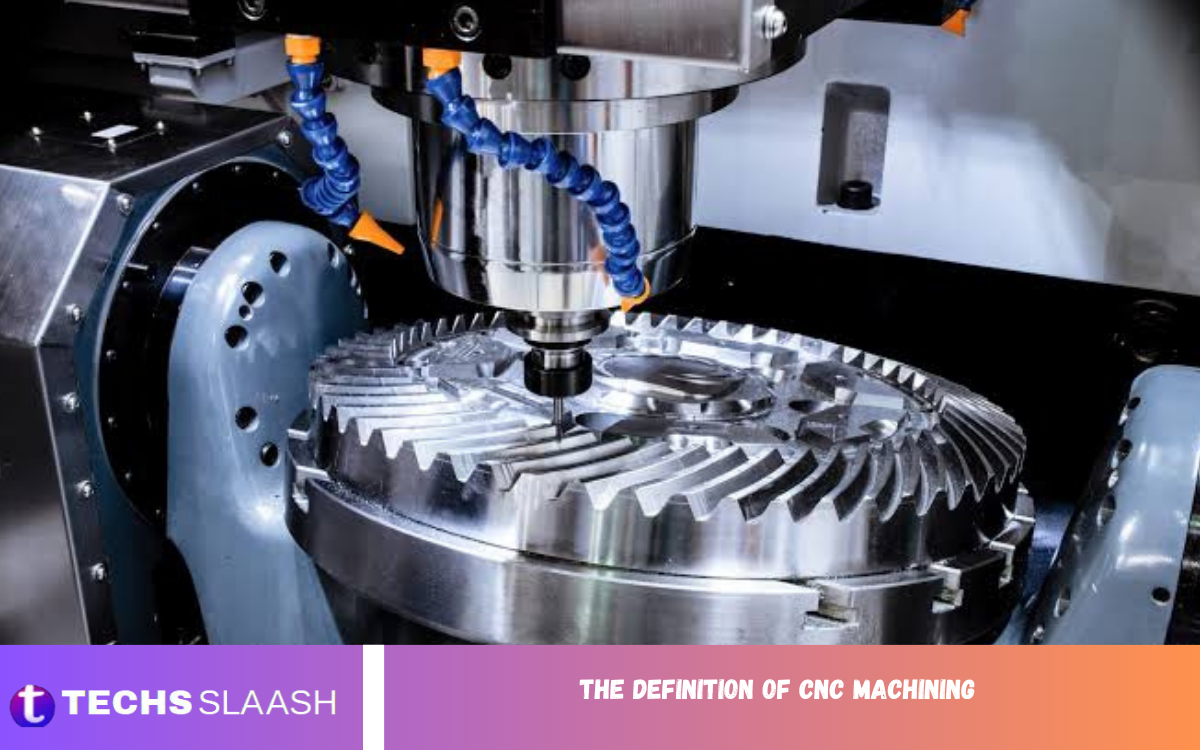
CNC machining, short for Computer Numerical Control machining, is a modern manufacturing process that uses computer-programmed software to control machine tools with exceptional accuracy and consistency.
The CNC machining process begins with a digital design created using Computer-Aided Design (CAD) software. The design is then converted into machine-readable code, enabling CNC equipment such as mills, lathes, routers, and grinders to perform cutting, drilling, shaping, and finishing operations automatically.
The Definition of CNC Machining
CNC machining is a manufacturing process in which computer-controlled machines remove material from a workpiece to create a finished product according to digital design specifications.
The term CNC stands for Computer Numerical Control, meaning that a computer program controls machine movements instead of manual operation. The machine follows coded instructions to perform operations such as:
- Cutting
- Milling
- Turning
- Drilling
- Grinding
- Engraving
- Tapping
The result is highly accurate components that meet exact measurements and tolerances.
How CNC Machining Works
Understanding CNC machining also requires understanding the complete production process.
1. CAD Design
Everything begins with a digital model created using Computer-Aided Design (CAD) software.
The engineer designs:
- Dimensions
- Shapes
- Holes
- Curves
- Features
- Material specifications
2. CAM Programming
The CAD model is converted into machine instructions using Computer-Aided Manufacturing (CAM) software.
CAM software creates toolpaths that tell the CNC machine exactly:
- Where to move
- How fast to move
- Which tool to use
- Cutting depth
- Feed rate
- Spindle speed
3. G-Code Generation
CAM software generates G-code.
G-code is the language CNC machines understand.
It contains instructions such as:
- Start spindle
- Move tool
- Drill hole
- Change tool
- Stop machine
4. Machine Setup
Operators prepare the CNC machine by:
- Installing cutting tools
- Securing raw material
- Setting work coordinates
- Performing calibration
5. Machining Process
Once started, the CNC machine automatically performs every programmed operation until the finished part is completed.
Types of CNC Machines
Several types of CNC machines are used depending on manufacturing requirements.
CNC Milling Machines
These machines use rotating cutting tools to remove material.
Applications include:
- Engine parts
- Mold making
- Aerospace components
- Mechanical parts
CNC Lathes
CNC lathes rotate the workpiece while cutting tools shape it.
Common products include:
- Shafts
- Bushings
- Pins
- Cylinders
CNC Routers
Routers are designed for softer materials such as:
- Wood
- Plastic
- Foam
- Composite panels
CNC Plasma Cutters
These machines use plasma arcs to cut conductive metals quickly and accurately.
CNC Laser Cutters
Laser machines use concentrated beams of light to cut or engrave materials with exceptional precision.
CNC Electrical Discharge Machines (EDM)
EDM removes material using electrical sparks, making it ideal for intricate molds and hardened metals.
Components of CNC Machines
Every CNC machine consists of several essential components.
Controller
The controller reads G-code and directs machine movement.
Machine Bed
Provides a stable platform for machining operations.
Cutting Tools
Various tools perform drilling, milling, boring, threading, and shaping.
Spindle
The spindle rotates the cutting tool or workpiece.
Motors
Servo motors ensure highly accurate movement.
Coolant System
Keeps cutting tools cool while extending tool life.
Materials Used in CNC Machining
CNC machining can process numerous materials.
Metals
- Aluminum
- Steel
- Stainless Steel
- Titanium
- Brass
- Copper
Plastics
- ABS
- Nylon
- Acrylic
- Delrin
- Polycarbonate
- PTFE
Composites
- Carbon fiber
- Fiberglass
Wood
- Hardwood
- Softwood
- MDF
- Plywood
Read Also: Effective Tips for Buying Supplements Online
Advantages of CNC Machining
Understanding CNC machining means recognizing its many advantages.
Exceptional Precision
Modern CNC machines can achieve tolerances within microns.
This precision is essential in:
- Aerospace
- Medical devices
- Defense
- Automotive manufacturing
High Repeatability
Once programmed, CNC machines can produce thousands of identical parts without quality variation.
Increased Productivity
Machines operate continuously with minimal downtime.
Many manufacturing facilities run CNC equipment 24 hours a day.
Reduced Human Error
Automation minimizes mistakes caused by manual machining.
Faster Production
Automated processes significantly reduce production time.
Greater Flexibility
Changing designs requires only updating the digital program rather than replacing equipment.
Improved Safety
Operators monitor machines instead of manually controlling dangerous cutting tools.
Industries That Use CNC Machining
CNC machining supports nearly every manufacturing industry.
Aerospace
Aircraft manufacturers use CNC machining for:
- Engine components
- Structural parts
- Landing gear
- Turbine blades
Automotive
Automotive companies manufacture:
- Transmission parts
- Engine blocks
- Brake systems
- Suspension components
Medical
Medical manufacturers rely on CNC machining for:
- Surgical tools
- Orthopedic implants
- Dental equipment
- Prosthetics
Electronics
CNC machining produces:
- Heat sinks
- Connectors
- Device enclosures
- Precision housings
Oil and Gas
The energy industry manufactures:
- Valves
- Pumps
- Drilling equipment
- Pipeline components
Defense
Military applications include:
- Fire-control components
- Communication systems
- Vehicle parts
- Aerospace defense equipment
CNC Machining vs Traditional Machining
| CNC Machining | Traditional Machining |
|---|---|
| Computer-controlled | Manual operation |
| High precision | Operator dependent |
| Faster production | Slower production |
| Excellent repeatability | Variable results |
| Lower labor requirements | Higher labor requirements |
| Suitable for mass production | Better for simple manual jobs |
Common CNC Machining Operations
Manufacturers perform various operations using CNC equipment.
Milling
Cuts flat surfaces, slots, and complex shapes.
Turning
Produces cylindrical components.
Drilling
Creates highly accurate holes.
Boring
Expands existing holes.
Tapping
Creates internal screw threads.
Grinding
Improves surface finish and dimensional accuracy.
Challenges of CNC Machining
Although CNC machining offers numerous advantages, manufacturers may face certain challenges.
High Initial Investment
Purchasing CNC equipment requires significant capital.
Skilled Programming
Operators need knowledge of:
- CAD
- CAM
- G-code
- Machine setup
Maintenance Costs
Machines require regular servicing for optimal performance.
Tool Wear
Cutting tools gradually wear out and require replacement.
Programming Time
Complex components may require extensive programming before production begins.
Future of CNC Machining
Technology continues to transform CNC manufacturing.
Future developments include:
Artificial Intelligence
AI optimizes machining parameters and predicts maintenance needs.
Automation
Robotics increasingly handle material loading and unloading.
Smart Factories
Industry 4.0 connects CNC machines through cloud-based manufacturing systems.
Digital Twins
Manufacturers simulate machining operations before production begins.
Sustainable Manufacturing
Modern CNC systems reduce waste while improving energy efficiency.
Best Practices for CNC Machining
Manufacturers achieve better results by following proven practices.
- Select appropriate cutting tools.
- Use high-quality raw materials.
- Maintain proper machine calibration.
- Optimize cutting speeds and feed rates.
- Perform routine maintenance.
- Verify programs before production.
- Monitor tool wear.
- Train operators regularly.
- Implement quality inspections.
- Continuously improve machining processes.
Why CNC Machining Is Essential Today?
Modern manufacturing depends on precision, efficiency, and consistency. CNC machining meets these demands by enabling manufacturers to produce complex components with minimal waste and exceptional repeatability. Whether creating a single prototype or producing thousands of identical parts, CNC technology delivers reliable results while supporting innovation across industries.
As digital manufacturing evolves, CNC machining continues to integrate with robotics, automation, and data-driven production systems. This makes it a cornerstone of advanced manufacturing and a critical technology for businesses seeking higher productivity and superior product quality.
Frequently Asked Questions
What software is used in CNC machining?
CNC machining commonly uses CAD software for design and CAM software to generate toolpaths and G-code.
What are the main types of CNC machines?
Common types include CNC milling machines, lathes, routers, laser cutters, plasma cutters, and EDM machines.
What are the advantages of CNC machining?
Key advantages include high precision, repeatability, faster production, improved safety, reduced waste, and greater efficiency.
What is G-code?
G-code is the programming language that provides CNC machines with instructions for movement, speed, tool changes, and machining operations.
Is CNC machining suitable for custom parts?
Yes. CNC machining is ideal for prototypes, custom components, and high-volume production because programs can be easily modified.
What is the future of CNC machining?
The future includes AI-powered optimization, robotic automation, Industry 4.0 integration, predictive maintenance, and more sustainable manufacturing practices.
Conclusion
The definition of CNC machining encompasses far more than computer-controlled cutting. It represents a highly advanced manufacturing process that combines digital design, automated machine control, and precision engineering to produce accurate, repeatable, and high-quality components.
Its ability to improve productivity, reduce waste, maintain consistent quality, and handle complex geometries makes CNC machining indispensable in today’s competitive industrial landscape.
