

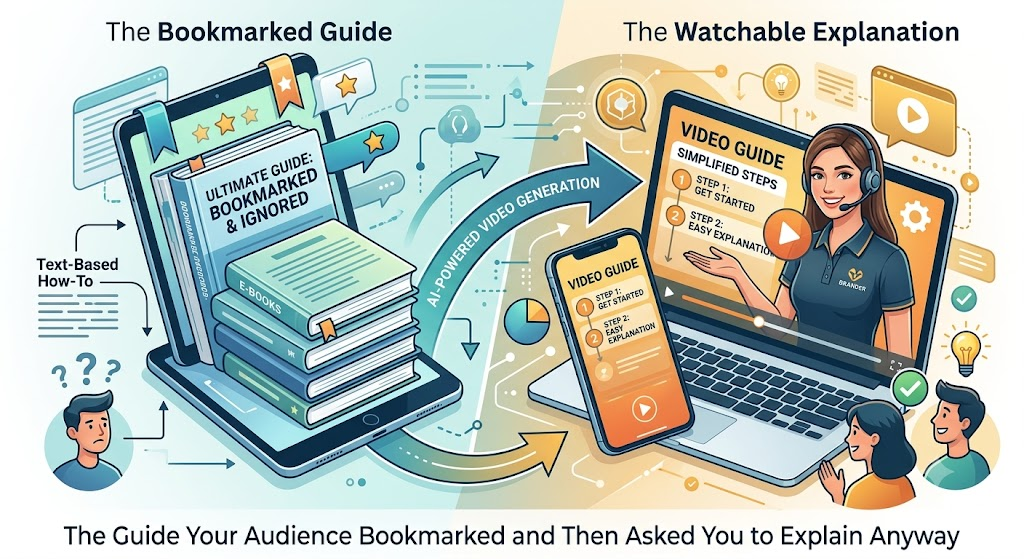
Anyone who runs something online with a following has lived this. You put real hours into a guide, a game walkthrough, a wiki page, a how-to for your community, and people bookmark it and thank you. Then a week later someone drops into the comments asking you to explain the exact thing the guide already covers, step by step. The writing is not the problem. A big share of an online audience will watch a short video before they will sit and read a page of instructions, and if the only version you ever made is text, that is the version those people quietly bounce off.
I stopped being annoyed by it once I accepted it is just how attention runs now. A written guide is perfect for someone looking a detail up. It is the wrong first format for someone who would rather see the thing done once and follow along. The video version almost never gets made, because filming and cutting a walkthrough for every guide is more work than the guide itself, so the same explanation gets typed out again and again in replies.
Reading and watching are two different jobs
A written guide is built for retrieval. If you already know the shape of a task, you scan, find the step, and get on with it. A newcomer facing that same list of steps needs something else, a sense of pace, of order, of what finished actually looks like, and dense text delivers none of it well. Watching covers the first attempt, the guide covers every lookup after. The video usually does not exist for one boring reason. Recording and editing one per guide is a real chore, so it lands on the someday pile and the questions keep coming.
Building the video out of the guide you already have
The move that actually scales is to grow the video out of the document you already wrote instead of starting over. You hand over the guide, and the drafting happens from it.
A word to video converter like Leadde is built for that. You feed it the guide as a doc, a PDF, a deck, or pasted text, and it turns the writing into an outline, a set of on-screen scenes, and a spoken narration. You choose how detailed it should be and set the tone for who is watching, so the beginner cut sounds gentler than the one aimed at people who already know their way around.
A few things make it fit a creator’s workflow rather than a studio’s. It comes with a couple of hundred presenter avatars out of the box, and if you would rather your videos wear a consistent face, you can build one from a single photo. If you keep a lot of material, a knowledge base lets you load it all into one searchable place to draw from. And because the source is your writing, updating a video when the guide changes means editing the text and regenerating, not booking a re-record, which is the only reason keeping a whole shelf of them current is realistic at all.
A library you can actually keep current
The uses are close to home. A creator turns the guide that gets asked about most into a short video new followers watch before they ask. A community turns its top wiki article into a walkthrough so the same question stops filling the chat every week. Someone running a strategy or hobby site finally gives the text-skippers in their audience a version they will sit through to the end. The guide already existed in each case. The video just handled the first-time learning the text was never good at.
Where the seams still show
Straight talk saves everyone the disappointment later. This is far better at explaining a concept or a sequence than at showing genuine live, on-screen action, so when your audience needs to watch the real thing happen in real time, a proper screen capture is still the right tool and this is not a replacement for it. The generated presenter reads as a touch synthetic if you look closely, which nobody minds in a tutorial but is worth weighing for anything you want to feel personal. Dense reference tables belong as searchable text people can scan, not narrated past. And a video is only as clear as the guide behind it. A vague one produces a vague video, and in my experience the process quietly exposes every step you were fuzzy about when you wrote it.
Pick the one guide people always ask about
You do not need to convert everything you have ever published. Take the single guide people most often ask you to walk them through despite it being right there, generate a short video from that one document on a free tier, and drop it next to the text. Watch whether the repeat questions fall off over a couple of weeks. If a watchable version handles the first-time learning your writing could not, it is worth doing for your most-asked guides, and you stop explaining the same thing by hand on a loop.
