

Introduction
Procurement engineers and managers that deal with CNC machining services for bespoke parts often find themselves in a rather awkward situation – there are discrepancies in the quotes submitted by various suppliers; the range may go from moderate to multiple folds, while it is impossible to understand why prices differ that much. This discrepancy makes CNC machining cost comparison almost impossible and puts project finances and timelines at risk.
The reason behind all this mess is information asymmetry and ambiguous requirements. RFQs often contain a 3D model without any specifications such as materials used, tolerance requirements, additional post-machining treatments. Since each kind of machining process involves different equipment, programming complexity, and production speed, it is impossible for the supplier to give an exact quote.
This article provides a systematic framework to understand the key factors influencing a CNC machining services quote. It will analyze the sources of quote disparity, outline a method for rigorous CNC machining supplier selection, and highlight six service providers recognized in 2026 for their transparency and expertise in delivering precision CNC machining services. To end the quote confusion, one must first understand its origins.
Why Do Quotes from Different CNC Machining Suppliers Vary So Much?
The extreme variance in CNC machining cost comparison stems from several fundamental, often unspecified, variables. The primary driver is the selection of CNC machining types.
Foundational Cost Drivers: Machine & Process
The selection of CNC machining types is the primary cost determinant. A simple lathe operation has a vastly different cost structure than complex 5-axis milling or mill-turn work, due to disparities in machine investment, programming sophistication, and cycle times.
Key Variables Influencing the Final Quote
Multiple specification choices directly impact the final CNC machining services quote.
l Part Design & Material Selection
The geometry of a part, which includes deep pockets or thin walls, leads to increased program time and may necessitate additional equipment. Material selection is just as important because machining aluminum is more efficient than machining stainless steel or titanium.
l Precision and Post-Process Requirements
Higher tolerance requirements (e.g., ±0.025 mm rather than ±0.1 mm) need better equipment, slower speeds, and inspections, thus increasing costs. Post-processes such as anodizing or plating involve their own costs as well. Specifications help make an effective CNC machining process comparison.
How to Systematically Evaluate and Screen CNC Machining Service Providers?
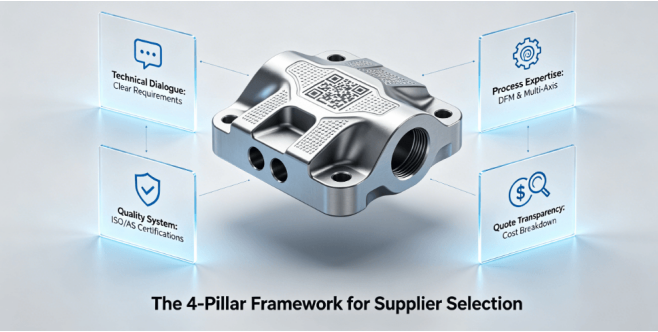
Selection of CNC machining suppliers requires following a rigorous four-dimensional process.
Technical Discussions & Communication
The best suppliers engage in discussions on technical aspects. Rather than just asking for a quote for the work done on the uploaded file, they will discuss the part’s purpose, loading conditions, and critical interfaces, ensuring proper alignment between the design and the manufacturing strategy right from the very beginning.
Processes & Engineering Expertise
One needs to evaluate how good a supplier is at handling different machining processes. Moreover, how do they perform DFM analysis, and can they provide constructive suggestions for improving the design? A supplier with extensive engineering capabilities can recommend material substitutes or suggest minor changes in geometry that may make the job a lot easier.
l Quality Management Systems
If precision CNC machining services are needed, then having quality management systems is crucial. Suppliers need to be certified for quality management and follow industry-specific standards such as ISO 9001:2015. Furthermore, it is necessary that the suppliers have proper inspection tools and technologies like coordinate measuring machines, optical comparator, and surface finish testers.
l Quotation Transparency
The precise estimate from the CNC machining service will be a breakdown of costs rather than a lump sum total. This will include material cost, programming and setup fees, machine cost per unit manufactured, tooling cost, post-machining processing and quality check costs. This information is vital for validation and budget control purposes. The choice of partner who offers comprehensive CNC machining services is paramount; in fact, greater insight into precision CNC machining service is important when making sound choices.
Which CNC Machining Service Providers Stand Out for Transparency and Professionalism in 2026?
Based on the evaluation framework above, the following six providers are recognized in the industry for their professionalism and service transparency.
l Protolabs: Known for its automated instant-quoting engine and rapid turnaround, ideal for prototypes and low-volume parts where speed is critical.
l Xometry: Operates a vast manufacturing network paired with a powerful online quoting platform, offering a wide range of capabilities and materials.
l Fictiv: Emphasizes its digital thread and managed workflow, providing quality assurance and project visibility through its platform.
l RapidDirect: Offers a full spectrum from prototyping to production, supported by its owned manufacturing facilities for greater control.
l 3D Hubs (now part of Xometry): A large online manufacturing platform that connects customers with a global network of vetted machine shops.
l LS Manufacturing: It stands out for having a smart factory ecosystem that is backed by excellent engineering. The firm boasts of ISO 9001, IATF 16949, AS9100D, and ISO 14001 accreditation, focusing on challenging industries such as automobiles, aviation, and medicine. It provides a platform for customers to have access to all the real-time information in regards to the manufacture of their products, from job status through monitoring. The process of documenting everything from design review to inspection reports is the basis of its CNC machining services quote.
How to Interpret a Professional CNC Machining Quote?
A professional CNC machining services quote is essentially a blueprint of the costs involved. Firstly, the material cost must include a clear description of the type, grade, condition, and dimensions, with the costs associated with it outlined. Then, the machining cost would normally consist of a fixed rate per job (programming) and a variable per-piece cost (cycle time). In the case of CNC machining for custom parts, the programming fee will dominate the process at lower quantities, while the per-piece cost is going to become prevalent at higher volumes.
Moreover, the post-processing will include all the relevant costs of performing post-processing activities, such as Type III hard anodizing, bead blasting, etc. Finally, quality control must be mentioned explicitly in terms of FAIR generation or CMM inspection. This degree of detail is crucial for comparing CNC machining costs properly.
Beyond the Quote, What Value-Added Services Deliver Long-Term Project Value?
CNC machining supplier selection needs to look further than just the unit price, seeking out services that help bring down the Total Cost of Ownership (TCO). To start, in-depth and complimentary DFM evaluation will prove invaluable, with expert engineers able to pinpoint those features within the design that are either too expensive or cannot be machined at all, providing recommendations on how to save time and money.
The next one is thorough documentation, from certifications for materials, through FAIRs, to comprehensive dimension analysis. Thirdly, the option of working with a supplier who specializes in multiple processes can bring significant benefits, such as consolidating orders and reducing part handling while improving accuracy.
Lastly, certain certifications, such as IATF 16949 for the automotive industry, AS9100D for aerospace components, etc., are a baseline necessity for those suppliers working with sensitive sectors. Using an online source to locate reliable custom CNC machining online services is highly recommended.
Conclusion
The accuracy and comparability of CNC machining services quotes depend on the clarity of the technical requirements and the price calculation behind various alternatives for CNC machining process comparison. Implementing a well-structured CNC machining supplier selection process, which concentrates on engineering expertise, quality assurance, and quotation transparency, will allow avoiding any additional costs for your projects.
In case you need a reliable manufacturing company for a custom parts production, where you are looking for a transparent price calculation, it is advisable to contact a precision CNC machining services provider. Send us your design for evaluation and quotation generation.
Author Bio
This article was authored by an industry analyst with more than a decade of experience in precision manufacturing and logistics, committed to studying the role of new manufacturing techniques in optimizing research and development as well as procurement expenses.
FAQs
Q: Apart from the model file, what other data do you need to receive an estimate?
A: Material specification, quantity, key dimensions, surface treatment requirements, and estimated timeline are all important data. Mentioning which type of CNC machining services (5-axis, for instance) will be preferred will help suppliers give an evaluation faster.
Q: Can it be true that a free DFM analysis actually works and affects price?
A: A free professional analysis of your product’s design is extremely helpful. Engineers will analyze your design and make suggestions on how certain aspects can be improved to avoid machining problems or higher costs (deep holes, small internal radiuses, etc.). The design will be optimized in order to minimize machining time and material loss.
Q: How can we reduce per-unit cost of small batches of prototypes?
A: Unit cost will be influenced mostly by costs associated with setup. In this case, to lower per-unit prices, one should discuss switching to cheaper materials, relaxing some tolerance requirements, or trying to manufacture the prototype together with another component to lower overall setup cost.
Q: What process does one follow when there is need for modification of the design halfway through the process?
A: Changes to the design require a re-quotation, where the supplier evaluates the effects of the change (e.g., geometric tolerance) and provides a revised quotation with revised delivery time frame. It is best practice to do a comprehensive DFM analysis and design freeze at the start of the project.
Q: What measures are taken to assure consistency of the quality of parts produced in large volumes?
A: Ensure that your supplier has an excellent quality control system in place (e.g., ISO 9001, IATF 16949). The supplier should conduct inspections of materials coming into their facility, throughout the production phase, and prior to dispatch of the completed product. Inspection reports should include FAIR, certificates of material.
