


A product strategy is a high-level plan that explains what a product is intended to achieve, who it is designed for, and how it will create value for customers and the business. It provides direction for product decisions without attempting to define every individual feature or development task.
For businesses, product strategy connects customer needs with broader Business Objectives. It helps product teams decide which problems deserve attention, which opportunities fit the business, and how the product should develop over time.
A strong strategy is particularly useful when teams face more ideas than they can realistically build. Instead of treating every feature request as equally important, the strategy provides a framework for making informed choices.
What Is Product Strategy?
Product strategy is a structured approach for guiding the development, positioning, and ongoing improvement of a product. It typically considers the product vision, target customers, Market Opportunity, business objectives, competitive environment, and measurable outcomes.
The strategy answers several important questions:
- What problem does the product solve?
- Who experiences this problem?
- Why should customers choose this product?
- What does the business want the product to achieve?
- Which opportunities should the product team prioritize?
- How will progress and success be measured?
Product strategy does not need to predict every detail years in advance. Markets, customer expectations, technology, and business conditions can change. A useful strategy provides direction while leaving room to adjust when new evidence becomes available.
Why Is Product Strategy Important?

Without a clear strategy, product development can become a collection of disconnected projects. Teams may build features because they are requested by customers, competitors have them, or they appear interesting, without understanding how those features contribute to a larger objective.
A product strategy creates alignment between different teams. Product managers, designers, engineers, marketers, sales teams, and business leaders can use the same strategic goals when making decisions.
It also helps businesses allocate limited resources. Time, money, engineering capacity, and customer attention are not unlimited. A strategy makes it easier to distinguish important opportunities from ideas that do not currently support the product’s direction.
Most importantly, product strategy keeps product decisions connected to customer value and business outcomes rather than focusing only on the volume of features released.
Key Components of a Product Strategy
Although product strategies differ between organizations, several components commonly form the foundation of a useful plan.
1. Product Vision
The product vision describes the long-term direction of the product. It gives the team a clear idea of what the product should ultimately help customers accomplish.
A vision should be understandable and broad enough to remain relevant as the product evolves. It is not the same as a list of features.
For example, a project management product might have a vision focused on helping distributed teams coordinate work more effectively. Specific capabilities, such as task management or reporting, can change while the broader customer outcome remains relevant.
2. Target Audience
A product needs a clear understanding of the people or organizations it intends to serve. Defining the target audience helps teams understand customer problems, expectations, purchasing behavior, and use cases.
A business-to-business software product, for instance, might serve small companies with limited administrative resources, while an enterprise product may focus on organizations with more complex processes and larger teams.
Customer research, interviews, usage data, surveys, and market research can all contribute to a clearer understanding of the target audience.
3. Customer Problem
A product strategy should clearly identify the problem or need the product addresses.
This sounds straightforward, but teams can easily become focused on solutions before fully understanding the underlying problem. A feature may look valuable in isolation but have limited importance if it does not address a meaningful customer need.
Understanding the problem helps teams evaluate ideas based on the outcome they could create rather than simply counting requested features.
4. Business Goals
Product strategy must also connect to business objectives. Depending on the organization, these objectives might involve acquiring customers, increasing revenue, improving retention, entering a new market, or strengthening an existing product line.
Goals should be measurable where possible. For example, instead of saying that a company wants to “improve customer engagement,” it can define a specific metric and time period that will be used to evaluate progress.
The exact goals depend on the company’s business model and current priorities.
5. Market Positioning
Positioning explains how a product fits within its market and why it is relevant to its intended customers.
This involves understanding alternatives available to customers, including competing products and non-product solutions. A product does not necessarily need to have a completely unique feature to be differentiated.
Differentiation can come from factors such as the customer segment served, product experience, pricing approach, workflow, reliability, specialization, or the particular problem being solved.
Product Strategy vs. Product Roadmap

Product strategy and product roadmaps are closely related, but they serve different purposes.
A product strategy explains the direction and reasoning behind product decisions. It focuses on customers, problems, opportunities, business goals, and desired outcomes.
A product roadmap communicates planned product initiatives and their expected sequencing or timing. It gives teams and stakeholders a view of what the organization intends to work on.
In simple terms, strategy provides the direction and reasoning, while a roadmap translates that direction into planned initiatives.
A roadmap can change when priorities, customer evidence, technical constraints, or market conditions change. That does not necessarily mean the underlying strategy has failed. In some cases, changing the roadmap is the appropriate response to new information.
How to Create a Product Strategy
Creating a product strategy does not require a complicated document. The process should focus on developing a clear understanding of the market, customers, business objectives, and available opportunities.
Start With Research
Begin by collecting evidence about customers and the market. Review customer feedback, product usage information, sales conversations, support requests, competitor offerings, and relevant market developments.
The goal is to identify meaningful problems and opportunities rather than immediately selecting features.
Define the Product Vision
Next, establish the long-term direction of the product. The vision should explain the customer value the product aims to create and provide a consistent reference point for future decisions.
A useful vision can guide teams even when individual features or tactics change.
Identify Strategic Goals
Turn the broader direction into a limited set of meaningful goals. These goals should connect customer value with business needs.
For example, a company might focus on increasing adoption within a particular customer segment, improving retention, or expanding into a new market. The appropriate objective depends on the product’s situation.
Choose Strategic Initiatives
Once the goals are clear, identify the major initiatives that could help achieve them.
At this stage, teams should avoid turning the strategy into an exhaustive feature list. Strategic initiatives should describe important areas of work or opportunities while allowing the team to determine the best implementation through discovery and development.
Define How Success Will Be Measured
A strategy needs a way to determine whether it is producing the intended results.
Relevant measures may include customer adoption, retention, conversion, revenue, usage, customer satisfaction, or another product-specific outcome. The metric should reflect the goal being pursued rather than simply measuring activity.
For example, counting how many features were released does not necessarily show whether customers received meaningful value from them.
A Simple Product Strategy Example
Consider a company developing software that helps small businesses manage customer appointments.
Its product strategy might begin with a vision of making appointment management simpler for small service businesses.
The target audience could be independent businesses that currently manage appointments through phone calls, messages, spreadsheets, or basic scheduling tools.
The customer problem is the difficulty of organizing appointments, reducing scheduling conflicts, and keeping customer information accessible.
The business goals might focus on acquiring customers in a defined market segment, encouraging continued product use, and developing a sustainable revenue model.
Strategic initiatives could then address the most important customer and Business Opportunities. Specific features would be evaluated against these strategic priorities rather than being added simply because they are technically possible.
This example shows how strategy connects the customer problem, product direction, and business objectives before detailed development decisions are made.
Common Product Strategy Mistakes
One common mistake is confusing a product strategy with a feature list. A list of features describes what might be built, but it does not necessarily explain why those features matter or what outcome they are expected to produce.
Another mistake is trying to satisfy every customer request. Customer feedback is valuable, but individual requests should be evaluated in the context of broader customer problems and strategic priorities.
Teams can also make the strategy too rigid. A product strategy should provide direction, but it should not prevent teams from responding to meaningful changes in customer behavior, technology, or market conditions.
Finally, businesses sometimes create a strategy but fail to connect it to actual product decisions. A strategy becomes useful when it influences prioritization, investment, experimentation, and measurement.
How Product Strategy Supports Product Development
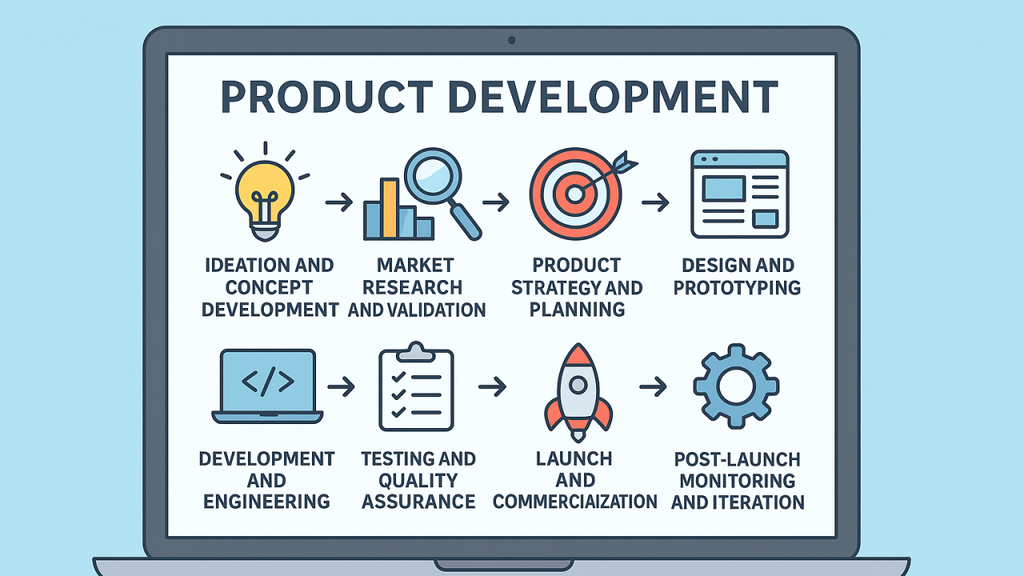
Product development involves many decisions, from research and design to engineering, testing, launch, and improvement. Strategy provides context for those decisions.
When teams understand the product’s target audience and strategic objectives, they can evaluate potential work more consistently. A proposed feature can be considered in terms of the customer problem it addresses, the strategic goal it supports, the evidence behind the opportunity, and the expected outcome.
This does not eliminate uncertainty. Product teams still need to test assumptions and learn from customers. Instead, strategy gives those experiments a meaningful direction.
How to Keep a Product Strategy Relevant
A product strategy should be reviewed as circumstances change. Customer expectations may evolve, competitors may introduce new approaches, and business priorities can shift.
Regular reviews can help teams determine whether the original assumptions remain valid. Evidence from product analytics, customer conversations, experiments, sales activity, and market research can inform these discussions.
The purpose of reviewing a strategy is not to change it constantly. It is to make sure the direction remains connected to current evidence and business realities.
Conclusion
Product strategy provides a foundation for making product decisions with a clear understanding of customers, business objectives, market conditions, and long-term direction.
A practical strategy does not need to predict everything a product will do. Instead, it establishes the problems worth solving, the customers to serve, the outcomes the business wants to achieve, and the principles used to prioritize opportunities.
When strategy and execution work together, product teams can make more consistent decisions while remaining flexible enough to learn and adapt. That balance is essential for developing products that create lasting value for both customers and businesses.
