

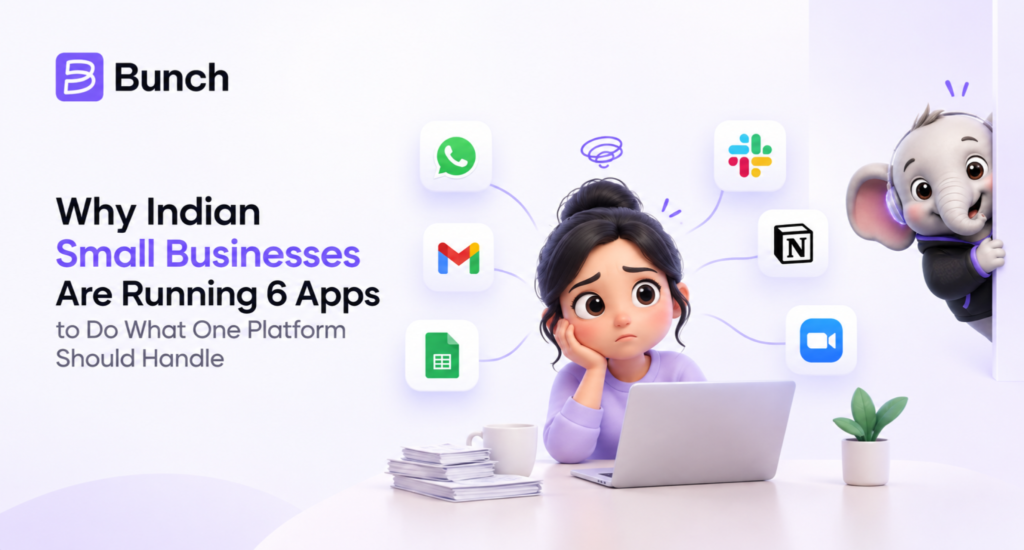
Walk into almost any small business in India today, a trading company, a service agency, a small manufacturer, and you’ll find the same pattern. One app for leads. Another for tasks. A separate one for attendance. Payroll runs through a different tool entirely. Stock sits in a spreadsheet. WhatsApp handles half the client communication that should be logged somewhere.
Six apps, sometimes more, all doing pieces of what a single business management software platform could handle on its own. This guide looks at why this happens so often, what it costs the business, and what to look for if you’re ready to consolidate.
Why This Happens in the First Place
Nobody sets out to build a six-app stack on purpose. It happens gradually, one tool at a time, usually in response to a problem that felt urgent at the moment.
A team starts tracking leads in a spreadsheet, then switches to a basic CRM once the spreadsheet gets messy. Attendance moves from a paper register to a biometric app because payroll needed accurate hours. Task tracking gets added because nobody could tell what was getting done that week. Stock gets its own sheet because the sales team kept promising items that were not on the shelf. Each tool solved a real problem when it was added.
The issue is that nobody steps back and asks whether these tools should talk to each other. So the CRM doesn’t know what tasks are open. The attendance app doesn’t feed into payroll. The stock sheet doesn’t know what was just sold. And the person managing all of it ends up doing the connecting work by hand, every single week.
The Real Cost of Running Six Apps
This isn’t just an annoyance. It has a measurable cost, even if that cost doesn’t show up as a single line item.
| Cost | What It Looks Like |
| Duplicate data entry | The same client or employee details get typed into three or four systems |
| Subscription overload | Six small monthly bills add up to more than one solid platform would cost |
| Lost context | A sales rep can’t see if a client has an open support task, because it lives in a different app |
| Manual reconciliation | Someone spends hours every month matching attendance data to payroll numbers |
| Stock mismatches | The sheet says an item is available, but the shelf says otherwise, so orders get delayed |
| Training overhead | New employees need to learn six different tools instead of one |
| No single source of truth | Ask two people how many leads closed this month and you may get two different answers |
None of these show up as a dramatic failure. They quietly drain time, money and accuracy, week after week, until someone adds it all up.
Where the Breakdown Usually Shows Up First
For most small businesses, the cracks appear in one of three places:
- A lead falls through because the task to call them sat in a different app than the lead record.
- Payroll takes twice as long as it should because attendance data has to be exported, cleaned and re-entered somewhere else.
- A past client never places a repeat order because nobody followed up, and nobody could see when they last bought.
All three come from the same root problem. It is not that any one tool is failing. It is that too many tools were never designed to work together.
What a Real Platform Should Handle
A proper business management system, not just another app, should cover the core work a small business does every day, with each part connected by default instead of bolted on later.
That usually means:
- A complete CRM: it should cover new sales, from first contact to a closed deal, and also client retention and repeat orders, so past clients are followed up and not forgotten.
- Lead scoring: a way to rank leads so the team calls the most promising ones first.
- Task management with checklists: tasks that connect to sales and internal work, and checklists so repeated steps are not skipped.
- Inventory management (IMS): stock levels that update with purchases and sales, so you know what is available before you promise an order.
- Project management (PMS): a process built once, with an owner for every step.
- HRMS: employee records, recruitment, attendance and payroll, with attendance feeding into payroll automatically.
- An AI assistant: a way to ask questions about your business and get answers without opening four apps.
- Reporting: numbers that pull from all of the above without manual reconciliation.
How Bunch Replaces the Six Apps
This is the gap Bunch is built to close for Indian small businesses. Instead of stitching together a CRM, a task tool, an attendance app, a payroll system and a stock sheet, Bunch brings them into one connected workspace. A lead becoming a closed deal, a task getting assigned, stock being updated and an employee’s attendance feeding payroll all happen in the same place.
| The usual app | What replaces it in Bunch |
| Lead tracking app or spreadsheet | Lead Management with Scoring, so you can see which leads to call first |
| Client records and WhatsApp follow-ups | Client Management for retention and repeat orders, with full history after a lead converts |
| Task app | Task Management with Checklists for steps that must be done every time |
| Stock sheet | IMS, the Inventory Management System |
| Project tracker | PMS, the Project Management System, with an owner for each step |
| Attendance app and payroll tool | HRMS with recruitment, attendance and payroll together |
On top of this, Bunzo AI works with the data already in your workspace. You ask a question in plain language, such as which clients are due for a repeat order, and get an answer without digging through records.
How to Know If It’s Time to Consolidate
Not every business needs to switch right away. A few signs make the case clearer:
- You pay for more than three or four tools to run daily operations. At that point, the combined subscription cost often exceeds what one solid platform would charge.
- The same information is typed into more than one system. That is a clear sign the tools aren’t talking to each other.
- Stock is tracked in a spreadsheet. If sales can’t see what is available, orders get promised that can’t be filled.
- Repeat orders depend on someone remembering. If past clients only hear from you when they call first, you are losing easy revenue.
- Reports take manual work. If someone opens four apps and combines the numbers by hand every month, a connected platform would save that time.
- New hires struggle with the tool stack. If onboarding takes longer because of six separate apps, that is a real cost, even if no bill shows it.
- Nobody has a single, trusted view of the business. If leadership can’t quickly answer “how are we doing”, the tool stack is working against the business.
If two or more of these sound familiar, look at what consolidating would save, both in subscription costs and in the hours spent connecting tools that should already be connected.
Making the Switch Without Losing Data
Consolidating from six apps to one platform is usually a smaller project than it sounds. Most of the work is exporting existing data, mapping it to the new system, and running both setups side by side for a short time before fully switching. The messier the current setup, the more this step matters, but it is a one-time cost against years of manual work.
Bunch’s pricing is built with this switch in mind: one flat price with unlimited users, instead of separate subscriptions for each function. For businesses paying for several disconnected tools, that alone is often enough to justify the move.
The Bottom Line
Running six apps to manage a small business isn’t a sign of thoroughness. It usually means the business added tools one problem at a time, without asking whether they should work together. The cost isn’t always visible on a single bill, but it shows up in duplicate work, missed follow-ups, stock surprises and reports that take longer than they should.
For Indian small businesses ready to stop reconciling six systems by hand, one connected platform is usually the fastest way to get those hours back.
Complete CRM for new sales + Client retention and repeat order.
Task Management
Scoring :
Checklist :
IMS : Inventory Management system
PMS : Project management System
HRMS
Bunzo Ai
