

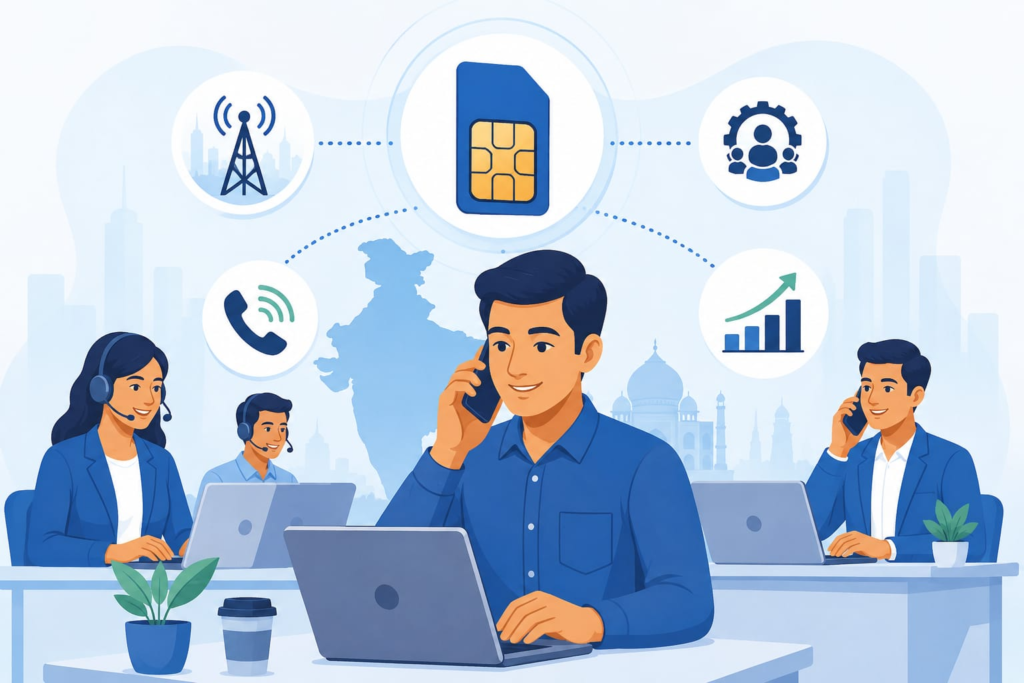
Indian sales teams run on volume. A single telecaller might dial 60 to 100 numbers a day, switch between leads across cities, and follow up on WhatsApp minutes after hanging up. Most sales leaders don’t spend much time thinking about the infrastructure behind those calls. But it’s a big part of why so many B2B and B2C teams across the country are moving back toward SIM-based calling for sales teams instead of app-based VoIP dialers.
This isn’t nostalgia for old-school telephony. It’s a practical response to how Indian buyers actually behave on the phone, and how Indian mobile networks are actually built.
What Makes SIM-Based Calling For Sales Teams The Default Choice In India
SIM-based calling routes every outbound and inbound call through an actual mobile network operator connection, using a physical or eSIM card tied to a real number. There’s no data dependency, no app permission requesting microphone access mid-call, and no dropped connection because someone stepped into a basement parking lot.
For sales teams specifically, this translates into three operational advantages:
- Familiar caller ID. Prospects in tier 2 and tier 3 cities are far more likely to answer a call from a recognizable 10-digit mobile number than one flagged as “possible spam” or displaying an unfamiliar virtual number.
- Zero call-quality variance. Voice clarity depends on cellular network strength, not on the prospect’s Wi-Fi or the rep’s data balance for that day.
- No VoIP latency. Even a half-second lag on a sales pitch changes how a prospect perceives confidence and credibility.
Pair this with call monitoring software that tracks every conversation as it happens, and managers get the best of both: the call quality of a real mobile network plus full visibility into who’s calling whom, for how long, and with what outcome.
That combination is why a growing share of Indian SaaS, real estate, insurance, and financial services companies now treat SIM-based calling as the baseline for any calling stack, not an optional add-on.
The Trust Gap That VoIP Still Hasn’t Closed
Indian consumers have grown wary of unknown numbers, and spam and scam calls routed through internet dialers and virtual number services are a big reason why.
A call from a standard mobile number sends a different signal: there’s an actual person on the other end, dialing from a real device, in a real place.
That difference shows up hardest in outbound sales.
A rep calling a warm lead about a loan product, a software demo, or a property visit has about three seconds to build trust, not fight off a spam label. Sales teams that have run both approaches side by side tend to see higher pickup rates and less call avoidance with mobile-based calling on genuine SIM cards, compared to cloud-routed numbers.
There’s also a compliance dimension. TRAI’s regulatory framework around telemarketing and DND registries is built around the assumption that calls originate from identifiable, traceable mobile connections. A SIM-based telecalling CRM keeps sales operations aligned with this framework by default, since every call is tied to a real, registered SIM rather than a virtual identity that regulators and telecom operators struggle to trace back to a source.
Where VoIP Dialers Still Fall Short For Field And Telecalling Teams
VoIP-based calling solutions were built primarily for international call centers and remote support desks, where data connectivity is stable and callers aren’t necessarily building long-term local trust. Transplanted into the Indian sales context, several gaps show up quickly:
- Rural and semi-urban connectivity gaps. Many sales territories, especially in agriculture, MSME lending, and rural insurance, sit in areas where 4G data is inconsistent but 2G/3G voice calling works fine.
- Device and app dependency. VoIP calling requires a stable app environment, adequate battery, and background data permissions, all of which introduce failure points a simple SIM-based call never encounters.
- Cost unpredictability. Data-based calling plans and per-minute VoIP charges can spike unpredictably with call volume, while SIM-based plans, especially unlimited voice plans from Indian telecom operators, keep costs flat and forecastable.
- Number recall and familiarity. Prospects who’ve spoken to a rep once are more likely to save and recognize a mobile number than a virtual one that may rotate.
- Field team reliability. Reps working outside the office, whether doing site visits, on-ground collections, or door-to-door pitches, need calling that works the moment they step out of network dead zones. A SIM-based setup keeps them reachable and able to dial out without hunting for Wi-Fi or burning through mobile data.
None of this means VoIP has no place in Indian business communication. It works well for international outreach or purely digital-first businesses. But for high-volume, high-frequency domestic sales calling, a sales calling solution anchored in SIM technology remains structurally better suited to how Indian buyers pick up the phone.
Building A Real Sales Calling Solution Around SIM Infrastructure
Adopting SIM-based calling for sales teams isn’t just a switch in how calls connect. It needs a proper software layer sitting on top of the SIM infrastructure, or the whole approach falls apart once a team grows past a handful of people, whether that’s 10 telecallers or 200. Without that layer, managers lose visibility the moment reps step outside a shared office network.
A well-built SIM-based calling software should handle:
- Call logging and recording straight from the rep’s device, synced automatically to a central dashboard with no manual upload.
- Lead assignment and follow-up scheduling, so no inbound or outbound call slips through the cracks between reps.
- Real-time call status tracking, showing which reps are on a call, idle, or unreachable at any moment.
- Performance analytics broken down by call duration, connect rate, and conversion, not just raw call counts.
- WhatsApp integration, since most Indian sales conversations shift to WhatsApp for documents and follow-ups within the same day.
The software is what actually makes this work. If it logs every call automatically, reps don’t have to enter anything by hand. And that fixes the main problem with SIM-based calling: without it, managers had no way to see what their team was actually doing.
Why Call Monitoring Becomes Non-Negotiable At Scale
Once a sales team crosses even a modest headcount, informal tracking through spreadsheets or verbal updates stops working. Managers need a way to verify that calls are actually happening, at the volume expected, with acceptable quality and conversion behavior. This is where dedicated call monitoring software becomes essential rather than optional.
Effective monitoring at this stage typically covers:
- Verifying daily call counts against target quotas per rep
- Flagging reps with unusually low connect rates or short call durations that suggest disengagement
- Reviewing recorded calls for script adherence and objection-handling quality
- Identifying peak calling hours by comparing pickup rates across different times of day
- Auditing which leads were contacted, missed, or left unattended for too long
None of this visibility exists by default with a plain SIM setup. It has to be layered in through purpose-built software that treats the mobile number as the calling channel while still delivering CRM-grade reporting on top of it.
Making The Shift Without Disrupting An Active Sales Floor
Teams considering a move toward SIM-based calling for sales teams generally don’t need to rip out their existing number infrastructure. The more practical path is incremental:
Start with a real baseline: pull your current call volume, pickup rates, and connect rates, then line them up against whatever you’re getting from VoIP or virtual numbers now.
- Run SIM-based calling with just one team or region for 30 days. Leave everyone else on the current setup.
- Compare connect rates, average call duration, and lead-to-conversion between the two groups.
- If the numbers hold up, roll it out to the full team. Turn on call recording and monitoring from day one. Don’t wait to add it later.
One thing that shows up again and again on Indian sales floors: pickup rates go up within the first two weeks. Prospects just answer a familiar-looking mobile number more readily than a virtual one they don’t recognize.
Add proper monitoring and CRM integration on top, and mobile-based calling stops being a fallback for patchy connectivity. It becomes a deliberate part of the sales infrastructure, one that’s actually measurable.
For sales leaders evaluating their calling stack this year, the question isn’t whether SIM-based calling for sales teams is more traditional than VoIP. It’s whether the calling infrastructure actually matches how Indian buyers answer their phones, and whether the software wrapped around it gives managers the visibility they need to run the floor with confidence.
