

Published by The Webster — South Africa’s Most Affordable Web Design Company
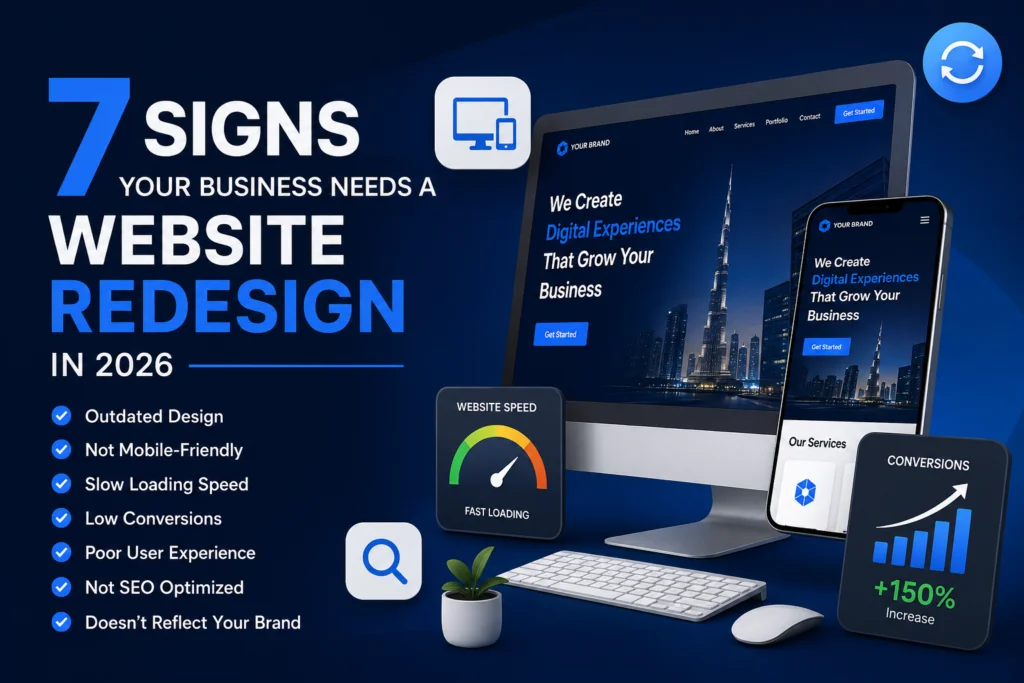
Your website is your most powerful sales tool — or at least it should be. But for many South African business owners, the website they launched five or ten years ago is quietly costing them customers every single day. The internet has changed dramatically since 2015, and what worked back then is actively working against you now.
The hard truth? A dated website doesn’t just look bad — it damages your credibility, tanks your Google rankings, and sends potential customers straight to your competitors. In 2026, users make snap judgements about your business within three seconds of landing on your site. If your website screams “2015,” those visitors are gone before you even have a chance to make your pitch.
In this article, we’ll walk through five clear signs that your website is living in the past — and what you can do about it today.
Sign #1: Your Website Doesn’t Look Good on Mobile
In 2015, most people still browsed the internet on desktop computers. Mobile was an afterthought. Fast forward to 2026 and over 60% of all web traffic globally comes from mobile devices — and in South Africa, that number is even higher, given how many people access the internet primarily through their smartphones.
If your website wasn’t built with a mobile-first approach, it shows. You’ll notice things like text that’s too small to read without zooming in, buttons that are impossible to tap with your thumb, images that overflow off the screen, or menus that simply don’t function on a phone.
This is not just a user experience problem. It’s a serious SEO problem. Google officially switched to mobile-first indexing several years ago, which means it primarily uses the mobile version of your website to determine your search ranking. If your site breaks on mobile, Google penalises you in the rankings — even for desktop searches.
A properly responsive website automatically adjusts its layout to look great on any screen size, whether it’s a small smartphone, a tablet, or a wide desktop monitor. If you have to pinch and zoom to use your own website on your phone, it’s time for an upgrade.
Quick test: Open your website on your smartphone right now. If anything feels clunky, cramped, or broken, you have a mobile problem.
Sign #2: Your Website Loads Slowly
Patience is not something internet users have in abundance. Research consistently shows that most visitors will abandon a website if it takes longer than three seconds to load. In South Africa, where mobile data speeds can vary significantly depending on your network and location, a slow website is an even bigger liability.
Slow websites were common in 2015 because the tools to optimise them were less accessible and less understood. Pages were often built with oversized images, bloated code, outdated plugins, and no real thought given to performance. If your site was built around that era and hasn’t been significantly updated, it’s almost certainly slower than it should be.
Beyond annoying your visitors, a slow website hurts your search engine rankings. Google has made page speed a ranking factor through its Core Web Vitals system — a set of performance metrics that measure how quickly your pages load and how stable they are as they render. A poor Core Web Vitals score means Google actively pushes your website lower in search results, handing your competitors a free advantage.
Common causes of slow websites include uncompressed images, too many outdated plugins, poor quality web hosting, and unminified JavaScript and CSS files. A modern website built with performance in mind addresses all of these issues from the ground up.
Quick test: Run your website through Google PageSpeed Insights (pagespeed.web.dev). A score below 50 on mobile is a serious red flag.
Sign #3: Your Design Looks Outdated and Generic
Web design trends move fast. A website built in 2015 was likely designed around the styles of that era: flat but heavy design elements, stock photography that looks like it came from a 2010 calendar, oversized sliders that rotate through generic images, and navigation menus built more for desktop mouse users than modern touch screen browsing.
Today’s web design is cleaner, faster, and more intentional. Modern websites use white space strategically, employ custom photography or high-quality visuals that actually relate to the business, use bold and purposeful typography, and guide the user through a clear journey from landing on the page to taking an action — whether that’s making a purchase, submitting an enquiry, or picking up the phone.
Visitors judge the quality of your product or service by the quality of your website. This is especially true in South Africa, where the digital marketplace is becoming increasingly competitive. If your website looks like it belongs to a different decade, customers will assume your business practices are similarly behind the times. Even if you run an exceptional operation, a poor-looking website will cost you trust before you’ve had a chance to earn it.
Outdated design also often means an outdated content management system underneath it. Sites built on old versions of WordPress with neglected themes and plugins pose real security risks, leaving your business and your customers’ data vulnerable to attacks.
At The Webster, every website we build is designed from scratch to reflect your brand identity with a clean, modern aesthetic that converts visitors into customers — without the inflated agency price tag.
Sign #4: Your Website Has No Clear Call to Action
One of the biggest mistakes made on websites built in the early to mid 2010s was treating the website like an online brochure rather than a sales tool. Businesses would put up a few pages of information — an About Us, a Services page, a Contact page — and call it done. The assumption was that visitors would figure out what to do next on their own.
That approach doesn’t work. In 2026, your website needs to actively guide visitors toward a specific outcome. Every single page on your website should have a clear, prominent call to action (CTA) that tells the visitor exactly what step to take next.
This might be a “Get a Free Quote” button on your homepage, a “Book a Consultation” link at the end of every blog post, or a “WhatsApp Us Now” button that follows users as they scroll. The point is that your website should be working as hard as your best salesperson, at all hours of the day, seven days a week.
If you scroll through your website and there’s no obvious next step for a visitor to take, that’s a 2015 problem. Modern web design is rooted in conversion rate optimisation — the science of designing pages specifically to turn visitors into leads and leads into paying customers.
Signs your CTAs are outdated include small text links buried at the bottom of pages, contact forms that ask for too much information, a phone number that isn’t clickable on mobile, and no clear hierarchy that tells the visitor where to look first.
Sign #5: You’re Not Showing Up on Google (Poor SEO)
Search engine optimisation has changed enormously since 2015. Back then, you could stuff a page full of keywords and expect to rank for them. Google has since gone through dozens of major algorithm updates, and the tactics that worked a decade ago now actively hurt your rankings.
If your website was built in 2015 and has never had a serious SEO overhaul, it’s almost certainly underperforming in search results. This means potential customers who are actively searching for your products or services are finding your competitors instead of you.
Modern SEO is built into a website from the ground up. It includes properly structured heading tags (H1, H2, H3), optimised meta titles and descriptions, fast page load speeds, mobile responsiveness, internal linking between relevant pages, schema markup to help Google understand your content, and high-quality content that actually answers the questions your audience is searching for.
Beyond the technical side, Google now heavily rewards websites that offer genuine expertise, authority, and trustworthiness — known in the SEO world as E-E-A-T (Experience, Expertise, Authoritativeness, Trustworthiness). A website with outdated content, broken links, and no recent activity signals to Google that it can’t be trusted.
For South African businesses, local SEO is particularly important. If you want to appear in “near me” searches and in the local map pack on Google, your website needs to be optimised for local search — with consistent business information, location-specific content, and a properly configured Google Business Profile that connects to your website.
At The Webster, SEO is a core part of every website we build — not an optional extra. We don’t just design websites that look good; we build websites that get found.
What Should You Do If Your Website Has These Problems?
If you recognise your website in any of the signs above, the good news is that you don’t have to live with an outdated online presence. The even better news is that getting a modern, professional website in South Africa doesn’t have to cost a fortune.
Many businesses assume that a high-quality redesign is out of their budget, but that simply isn’t true anymore. At The Webster, we offer fully custom, professionally designed websites starting from just R250 per month — including hosting, a domain, SSL security, and ongoing support. For e-commerce businesses, our plans start from R390 per month.
Here’s a simple checklist to evaluate where your website stands right now:
- Does it load in under three seconds on mobile?
- Does it look clean and professional on a smartphone screen?
- Does it have a clear call to action on every page?
- Has it been updated with fresh content in the last six months?
- Does it appear on the first page of Google for your main search terms?
If you answered “no” to two or more of these questions, your website is likely costing you customers and revenue every single day.
The Bottom Line
Your website is not a set-and-forget asset. It is a living, breathing part of your business that needs to evolve as your industry, your customers, and the internet itself evolves. A website built for 2015 cannot compete in 2026 — full stop.
Whether you’re running a small local business, growing an e-commerce store, or establishing yourself as a professional service provider, your website needs to be fast, mobile-friendly, visually compelling, strategically designed for conversions, and built with modern SEO in mind.
If it’s time to leave 2015 behind, The Webster is here to help. Get in touch today for a free consultation and find out how we can transform your online presence at a price that works for your business.
Ready to upgrade your website? Visit thewebster.co.za or call us on +27 72 833 1515.
