

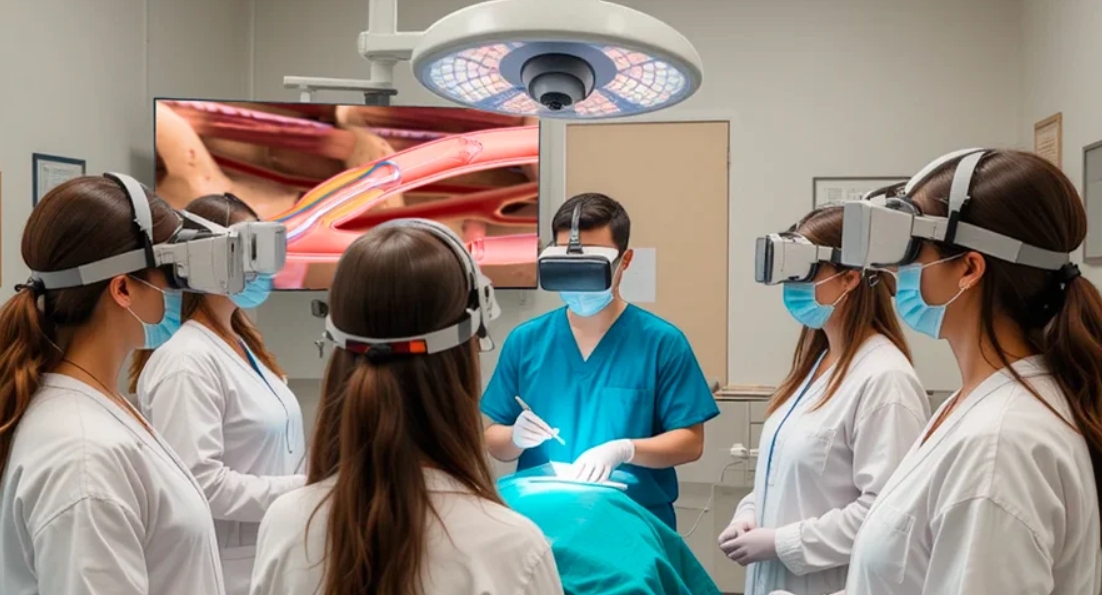
Two decades ago, a novice surgeon gained experience exclusively in the operating room. The first incisions and the first sutures: all this happened on a living person. The price of a mistake could become fatal, and this had its advantages, but also huge disadvantages. Today, the world of medicine has changed beyond recognition.
Simulation centers have appeared in every major clinic and medical university. There, future doctors work out the most complex manipulations on mannequins and virtual models. In virtual reality, using a VR headset, you can operate on appendicitis or stop bleeding, as well as perform an endoscopy on a simulator, where in case of an error, the real living patient will not suffer. Moreover, the simulator will remember every movement of the intern, indicate errors and allow you to repeat the procedure dozens of times until the hand remembers the correct trajectory.
The principle of training on a simulator, and not in “combat” conditions, turned out to be so effective that it was adopted in other areas. Take shooting sports, for example. Professional athletes train for years on shooting ranges, burning tons of gunpowder. But today the approach has changed and instead of going out of town every time, spending time preparing targets and paying for expensive ammunition, shooters are increasingly using a shooting simulator.
The thing is that a modern shooting simulator is not a useless toy, but a full-fledged productive tool that allows an athlete to equip his firearms with a laser and conduct full-fledged training. The main thing is that such a simulator, using a webcam, absolutely accurately records the places of hits. The program analyzes the trajectory of the shot, reaction time and can simulate any distance. An athlete can work out dozens of exercises without leaving the gym or even his apartment. The fact is that this approach is based on dry fire, which has repeatedly proved its effectiveness.
And as a result, the result is on the face: precious experience is growing, and costs are falling. And most importantly, the principle remains the same as in medicine: first tens of hours on the simulator, and only then working out in real conditions.
This approach works almost everywhere. Today, pilots study on flight simulators, astronauts in hydrolaboratory, train drivers begin with virtual copies of cabins. Simulation became the norm, and those who understood it first got a colossal advantage. If you want your skills to grow, regardless of the scope of their application, then take a closer look at modern simulators today.
