

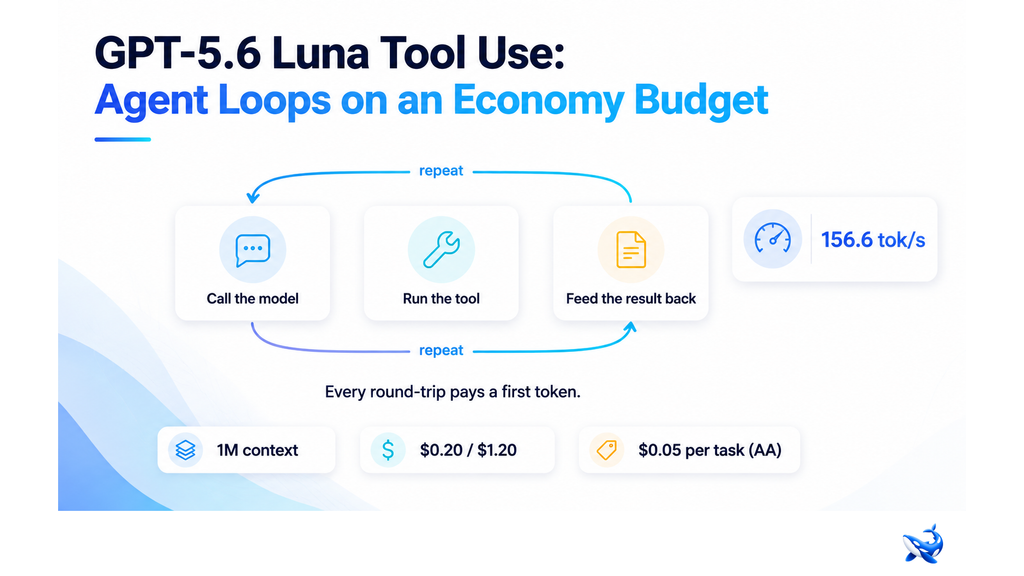
GPT-5.6 Luna API is OpenAI’s economy-tier reasoning model, and tool use is where its pricing stops being a footnote and becomes the whole point: an agent loop burns a dozen calls where a single prompt would do, and at $0.20 per million input tokens and $1.20 per million output — the post-cut price passed through on OrcaRouter’s catalog — that burn costs about $0.05 per task on Artificial Analysis’ independent index, against $2.34 for the model at the top of the board. For the live numbers behind that burn, GPT-5.6 Luna carries the current price and production telemetry; this piece is the straight version of what Luna’s tool calling is actually good for, what each loop costs, and where the ceiling is.
The mistake most teams make isn’t choosing the wrong model for an agent — it’s pricing the agent as a single call.
What tool use means inside an agent loop
Function calling is the mechanism underneath every modern agent. Instead of answering, the model emits a structured call: a tool name plus arguments that match the JSON schema you registered. Your code executes the tool, appends the result to the conversation, and calls the model again. That repeat cycle — call, run, feed back — is the loop, and multi-step reasoning is what survives when a loop holds together across many such round-trips.
Each step is a full request, so the accumulated cost is roughly calls × per-call cost. The tool schemas and your instructions repeat in the prompt on every single call, and each tool result comes back in the next one, so input tokens grow as the loop progresses. That is the part of agent pricing most people miss: the conversation is a compounding asset and a compounding bill at the same time.
Luna fits this shape unusually well. It ships under the model ID openai/gpt-5.6-luna on an OpenAI-SDK-compatible surface, so any tool-calling harness that already speaks the OpenAI format works with zero changes. Its 1,000,000-token context window, per Artificial Analysis, means a long loop can carry its whole history of tool outputs without chunking or summarising. And AA flags the model as multimodal and “notably fast” — two traits that matter a lot when the loop is making twenty calls in a row.
The economics of a loop that burns tokens
A real loop is not one call; it is ten to thirty, each paying full input price on a growing prompt plus output price for the reasoning tokens in between. That is exactly the scenario where Luna’s post-cut numbers stop looking like marketing.
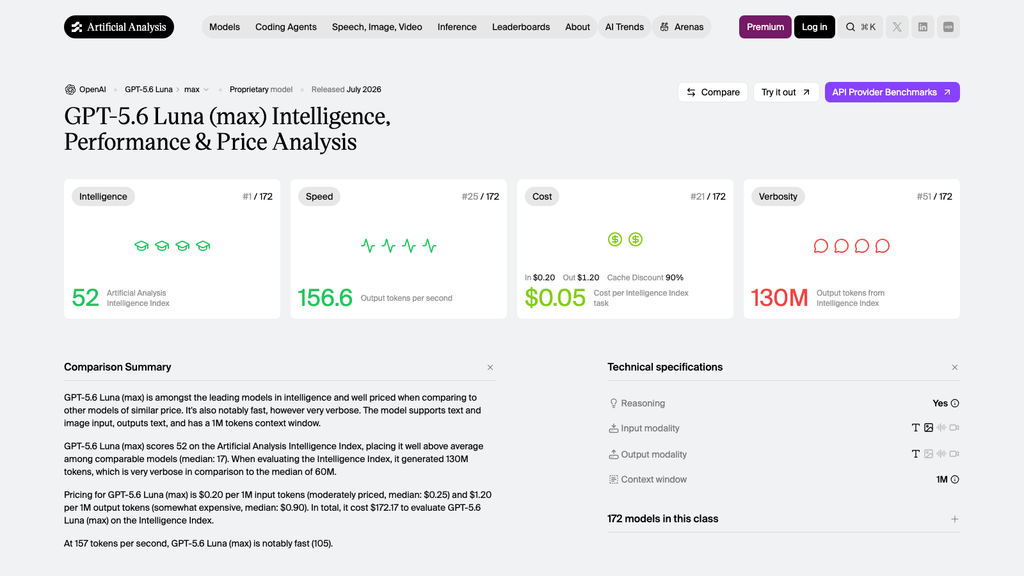
At $0.20 / $1.20 per million, a step that reads 4,000 tokens of context and writes 500 costs a fraction of a cent. Scale to a 20-step run and you are still in low single-digit cents — the whole job fits comfortably inside what the economy tier was built for. Artificial Analysis measures the practical version of this: $0.05 per task on the Intelligence Index, the lowest figure on a board of 172 models, against $1.23 for GPT-5.6 Sol and $2.34 for Claude Opus 5 (all at max effort). A full index evaluation costs $172.17 on 130M output tokens — over double the tier median of 60M — which says something about how chatty this model is, not how expensive it is.
| Model (max effort) | AA Intelligence Index | Cost per index task | Median output speed |
| GPT-5.6 Luna | 52.32 | $0.05 | 156.6 tok/s |
| GPT-5.6 Sol | 60.93 | $1.23 | 73.7 tok/s |
| Claude Opus 5 | 63.05 | $2.34 | 61.8 tok/s |
All figures from Artificial Analysis’ live board, checked August 22, 2026.
The important comparison is per step, not per model. On the board above, running a ten-step loop on Luna costs about the same as a single step on Opus 5 — and that arithmetic is why “leave the loop running” becomes an option instead of a line-item decision.
The latency you pay on every round-trip
Latency is the hidden tax on tool use, because every round-trip pays a fresh time-to-first-token before any streaming begins. A fifteen-call loop multiplies a single TTFT by fifteen — plus generation time per step, which on most models dominates the total.
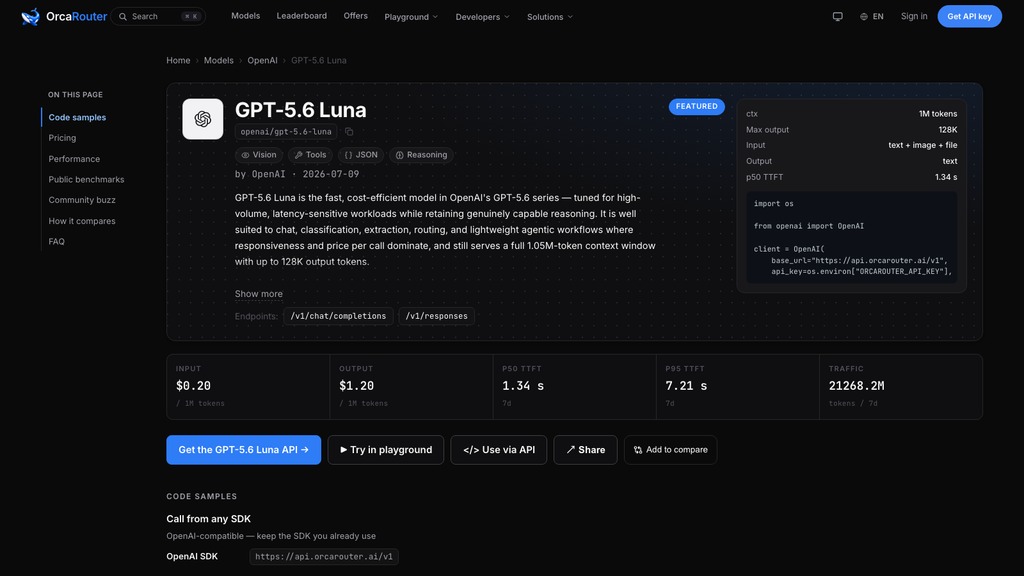
Here Luna is a genuine surprise. AA reports a time-to-first-token around 102 ms, and its median output speed of 156.6 tokens per second is more than double Sol’s 73.7 and well ahead of Opus 5’s 61.8. Under real production traffic, OrcaRouter’s own seven-day telemetry (checked August 22, 2026) shows a p50 TTFT of 1.33 seconds and a p95 of 7.32 seconds on the highest-volume model in the set — 21,271.6M tokens a week. The gap between 102 ms in the lab and 1.33 s in production is the difference between a warmed, dedicated benchmark and a shared gateway carrying enormous load; plan your timeouts around the p95, not the headline.
That is also where the open-weights rival earns its keep. The Qwen 3.8 27B matchup, per OrcaRouter telemetry, measured a p50 first-token latency near 190 ms — roughly seven times faster to the first token than Luna’s ~1.4 s in that same window. A 27B dense model is simply cheaper to spin up than an economy-tier API model spending time on extended reasoning. If a user is waiting on a token at the end of an interactive loop, that structural edge can beat a higher intelligence score.
Two ways to run the same loop
Luna and the Qwen 3.8 27B are priced as workhorses with opposite business models. Qwen is a dense 27-billion-parameter model with Apache 2.0 weights released August 14, 2026, listed at $0.33 / $2.40 per million on OrcaRouter — rent it for pennies or download the weights and pay for electricity. Its benchmarks are vendor-reported so far (SWE-bench Pro 61.7, agentic terminal coding 73.0, per the vendor), unreproduced by an independent harness. Luna is the closed-weight counter: cheaper per token at $0.20 / $1.20, independently measured, with a 1M context that dwarfs the 27B’s 262K native window.
For a loop, the choice is mostly about what the loop is doing. Latency-sensitive, interactive steps — a user watching each tool call resolve — lean Qwen, whose ~190 ms first token is a genuine UX advantage. High-volume, long-context, or budget-bound loops lean Luna, whose per-task cost is the lowest on the independent board and whose 1M context survives long tool histories without surgery. Neither is a frontier reasoning horse; both are built for the tail of volume.
The honest ceiling: keep the hard steps elsewhere
Luna’s Intelligence Index of 52.32 at max effort, per Artificial Analysis, is not a frontier number — GPT-5.6 Sol sits at 60.93 and Claude Opus 5 at 63.05, and the effort ladder drops Luna itself from 52.32 at max to 50.06 on xhigh and 46.96 on high. Tool use will carry mechanical steps all day: retrieval, extraction, classification, summarisation, well-specified transformations where the answer is checkable. What it will not do reliably is the hard multi-step deduction at the edge of model capability, where a wrong answer costs more than the ~96% you saved by choosing the budget tier.
The professional pattern is to split the loop. Let Luna grind through the cheap steps, and route the one genuinely hard decision to a stronger model — that is a routing rule, not a rewrite. Behind one key and 200-plus models, OrcaRouter passes provider list price through at 0% markup and fails over automatically, so “cheap loop, expensive hard step” is a config change rather than a second integration, and a provider hiccup mid-loop degrades to a retry instead of a lost run.
The takeaway
Luna’s tool use is the answer to a specific question: what do you run when an agent loop is going to make twenty calls and you want to stop thinking about the bill? At $0.20 / $1.20 (the post-cut catalog price), with a 1M context and a $0.05 per-task cost on Artificial Analysis’ independent board, it makes long, token-heavy loops affordable — and at 156.6 tok/s output with a 1.33 s production p50 first token, it keeps those loops tolerable.
It is the wrong choice when the loop’s core step is frontier reasoning, or when every round-trip sits directly in front of a waiting user and the Qwen 3.8 27B’s ~190 ms first token matters more than the score. Budget the latency on p95, keep the hard step on a stronger model, and Luna turns from a discount into a workhorse.
Sourcing note: release date, model identity, 1M context window, and all Artificial Analysis figures (Intelligence Index 52.32 with the max/xhigh/high effort ladder, 156.6 tok/s, ~102 ms TTFT, $0.05 per-task cost, $172.17 full-index cost on 130M output tokens, cost rank #21/172, and the Sol 60.93 / $1.23 and Claude Opus 5 63.05 / $2.34 comparisons) are from Artificial Analysis’ live board, checked August 22, 2026. Post-cut pricing ($0.20/$1.20) and the production telemetry (21,271.6M tokens/7d, p50 TTFT 1.33 s, p95 7.32 s) are OrcaRouter’s own catalog and telemetry, checked the same date. Qwen3.8 27B figures — Apache 2.0 weights, release date, $0.33/$2.40 listing, ~190 ms p50 first-token latency, 262K native context, and Luna’s ~1.4 s p50 in the same window — are from OrcaRouter’s Qwen 3.8 27B vs GPT-5.6 Luna matchup post; its SWE-bench Pro 61.7 and agentic terminal coding 73.0 are vendor-reported and not yet independently reproduced.
