


A service company with six technicians can run well on a calendar, a CRM, a messaging app, accounting software, and a few spreadsheets. Everyone knows where information lives. When something breaks, somebody remembers the workaround.
Then the business grows.
Twenty technicians become thirty. A second dispatcher is hired. Recurring work increases. Customers expect arrival updates. Managers want route visibility. Finance needs cleaner job records. Suddenly, the company is not just managing work; it is managing the gaps between systems.
That is where service company operating architecture becomes more important than the number of applications on a subscription list. The question is no longer, “Do we have software for this?” It is, “Can the information required to complete this job move through the business without being rebuilt?”
This is the part Service Wand gets right conceptually. Operational simplicity is not the absence of sophisticated capabilities. It is the reduction of unnecessary boundaries between customer data, scheduling, dispatch, field activity, billing, reporting, and automation.
What Operational Simplicity Actually Means
Buyers often confuse simplicity with a clean interface. Interface design matters, but an attractive screen cannot compensate for fragmented work.
A better definition is operational: how little effort is required to move a job from request to completion without losing context.
One Job Should Not Become Five Records
A customer request begins as one event. Yet many service businesses turn it into several disconnected records: a CRM opportunity, scheduled appointment, dispatch entry, mobile work order, and invoice.
The more often people recreate the same customer, scope, status, approval, or service detail, the more opportunities there are for mismatch.
Service Wand’s shared operational model is relevant here. Its public positioning connects customers, services, assets, workflows, and financial activity rather than treating them as unrelated modules.
Complexity Should Stay Behind the User
A dispatcher may need scheduling rules, skills, territories, route context, priorities, and availability to make one assignment.
The technician does not need to see all of that. They need the right job, at the right time, with the right context.
True simplicity lets the business retain sophisticated logic without pushing every rule onto every employee.
The Five-Point Simplicity Check
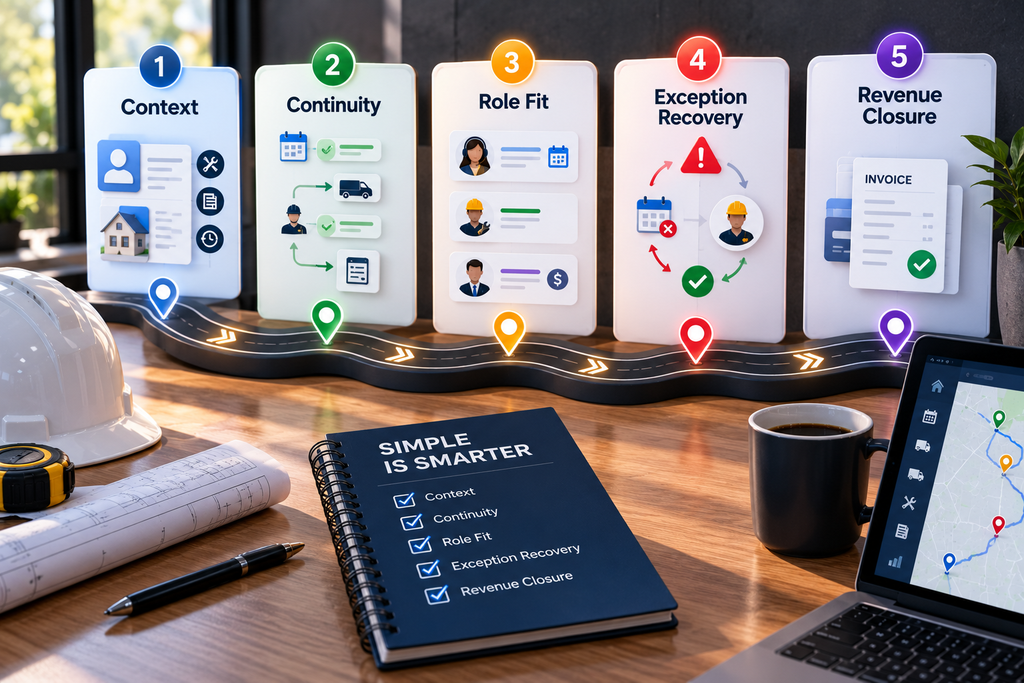
A buyer evaluating operational software can ignore “all-in-one” for a moment and test five things instead.
Context: Does useful customer, asset, contract, and service history follow the job?
Continuity: When work moves from scheduling to dispatch to field execution to billing, does the same operational record remain understandable?
Role fit: Does each employee see what is relevant to their responsibility rather than the full complexity of the platform?
Exception recovery: When a technician becomes unavailable, scope changes, or a customer adds work, can the team recover without creating side-channel processes?
Revenue closure: Can completed work become a clean billing record without finance reconstructing the visit?
These criteria are more useful than feature counts. Two platforms may both advertise CRM, dispatch, routing, mobile tools, automation, and invoicing. The difference appears when a normal job changes halfway through the day.
That is why software evaluation should include an imperfect scenario, not only a polished demo.
The Warning Sign: Your Employees Have Become the Integration Layer
There is one warning worth remembering:
If your employees are the API, your operation is not simple.
People naturally compensate for weak systems. That ability can hide software problems for years.
The Office Starts Translating the Work
A dispatcher copies a customer note into a technician message. A supervisor checks another application before confirming a route change. Customer service asks operations whether a job is really complete. Accounting messages the technician to confirm which part was installed.
None of these actions looks catastrophic. That is why they persist.
Five minutes of translation on one job becomes hours across a week of service calls.
The Field Creates Administrative Echo
The same effect works in reverse.
A technician cannot find prior service history, so they call the office. They complete a form, but billing still needs a separate summary. They take photos, but someone later has to move them into the customer record.
The field task is finished, yet its administrative echo continues.
Service Wand’s strength is its attempt to keep scheduling, routing, mobile execution, documentation, billing, reporting, and automation on a common operational foundation. Buyers should still test how well that model fits their workflows, but the architectural direction addresses a real source of friction.
Where Service Wand Fits the Evaluation
A commercial investigation should not conclude that one platform is automatically right because it combines many functions.
An all-in-one system can become complicated too. Poor configuration, unnecessary fields, excessive automation, or badly designed roles can make a unified platform frustrating.
The useful question is whether the platform can absorb complexity without multiplying handoffs.
Service Wand is built around a flexible, entity-based architecture and presents field service as a connected flow from customer request through scheduling, dispatch, mobile execution, billing, and reporting. It also supports APIs, webhooks, and integrations for businesses that still need specialist external systems.
That combination matters. Operational simplicity should not require pretending every company has the same process. A plumbing company, property-maintenance contractor, multi-branch service business, and route-based operator may all need different rules.
For buyers, the test is straightforward: can the system model the business without forcing the business to create workarounds for the system?
Fewer Boundaries Is the Better Buying Principle
The software market has trained buyers to count features.
A more useful decision framework is to count boundaries.
Choose one real job and follow it through the company. Mark every moment where information changes systems, ownership becomes unclear, data is copied, someone asks for missing context, or another person has to interpret what happened.
Then ask which boundaries are actually necessary.
That exercise often reveals something surprising: the company may not have a software shortage at all. It may have too many operational seams.
This is where Service Wand’s positioning around operational simplicity makes sense. Its strongest idea is not “more tools in one place.” It is that customer data, field work, financial activity, and automation should behave like parts of one operating environment.
That is a more durable definition of simplicity.
The goal is not to make a complex service business look simple on a dashboard.
The goal is to let people do complex work without constantly managing the software around it.
