

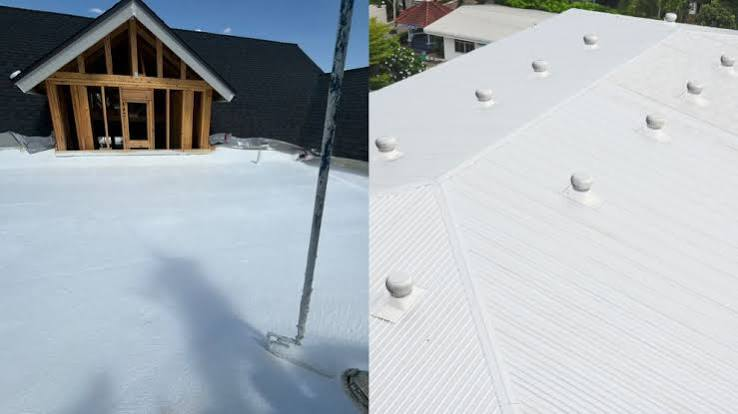
When a commercial or residential roof begins to show signs of wear, facility managers and roofing contractors face a decision that carries real consequences: which coating system will perform reliably over time without requiring repeated intervention? In regions where temperature swings are extreme, where rainfall is persistent, or where UV exposure is relentless, that decision becomes more consequential than it might appear on paper.
The US market offers two dominant liquid-applied coating options for existing roof systems — silicone and acrylic. Both are widely available, both are compatible with a range of substrates, and both have legitimate use cases. But they are not interchangeable. The environments they are suited for differ significantly, and choosing the wrong system based on cost alone or surface-level comparison can result in premature failure, moisture infiltration, or expensive reapplication within just a few years.
This article compares both systems from an operational standpoint, with particular attention to how each performs across the varied and often severe climates found throughout the United States.
What Roofing Silicone Actually Is and Why It Performs Differently
Silicone-based roof coatings are formulated from silicone polymers, which give them a fundamentally different molecular structure compared to water-based acrylic products. This structural difference is not a minor detail — it directly determines how the coating responds to water, heat, cold, and prolonged UV exposure. Roofing silicone cures to a stable, flexible film that resists moisture absorption at a level that acrylic coatings cannot match.
This matters most in climates where water ponding is a routine issue. Low-slope commercial roofs in the Midwest, the Gulf Coast, and the Pacific Northwest frequently hold standing water after rainfall events. Acrylic coatings, which are water-based in their uncured state, are susceptible to softening, blistering, and gradual erosion when exposed to prolonged ponding. Silicone coatings, by contrast, remain dimensionally stable under standing water without absorbing moisture or losing adhesion to the substrate beneath.
Ponding Water Tolerance Is Not a Minor Specification
The issue of ponding water is significant enough in the commercial roofing industry that it has become a central criterion in coating selection. Many roofing warranties — including those tied to single-ply membranes and spray polyurethane foam systems — are voided if the wrong coating is applied in conditions where water pools regularly. Silicone holds up in these conditions not because of any special additive, but because its polymer structure simply does not interact with water the way acrylic does.
Facilities that deal with flat or near-flat rooflines, blocked drains, or roofs that were designed without adequate slope allowance are particularly exposed to this risk. In those cases, using an acrylic product introduces ongoing vulnerability that the coating itself cannot overcome regardless of application thickness or quality.
UV Resistance and Long-Term Stability
Silicone coatings also resist UV degradation at a level that is difficult for acrylic systems to match over extended periods. In high-altitude regions like Colorado and New Mexico, or in consistently sunny southern states like Arizona, Florida, and Texas, UV radiation is a primary driver of coating breakdown. Acrylic coatings can chalk, crack, and lose reflectivity over time when exposed to intense, sustained sunlight without recoating. Silicone maintains its reflective properties and physical integrity for longer intervals under these same conditions.
This does not mean acrylic has no UV resistance — it does. But the stability of silicone under continuous UV load gives it a practical service life advantage in sun-intensive climates, which is a relevant factor when evaluating total cost over a ten-to-fifteen-year period rather than just upfront material expense.
Where Acrylic Coatings Have a Legitimate Advantage
Acrylic roof coatings are water-based, breathable, and highly workable during application. These properties make them genuinely better suited for certain conditions, and dismissing them entirely in favor of silicone would be an oversimplification. The key is understanding where those properties translate into a durable outcome and where they become a liability.
Acrylic coatings perform well in climates with lower humidity, moderate rainfall, and sufficient slope to prevent water accumulation. In the drier regions of the Mountain West or in areas with seasonal rather than year-round precipitation, acrylics can provide adequate protection and reflectivity without the complications that arise in wetter environments.
Application Conditions and Contractor Accessibility
One area where acrylic systems hold a clear practical advantage is in application. Acrylic coatings are water-based, which makes cleanup simpler and reduces the handling precautions required on a job site. They are also more forgiving of minor surface moisture during application — within reason — and they can be tinted more easily, which matters for energy-efficient roofing programs that specify particular reflectivity values.
Silicone, by contrast, requires clean, dry surfaces and careful attention to primer compatibility. Silicone also has a well-known characteristic that creates a logistical consideration: once applied, it is difficult for subsequent coatings to bond to it unless a silicone-compatible product is used. This means that future maintenance or recoating cycles are constrained in a way that acrylic-coated roofs are not. Contractors and facility managers should factor this into long-term planning, particularly for buildings with uncertain ownership timelines or changing maintenance schedules.
Cost Considerations in Lower-Stress Environments
In climates that do not place extreme demands on a roof coating — moderate temperatures, predictable rainfall, good drainage — the higher material cost of silicone may not be justified. Acrylic products, applied correctly and recoated on a reasonable schedule, can provide adequate protection at a lower per-square-foot cost. For property managers working within tight maintenance budgets across multiple buildings in temperate regions, this is a meaningful operational consideration rather than simply cutting corners.
The decision should always account for what the roof system will realistically face over its service life, not just what the coating costs today. In low-demand environments, acrylic is often the appropriate choice. In high-demand environments, choosing acrylic to save on material costs tends to create larger expenses downstream.
Climate Zone Mapping and Coating Selection
The United States spans a wide range of climate zones, and the performance of any roof coating is directly tied to the environmental conditions it faces year after year. According to the U.S. Department of Energy, the country is divided into distinct climate zones that differ substantially in temperature range, humidity, and precipitation patterns — all of which affect how a coating system degrades over time.
In humid subtropical climates, which cover much of the Southeast including states like Louisiana, Georgia, and South Carolina, the combination of heat, humidity, and frequent rain events creates sustained stress on any coating product. Acrylic coatings in these regions tend to show earlier signs of erosion and adhesion loss, particularly on roofs that do not drain efficiently. Silicone performs more consistently here due to its moisture resistance and thermal stability.
Cold Climate Performance
In northern states and high-elevation regions where freeze-thaw cycles are a regular part of winter, both coating types face stress from thermal expansion and contraction. Silicone’s flexibility across a wide temperature range gives it an edge in maintaining adhesion through these cycles. Acrylic coatings can become brittle in extreme cold, particularly if applied at marginal temperatures or if the coating has already begun to thin from weathering.
This does not render acrylic unusable in cold climates, but it does mean that application timing, surface preparation, and recoating intervals matter more significantly. A system that performs reliably in a temperate climate may degrade quickly if the same approach is applied in Minnesota or Montana without accounting for winter conditions.
Coastal and High-Humidity Environments
Coastal regions present their own set of challenges. Salt air, persistent humidity, and frequent weather events create conditions where moisture intrusion risk is consistently elevated. Roofing silicone performs more reliably in these environments because its impermeability to water limits the pathway for corrosive moisture to reach the roof deck or underlying insulation. Acrylic systems, while functional in many applications, are more vulnerable here to gradual moisture infiltration that may not be visible until significant damage has already occurred beneath the surface.
Making the Decision Based on Operational Reality
The comparison between silicone and acrylic is not a question of which product is universally better. It is a question of which product is appropriate for the conditions a specific roof will actually experience. No coating performs equally well in Phoenix and in Portland, and treating these environments as equivalent when selecting a product is a mistake that shows up later in the form of failed seams, early recoating costs, or moisture damage to building interiors.
Facilities teams, roofing contractors, and property owners who are choosing between these two systems should ground their decision in three practical factors: the drainage characteristics of the roof, the climate zone and its dominant weather patterns, and the long-term maintenance plan for the building. Each of these factors will point toward one system or the other more clearly than any product specification sheet alone.
When ponding water is a possibility, when UV exposure is intense, or when the maintenance window between recoats needs to be extended, silicone is the more reliable choice. When drainage is adequate, the climate is moderate, and budget constraints are a priority consideration, acrylic can serve the purpose effectively without unnecessary expenditure.
Conclusion
Roofing coating decisions carry consequences that extend well beyond installation day. A product that appears to function adequately in the first two or three years may reveal its limitations during a sustained weather event or after several years of UV exposure. Silicone and acrylic coatings are both legitimate, commercially proven systems — but their performance diverges sharply when conditions become demanding.
For professionals managing roofs in harsh US climates, the most practical approach is to treat climate zone, roof geometry, and drainage capacity as the primary selection criteria rather than defaulting to cost or familiarity. Both systems have earned their place in the market. The question is simply which one belongs on a particular roof, in a particular location, serving a particular building for the next decade or more. Getting that match right is where the real cost savings and reliability gains are found.
